
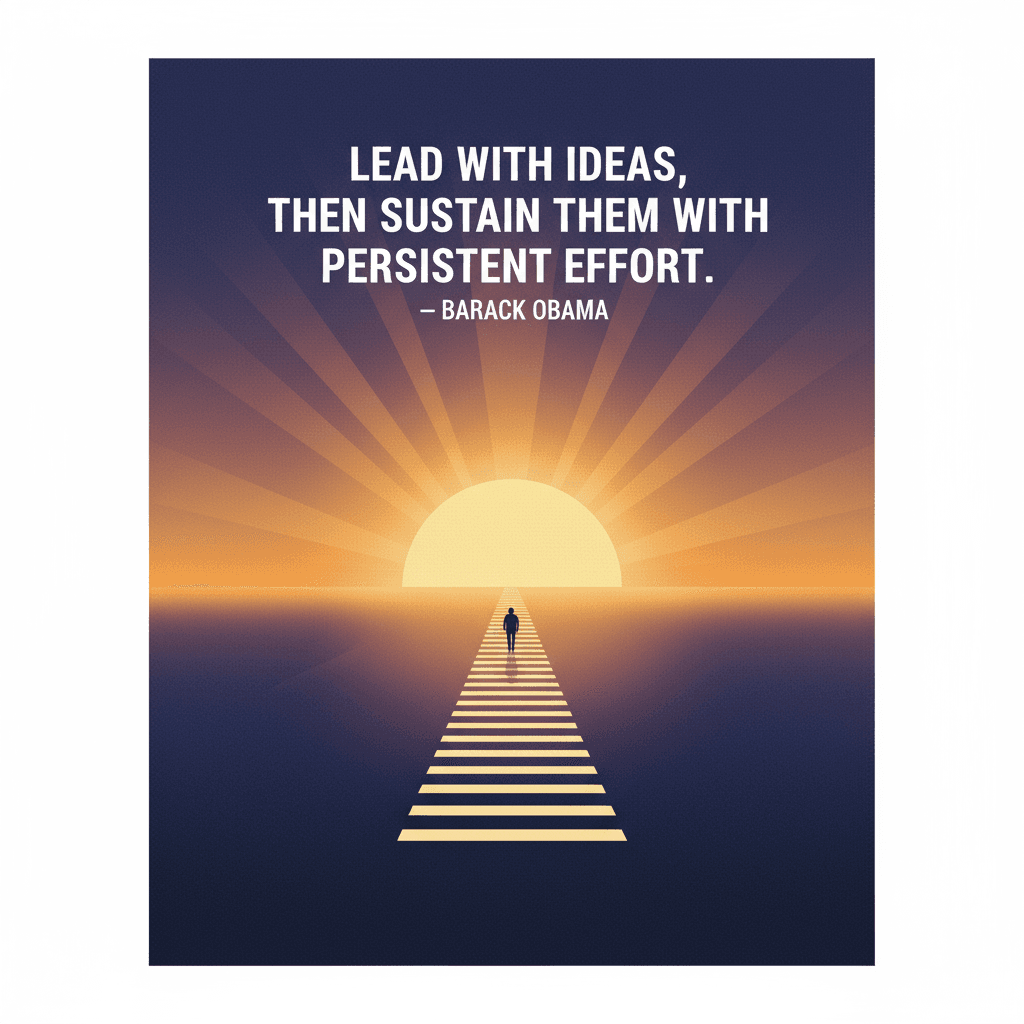
Lead with ideas, then sustain them with persistent effort. — Barack Obama
—What lingers after this line?
Ideas as the Compass of Leadership
Obama’s line distills a discipline: set a direction with lucid ideas, then earn outcomes through sustained work. Vision without stamina drifts into rhetoric; effort without an anchoring idea degenerates into motion without meaning. Thus, true leadership begins by naming the problem and proposing a principled course, and then building the habits, teams, and timelines that make the idea durable. Crucially, this sequence imposes accountability. When a leader starts with ideas, they invite others to measure progress against explicit aims; when they follow with persistence, they demonstrate that ideals are not mere slogans. The result is credibility, forged through the patient translation of “why” into a reproducible “how.”
Policy in Practice: The Affordable Care Act
Consider health reform. The idea—expand coverage, control costs, and protect patients with preexisting conditions—was clear. Yet passing the Affordable Care Act required procedural endurance: committee markups, whip counts, and compromises over exchanges and mandates throughout 2009–2010. Implementation demanded further persistence, from navigating NFIB v. Sebelius (2012) to fixing HealthCare.gov after its troubled launch. As Obama recounts in A Promised Land (2020), the policy’s survival hinged less on a singular speech than on methodical follow-through—regulatory rulemaking, state partnerships, and continuous enrollment improvements. The idea lit the path; persistence paved it.
From Slogan to System: ‘Yes We Can’
Moving from governing to campaigning, the 2008 message—opportunity and shared responsibility—only mattered because it was engineered into practice. Organizing for America translated a slogan into systems: data-informed canvassing, volunteer training ladders, and neighborhood teams that met weekly regardless of headlines. In other words, inspiration became infrastructure. Micro-targeted outreach, rapid feedback loops, and steady field cadence proved that emotional resonance gains power when paired with repeatable processes. The idea recruited people; persistence kept them effective.
Movement Lessons: Civil Rights Endurance
History echoes the same pattern. The civil rights idea—equal citizenship—was morally unmistakable, yet victory came through long-haul discipline: the 381-day Montgomery Bus Boycott, relentless voter registration drives, and painstaking legal strategies culminating in the Civil Rights Act (1964) and Voting Rights Act (1965). Taylor Branch’s Parting the Waters (1988) shows how nightly meetings, fundraising, and coordination—not only speeches—moved policy. Thus, moral clarity set the horizon, but logistical persistence moved feet toward it, day after day.
Innovation’s Long Game: mRNA and Persistence
Beyond politics, science tells the same story. The idea behind mRNA therapeutics—program cells to produce protective proteins—was elegant, but progress demanded steady refinement. Katalin Karikó and Drew Weissman’s 2005 paper on nucleoside modifications solved key immunogenicity issues, yet years of formulation work, delivery advances, and clinical trials were required before COVID-19 vaccines proved the concept at scale. Here, the hypothesis opened a frontier; persistent experimentation, funding, and iteration converted promise into lifesaving platforms.
A Practical Playbook for Sustained Execution
Finally, translating vision into results benefits from a simple cadence: define a crisp thesis; break it into operating routines; create feedback metrics; and schedule review cycles that force improvement. Implementation intentions (Gollwitzer, 1999) and deliberate practice (Ericsson et al., 1993) show how pre-commitment and focused repetition turn goals into behaviors. Put differently, lead with the why, specify the how, and then keep showing up. Over time, compounding effort makes the initial idea not only visible, but inevitable.
One-minute reflection
What does this quote ask you to notice today?
Related Quotes
6 selectedGenius begins great works; labor alone finishes them. — Joseph Joubert
Joseph Joubert
Joubert’s remark begins with a striking division of creative life: genius initiates, but labor fulfills. In other words, inspiration may provide the first flash of vision, yet that flash alone cannot carry a work into la...
Read full interpretation →Be a steady tide: small, persistent forces move continents over time. — Pablo Picasso
Pablo Picasso
Picasso’s call to be a “steady tide” reframes success as a function of direction and duration rather than dramatic bursts. The image suggests that gentle, rhythmic effort—small yet relentless—can reshape what seems immov...
Read full interpretation →Set your hands to the task with patient courage, and fate will bend to effort. — Virgil
Virgil
Virgil’s counsel marries steadfastness with action: set your hands to the task, and let courage be patient. Though phrased anew, it distills the poet’s recurring ethic.
Read full interpretation →Dream expansively, then build the ladders that let others climb with you. — Carl Sagan
Carl Sagan
To begin, the aphorism marries two obligations: imagine without fences, then convert that vision into structures others can use. Dreams name destinations; ladders are the engineering that makes ascent possible—tools, cur...
Read full interpretation →Carry a lantern of effort into the rooms where change waits in shadow. — Audre Lorde
Audre Lorde
At the outset, Lorde’s image turns effort into light: a disciplined, sustaining practice that reveals what avoidance keeps obscure. Change, she suggests, is already present—waiting in a corner—but without the beam of sus...
Read full interpretation →Let your hands learn bravery before your mind catches up. — Barack Obama
Barack Obama
In this line, Barack Obama frames courage as something practiced physically and behaviorally—through what we do—rather than something we perfect intellectually first. “Let your hands learn bravery” suggests that the body...
Read full interpretation →More From Author
More from Barack Obama →Let your hands learn bravery before your mind catches up. — Barack Obama
In this line, Barack Obama frames courage as something practiced physically and behaviorally—through what we do—rather than something we perfect intellectually first. “Let your hands learn bravery” suggests that the body...
Read full interpretation →Make each choice a brushstroke in the portrait of your future — Barack Obama
Barack Obama’s line frames the future not as a fixed destination but as a canvas gradually filled in. By calling each choice a “brushstroke,” he suggests that even small decisions—what you practice, what you ignore, what...
Read full interpretation →We did not come to fear the future. We came here to shape it. — Barack Obama
Obama’s statement reframes why we are present in any pivotal moment—whether in a nation, a classroom, or a community. Rather than existing simply to endure uncertainty, he insists we are here to act upon it.
Read full interpretation →Open your hands to effort; what you hold will be the proof of your intention. — Barack Obama
Obama’s line moves from inner resolve to outward proof: open your hands—do the work—and the results you hold will verify what you meant to do. The image fuses motive and material, insisting that sincerity without sweat i...
Read full interpretation →