
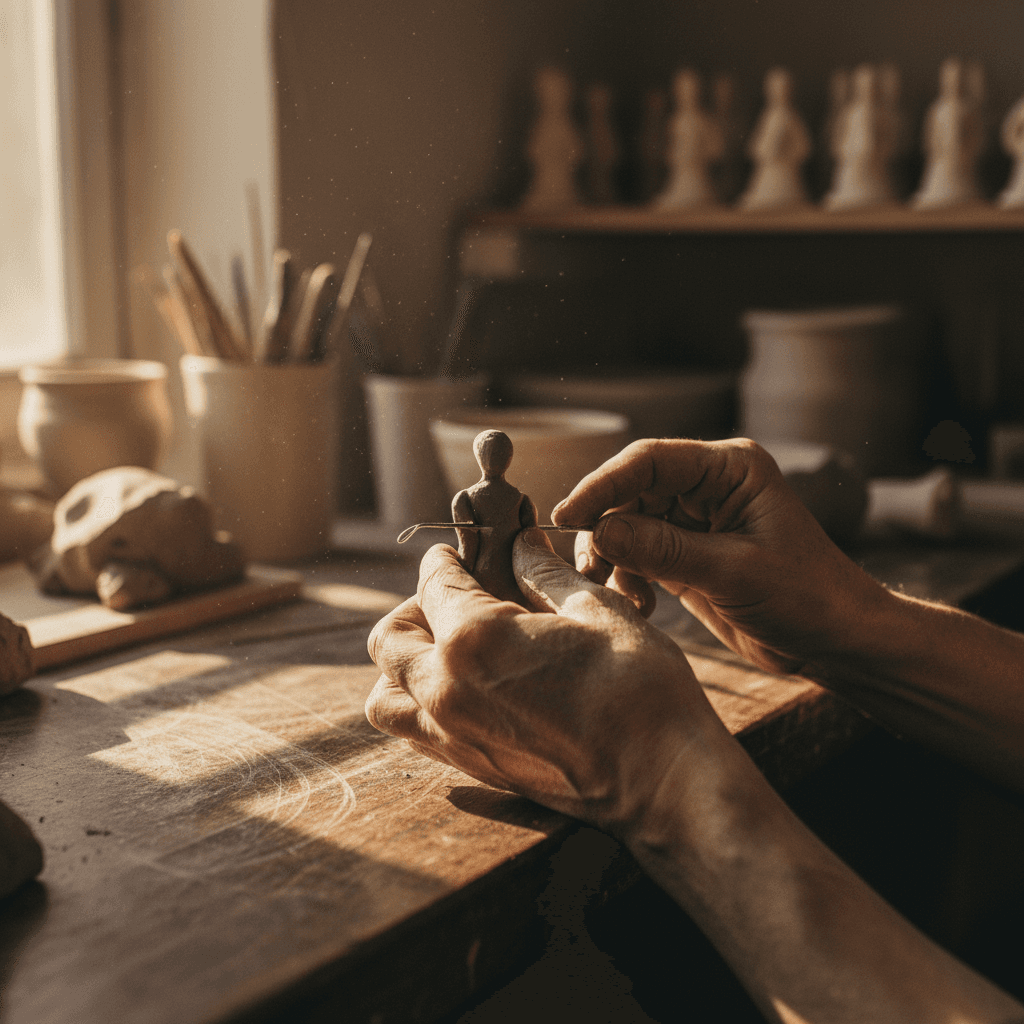
Let your hands be the proof of your intention. — Leonardo da Vinci
—What lingers after this line?
From Thought to Touch: Embodied Intention
This maxim, often linked to Leonardo, insists that credibility begins where words end—at the threshold of action. Intention gains moral weight only when it takes form in the world, and in the Renaissance imagination the hand was the mind’s most persuasive ambassador. Thus the saying does not diminish thought; rather, it argues that thought culminates in making, where ideas become accountable.
Leonardo’s Workshop Ethic: Learning by the Hand
Carrying this further, Leonardo’s training in Verrocchio’s Florentine workshop modeled knowledge as something done before it was said. Apprentices sketched, mixed pigments, cast bronze, and repaired tools—habits that braided reflection with craft. Vasari’s *Lives* (1550/1568) emphasizes how such bottega discipline forged artists whose skill could be read in their workmanship. In that milieu, a promise without a prototype was merely noise.
Gesture as Evidence: Reading The Last Supper
Leonardo painted intention into hands as eloquently as into faces. In *The Last Supper* (1495–1498, Santa Maria delle Grazie), Christ’s open palms signal offering; Judas’s clenched fist tightens around the purse; Peter’s hand grips a knife, lean and decisive; Thomas raises a probing finger—foreshadowing his later doubt (John 20:24–29). As Leo Steinberg argues in *Leonardo’s Incessant Last Supper* (2001), these gestures do not decorate the scene; they declare inner motives outwardly, making the visible hand the proof of the hidden heart.
Anatomy and Experiment: Hands in Science and Craft
Moreover, Leonardo’s anatomical drawings of the hand (c. 1510–1511, Royal Collection, Windsor) map bones and tendons with engineerly clarity, aligning physiology with mechanics. The same pages converse with the working models of pulleys, gears, and flyers scattered through the *Codex Atlanticus*: study becomes tool-making, and tool-making refines study. Even his left-handed hatchings and mirror script are embodied signatures—his very process leaving a manual proof that the intellect was at work.
The Moral of Making: Accountability Through Action
Translating this ethos beyond art, the measure of integrity is the say–do ratio. Management research on behavioral integrity notes that trust grows when stated values match enacted behavior (Simons, Organization Science, 2002). In other words, hands that follow through validate intention more persuasively than declarations ever could. Through consistent execution, intention ceases to be a claim and becomes a character.
Modern Applications: Design, Care, and Civic Work
Consequently, many disciplines institutionalize proof-by-doing. Design teams prototype early and often—IDEO’s “show, don’t tell” culture makes sketches and models the argument (Kelley & Littman, *The Art of Innovation*, 2001). In medicine, checklists convert concern for safety into repeatable acts, reducing errors at the bedside (Atul Gawande, *The Checklist Manifesto*, 2009). Community life follows the same logic: cleanup days, mutual aid, and tutoring hours make civic intent legible and contagious.
Practicing Proof: Turning Intent into Tangible Steps
Finally, to let your hands prove your intention, design in small verifiable increments. State the commitment, build the first unit, and deliver it on a clock—then improve it in the open. Keep a brief log of promised versus completed tasks to shrink the say–do gap, and favor repairs before additions so stewardship precedes expansion. In this cadence, intention steadily becomes evidence, and evidence becomes trust.
One-minute reflection
What does this quote ask you to notice today?
Related Quotes
6 selectedAim with your hands, not just your dreams. — Sun Tzu
Sun Tzu
Though the wording is modern, the maxim echoes Sun Tzu’s Art of War: objectives become real only when translated into disciplined movement. Dreams set direction; hands set trajectory.
Read full interpretation →The highest realms of thought are impossible to reach without first passing through the realm of action. — James Allen
James Allen
This quote highlights the intrinsic connection between thought and action. It suggests that lofty or profound ideas alone are insufficient; one must translate thoughts into practical actions to truly understand them or a...
Read full interpretation →The essence of life is not in ‘what am I going to do?’ but in ‘what can I do?’ — John Steinbeck
John Steinbeck
Steinbeck emphasizes the importance of focusing on what is possible in the present rather than obsessing over future plans. Instead of fixating on long-term goals, life is about acting on what can be done now.
Read full interpretation →Dreams nourish the soul just as actions feed the body. — African Proverb
African Proverb
The proverb draws a compelling analogy between dreams and actions, suggesting that both are essential for a balanced life. Just as the body relies on sustenance to survive and thrive, the soul seeks nourishment through a...
Read full interpretation →Refuse stagnation: turn thought into tool. — Amartya Sen
Amartya Sen
At its core, the aphorism channels Amartya Sen’s capability approach: thought matters only insofar as it expands what people are able to be and do. Rather than treating ideas as decorative, Sen urges their conversion int...
Read full interpretation →Build bridges with your hands, not just your wishes. — Eleanor Roosevelt
Eleanor Roosevelt
This line, attributed to Eleanor Roosevelt, shifts us from wishing to working. A wish gestures toward possibility; hands take responsibility for outcomes.
Read full interpretation →More From Author
More from Leonardo da Vinci →You will never have a greater or lesser dominion than that over yourself. The height of a man's success is gauged by his self-mastery. — Leonardo da Vinci
Leonardo da Vinci’s statement begins by redefining power itself. Rather than pointing to wealth, rank, or influence over others, he insists that the greatest dominion a person can possess is mastery over the self.
Read full interpretation →When the spirit does not work with the hand, there is no art. — Leonardo da Vinci
Leonardo da Vinci’s statement begins with a simple but profound claim: art is never merely the product of manual skill. The hand may shape stone, guide a brush, or draft a line, yet without the animating force of spirit—...
Read full interpretation →You cannot expect the level of excitement of your audience to be greater than your own. If you want a life that is alive, lead it with purpose. — Leonardo da Vinci
Leonardo da Vinci’s insight begins with a simple but demanding truth: people rarely rise above the emotional energy of the person leading them. Whether in art, teaching, or daily life, enthusiasm is contagious precisely...
Read full interpretation →It is not possible to control the outside of yourself until you have mastered your breathing space. — Leonardo da Vinci
At its core, this saying argues that self-governance must begin within. Before a person can hope to influence events, relationships, or circumstances beyond themselves, they must first steady their own internal state.
Read full interpretation →