
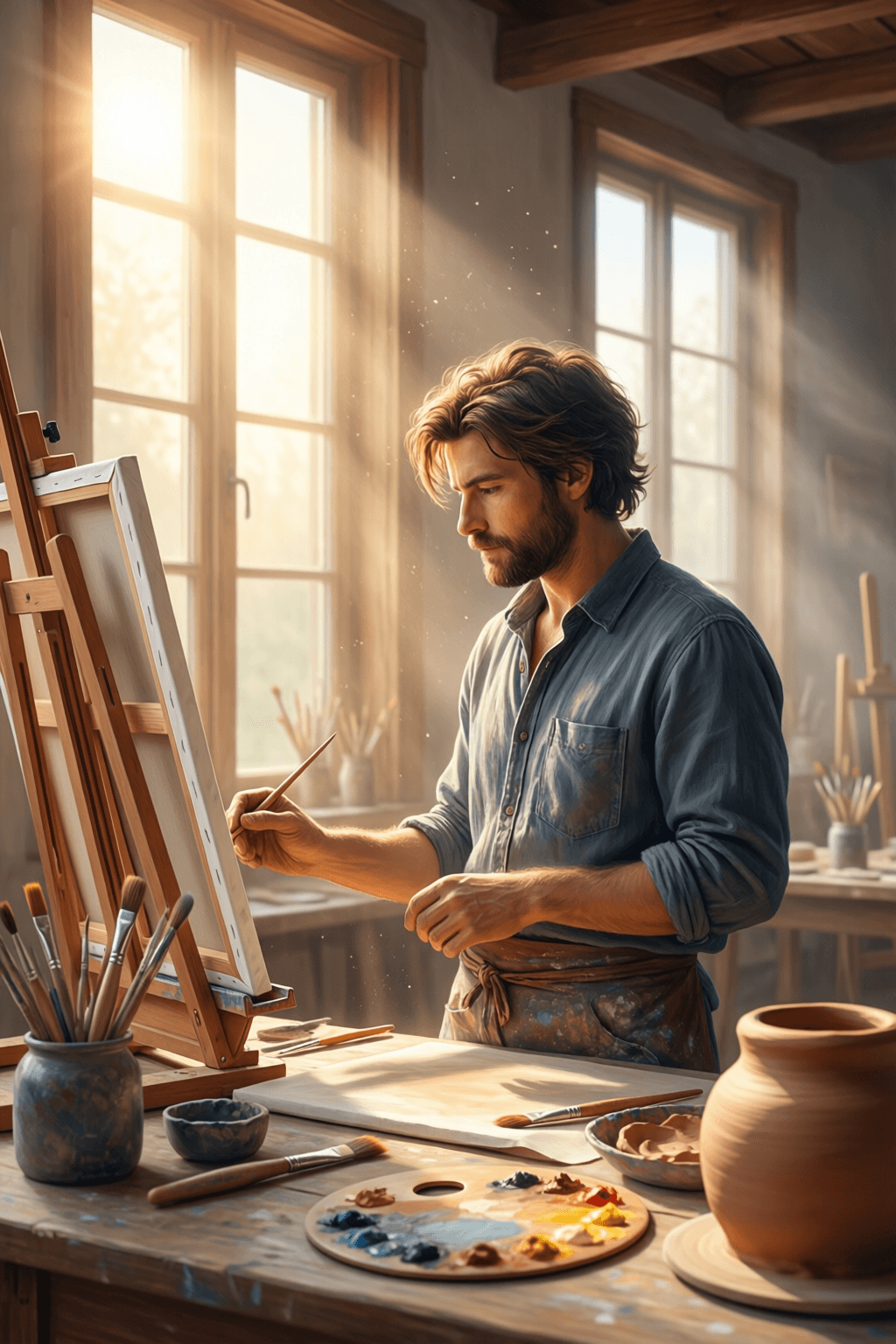
When the spirit does not work with the hand, there is no art. — Leonardo da Vinci
—What lingers after this line?
Art as Inner Vision Made Visible
Leonardo da Vinci’s statement begins with a simple but profound claim: art is never merely the product of manual skill. The hand may shape stone, guide a brush, or draft a line, yet without the animating force of spirit—imagination, feeling, intention, and insight—the result remains hollow. In this sense, Leonardo defines art as the meeting point between technical execution and inner life. From this starting point, the quote asks us to see creation as a collaboration within the artist. The spirit conceives what matters; the hand gives it form. Only when these two faculties move together does an object become more than craft and enter the realm of art.
The Renaissance Ideal of Complete Mastery
Seen in context, the remark reflects the Renaissance belief that true excellence joins intellect and practice. Leonardo himself embodied this union: his notebooks reveal scientific curiosity, anatomical study, engineering sketches, and artistic experimentation all feeding one another. Works such as the Mona Lisa (c. 1503–1506) feel alive not because of brush control alone, but because observation and inward vision are fused in every detail. Therefore, the quote also resists any separation between thinking and making. For Leonardo, the artist was not a laborer executing empty motions, but a mind in action through the body. The hand becomes expressive precisely because it is guided by a searching, disciplined spirit.
The Difference Between Craft and Art
This naturally leads to an important distinction: craft can reproduce, but art transforms. A skilled artisan may imitate forms accurately, just as a student can copy a master’s composition, yet something essential may still be missing. When spirit is absent, technique becomes repetition; when spirit is present, even a simple gesture can carry originality and emotional weight. Plato’s Ion (c. 390 BC), though very different in tone from Renaissance humanism, similarly explores the idea that artistic expression involves more than trained ability. Leonardo’s version is more grounded, but the implication is close: art emerges when human making is charged with inner vitality, not when the hand works mechanically.
Why Emotion and Intention Matter
Moreover, Leonardo’s use of “spirit” suggests that art communicates something irreducibly human. Viewers often respond most deeply to works in which they sense conviction, tenderness, unrest, wonder, or devotion beneath the surface. Michelangelo’s Pietà (1498–1499), for instance, astonishes through marble technique, yet its lasting power comes from the grief and serenity breathed into the stone. In that way, the quote explains why technically perfect works can still leave us cold. Precision alone does not guarantee meaning. The hand may complete the object, but spirit gives it resonance, allowing one person’s inward experience to cross time and reach another.
A Lesson for Every Creative Discipline
Although Leonardo speaks of art in the traditional sense, his insight extends far beyond painting or sculpture. A musician may play every note correctly and still fail to move an audience; a writer may produce flawless sentences that say nothing alive; even in design or architecture, technical competence without human purpose can feel sterile. Thus, the principle remains universal: form must serve living intention. Finally, the quote offers both a challenge and an encouragement. It reminds creators that discipline of the hand is necessary, but it is not sufficient. At the same time, it affirms that genuine art becomes possible when skill is joined to sincerity, attention, and soul—when what one feels and what one makes become inseparable.
One-minute reflection
What's one small action this suggests?
Related Quotes
6 selectedLet your curiosity lead and your craft will follow. — Leonardo da Vinci
Leonardo da Vinci
Begin with a question, and skill arrives as its consequence. Whether or not the phrasing is verbatim, the sentiment attributed to Leonardo da Vinci captures a reliable sequence: curiosity sets direction; craft supplies m...
Read full interpretation →Fine art is that in which the hand, the head, and the heart of man go together. — John Ruskin
John Ruskin
John Ruskin’s remark defines fine art as a union rather than a single talent. The hand represents skilled execution, the head stands for thought and judgment, and the heart brings feeling and moral sincerity.
Read full interpretation →He who works with his hands and his head is a craftsman. He who works with his hands and his head and his heart is an artist. — Francis of Assisi
Francis of Assisi
Francis of Assisi draws a graceful line between skill and art by adding one decisive element: the heart. In his view, working with the hands and the head produces competence, discipline, and useful creation—the marks of...
Read full interpretation →What keeps life fascinating is the constant creativity of the soul. — Deepak Chopra
Deepak Chopra
At its core, Deepak Chopra’s line suggests that life stays interesting not because the world is fixed and exciting on its own, but because the inner self continually reinterprets it. The phrase “creativity of the soul” p...
Read full interpretation →We are born makers. We move what we're learning from our heads to our hearts through our hands. — Brené Brown
Brené Brown
Brené Brown’s line begins with a striking claim: making is not a hobby added onto life, but part of our basic human design. To say “we are born makers” suggests that creativity is native to us, whether we are cooking, bu...
Read full interpretation →Creativity is intelligence having fun. — George Scialabba
George Scialabba
At first glance, George Scialabba’s line turns creativity into something disarmingly simple: intelligence at play. Rather than presenting invention as grim labor or mystical inspiration, the quote suggests that original...
Read full interpretation →More From Author
More from Leonardo da Vinci →You will never have a greater or lesser dominion than that over yourself. The height of a man's success is gauged by his self-mastery. — Leonardo da Vinci
Leonardo da Vinci’s statement begins by redefining power itself. Rather than pointing to wealth, rank, or influence over others, he insists that the greatest dominion a person can possess is mastery over the self.
Read full interpretation →You cannot expect the level of excitement of your audience to be greater than your own. If you want a life that is alive, lead it with purpose. — Leonardo da Vinci
Leonardo da Vinci’s insight begins with a simple but demanding truth: people rarely rise above the emotional energy of the person leading them. Whether in art, teaching, or daily life, enthusiasm is contagious precisely...
Read full interpretation →It is not possible to control the outside of yourself until you have mastered your breathing space. — Leonardo da Vinci
At its core, this saying argues that self-governance must begin within. Before a person can hope to influence events, relationships, or circumstances beyond themselves, they must first steady their own internal state.
Read full interpretation →Every now and then go away, have a little relaxation, for when you come back to your work your judgment will be surer. — Leonardo da Vinci
Leonardo da Vinci’s advice begins with a simple but powerful claim: distance improves discernment. By urging us to ‘go away’ from our work from time to time, he suggests that constant effort can blur perception rather th...
Read full interpretation →