
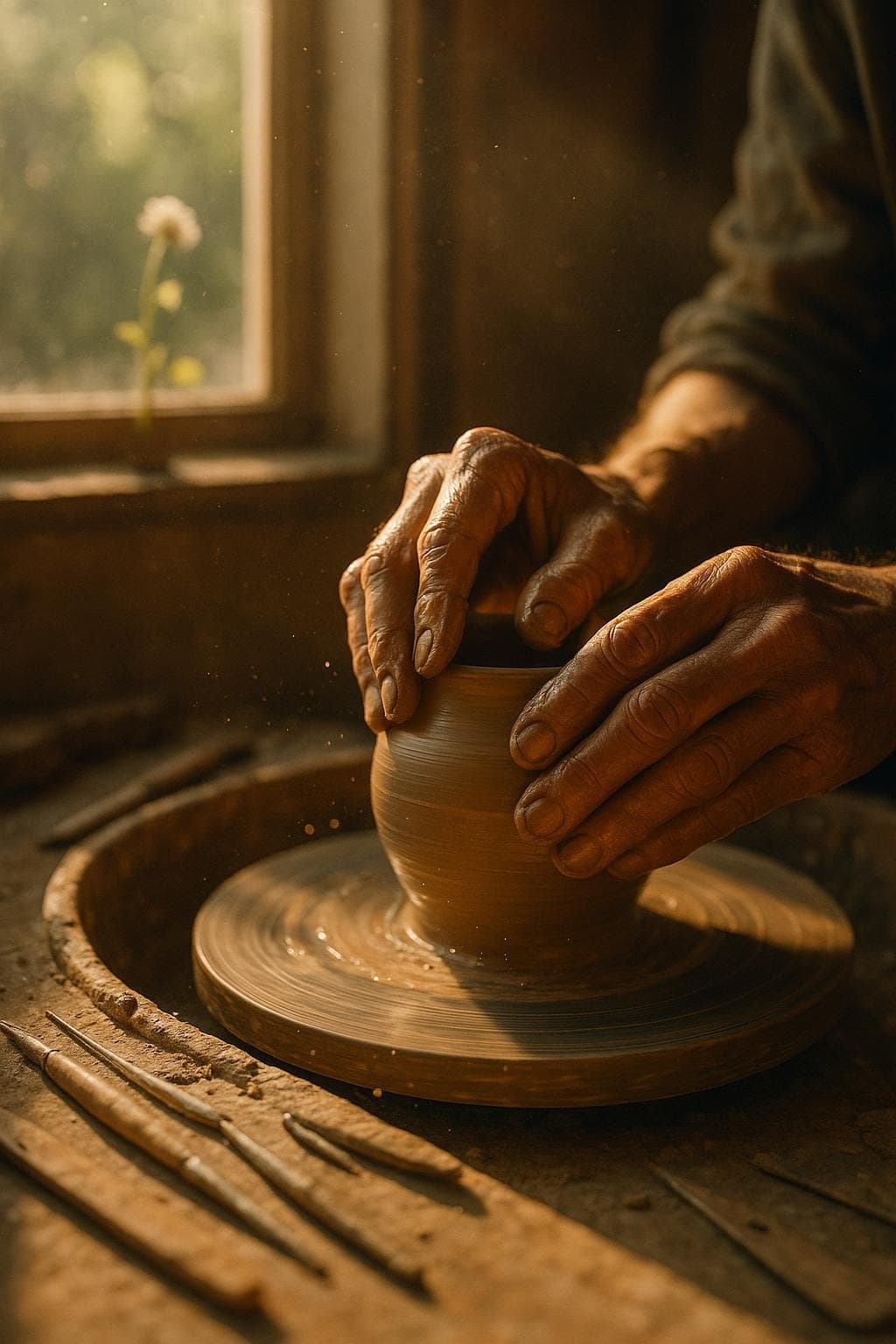
Pay attention to what moves you, then answer it with your hands. — Mary Oliver
—What lingers after this line?
From Sensation to Making
At the outset, Oliver’s sentence binds two acts: attend to what stirs you, then translate that feeling into tangible work. Attention gathers the raw current; the hands give it form. Rather than letting emotion dissipate, the line urges a conversion—from motion inside the chest to motion across paper, clay, soil, or strings. In this way, feeling becomes artifact, and the self becomes a conduit instead of a container.
Mary Oliver’s Discipline of Attention
In Oliver’s own practice, attention was a daily vow. Her poem in Red Bird (2008) offers the triad: "Instructions for living a life: Pay attention. Be astonished. Tell about it." Meanwhile, the essays in Upstream (2016) depict long walks where noticing wild geese or fox tracks ripened into lines. By placing the hand after the heart—pen following pulse—she trusted craft to articulate astonishment. Thus the quote is less an aphorism than a method.
How Hands Think
Extending this insight, thinkers of craft argue that hands themselves are cognitive. John Dewey’s Art as Experience (1934) describes art as a rhythm of "doing and undergoing," where manipulation and perception educate each other. Richard Sennett’s The Craftsman (2008) similarly shows how tactile feedback tutors judgment; the tool "answers back," shaping decisions in real time. In practice, the hand isn’t just executing orders from the mind; it is revising them as it feels, thereby discovering the form the feeling can bear.
Flow: Emotion Turned Into Craft
Consequently, when we answer with our hands, attention often deepens into flow. Mihaly Csikszentmihalyi (1990) documented this state as focused immersion where skill meets challenge. A potter at the wheel attends to a wobble and, by steadying the clay, feels the vessel clarify; a gardener moved by the first thaw lays out beds, and through raking and measuring, intention becomes habitat. The act itself refines the initial emotion, turning vague wonder into precise choices.
Reciprocity With the Living World
From the studio to the shoreline, Oliver’s imperative carries an ethic of reciprocity. Robin Wall Kimmerer’s Braiding Sweetgrass (2013) describes gratitude made material—planting, mending, harvesting with care—as a way to answer the gifts of the land. So, being moved by the call of thrushes might lead to trail repair, bird counts, or native plantings. In this light, the hand’s reply is not merely self-expression; it is participation in the health of places that moved us first.
From Private Wonder to Shared Gift
Ultimately, the hand’s answer becomes a social offering. As Lewis Hyde argues in The Gift (1983), works made from genuine attention circulate as gifts that strengthen bonds—bread shared, a letter written, a protest sign lifted. Each begins as a private stirring, then, through touch and time, becomes communal. Thus Oliver’s counsel charts a simple arc: notice, be moved, make. Follow it often enough, and you will find a life shaped by what you love—and useful to others.
One-minute reflection
What does this quote ask you to notice today?
Related Quotes
6 selectedInspirations never go in for long engagements; they only ask, 'Do you want to be a writer?' — Ernest Hemingway
Ernest Hemingway
Hemingway conveys that inspiration strikes with immediacy and does not linger indefinitely. It demands action in the moment rather than prolonged deliberation.
Read full interpretation →Learn to speak in actions as plainly as in words; consistency is a revolution — bell hooks
bell hooks
To begin, hooks’ aphorism compresses a demanding ethic: words can signal intent, but only repeated conduct makes meaning undeniable. To speak in actions is to let behavior carry the thesis, so that leadership, care, and...
Read full interpretation →The real work is to look at the world and feel that you belong to it. — Mary Oliver
Mary Oliver
Mary Oliver’s line begins with a deceptively simple instruction: the ‘real work’ is not conquest, achievement, or self-display, but learning to see. By telling us to look at the world, she shifts attention outward, away...
Read full interpretation →Trace your dreams with steady hands and honest eyes. — Mary Oliver
Mary Oliver
Mary Oliver’s line reads like a quiet imperative: pursue your visions with method and truth. "Steady hands" suggest disciplined commitment, while "honest eyes" ask for unflinching attention to what is real.
Read full interpretation →Everything that is made is made by slow, steady effort. — Mary Oliver
Mary Oliver
Mary Oliver’s line distills a quiet truth: meaningful things rarely appear all at once. Instead, they emerge through repetition, patience, and attention, whether one is writing a poem, raising a family, or restoring a ga...
Read full interpretation →The real flex is no longer looking busy. It is looking peaceful. It is having ambition without self-destruction. — Anonymous (skipped) -> The quietest moments are often where the greatest strength is found. — Mary Oliver
Mary Oliver
At first glance, these paired lines challenge a modern performance ritual: the need to appear constantly overwhelmed in order to seem important. Instead of praising busyness, they propose a subtler ideal—peacefulness as...
Read full interpretation →More From Author
More from Mary Oliver →Everything that is made is made by slow, steady effort. — Mary Oliver
Mary Oliver’s line distills a quiet truth: meaningful things rarely appear all at once. Instead, they emerge through repetition, patience, and attention, whether one is writing a poem, raising a family, or restoring a ga...
Read full interpretation →The real flex is no longer looking busy. It is looking peaceful. It is having ambition without self-destruction. — Anonymous (skipped) -> The quietest moments are often where the greatest strength is found. — Mary Oliver
At first glance, these paired lines challenge a modern performance ritual: the need to appear constantly overwhelmed in order to seem important. Instead of praising busyness, they propose a subtler ideal—peacefulness as...
Read full interpretation →The slow work of cultivation is the only antidote to the frantic pace of our digital existence. — Mary Oliver
Mary Oliver’s line sets two tempos against each other: the hurried pulse of digital life and the patient rhythm of cultivation. By calling cultivation an antidote, she implies that our overstimulated routines are not mer...
Read full interpretation →When you feel like you've reached the end of your rope, tie a knot in it and hang on—or better yet, realize you can just let go and float. — Mary Oliver
At first, Mary Oliver’s line begins with a familiar survival lesson: when life feels unbearable, hold on. The image of reaching the end of a rope evokes exhaustion, fear, and the instinct to preserve oneself at any cost.
Read full interpretation →