
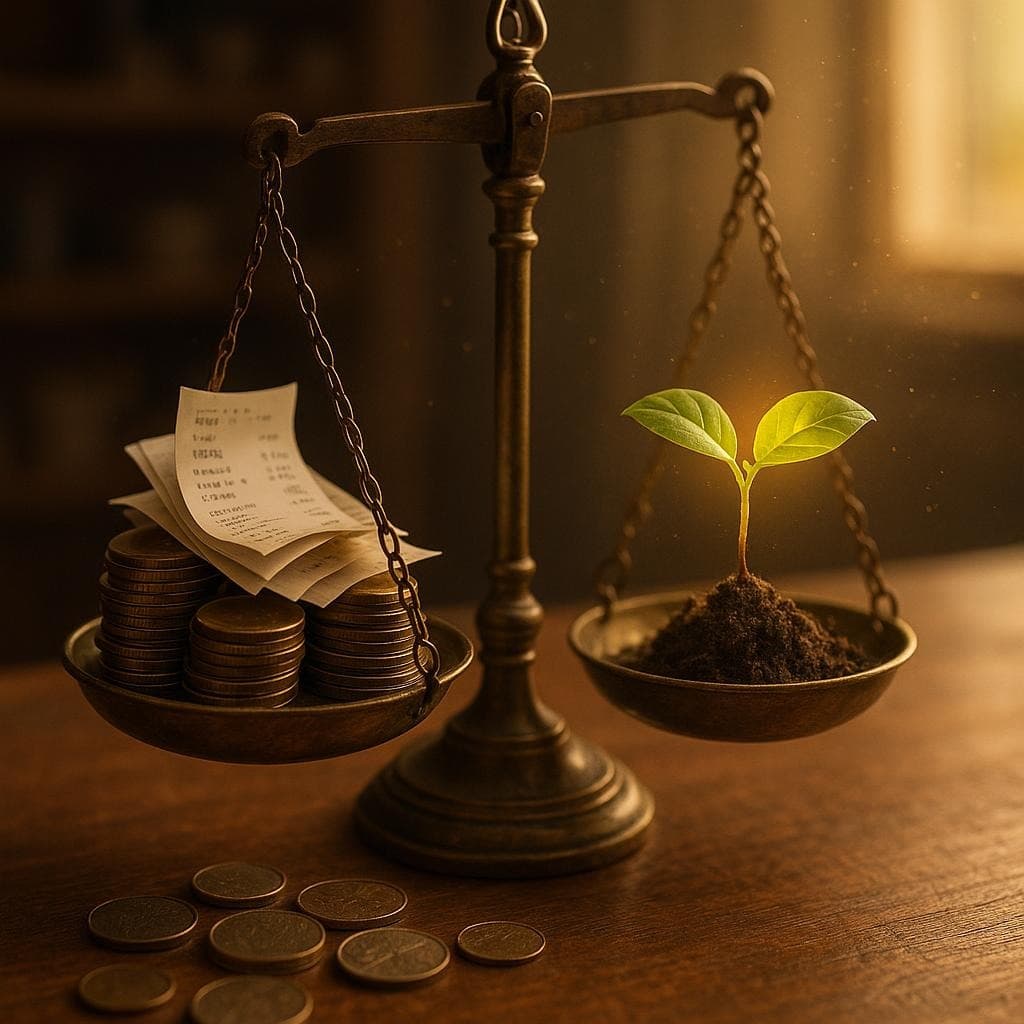
Price is what you pay; value is what you get. — Warren Buffett
—What lingers after this line?
Separating Cost from Worth
Warren Buffett’s maxim distills a timeless lesson: markets constantly publish prices, but they never print value. In his Berkshire Hathaway Shareholder Letter (2008), he credits Benjamin Graham for the insight that price merely reflects what you surrender, while value denotes what you actually receive in durable benefits. The difference matters because prices can be swayed by sentiment, scarcity, or hype, whereas value anchors to real earning power and usefulness. Thus, a low price can still be expensive if what you get is fragile or unproductive.
Intrinsic Value and a Margin of Safety
To turn that distinction into action, value investors estimate intrinsic value—the present worth of cash a business can generate—then insist on a margin of safety before buying. This discipline, formalized by Graham in The Intelligent Investor (1949), guards against errors in forecasting and the unforeseen. While discounted cash flow models can be imprecise, they focus attention on fundamentals: competitive position, reinvestment prospects, and capital discipline. Consequently, the investor shifts from predicting price moves to weighing long-term earning capacity.
Case Studies: See’s Candies and Coca‑Cola
Consider how this plays out in Berkshire’s history. Buffett bought See’s Candies for about $25 million in 1972; by 2011 it had produced roughly $2 billion in pre‑tax earnings with minimal additional capital (Berkshire Letter, 2011). The purchase price soon looked trivial beside the enduring value of brand and customer loyalty. Similarly, Berkshire’s 1988–89 Coca‑Cola investment cost about $1.3 billion; by 2022, annual dividends alone were roughly $704 million (Berkshire Letter, 2022), approaching half the original outlay each year. In both instances, price was temporary, while value compounded.
Resisting Market Psychology
However, even sound estimates must contend with human bias. Prospect theory shows how loss aversion and framing distort decisions (Kahneman & Tversky, 1979). During the dot‑com bubble (1999–2000), many paid soaring prices for firms with little cash generation, while ignoring duller businesses with steady value. Buffett’s lens helps investors sidestep such frenzies: if cash flows, moats, and prudent capital allocation are absent, a falling price is not a bargain—just a cheaper mistake.
Operational Decisions: Paying for Quality
Extending the logic to managers, value hides in unit economics and durability. Paying more for a supplier with higher reliability, shorter lead times, or better failure rates can lower total cost of ownership through fewer defects and less downtime. Likewise, customer lifetime value relative to acquisition cost (LTV/CAC) often outweighs headline pricing when growth is profitable. As See’s illustrated, intangible assets—brand, habit, and service—quietly compound value even when they look expensive on day one.
Personal Finance and Career Choices
Finally, the principle informs everyday decisions. A cheaper appliance with poor service and high energy use can cost more over its life than a pricier, efficient model. Similarly, a job offering training, mentorship, and a strong network may deliver greater lifetime value than a higher salary with stagnant learning. By weighing durability, growth, and options created, individuals—like investors—learn to favor what endures over what merely appears inexpensive.
One-minute reflection
What does this quote ask you to notice today?
Related Quotes
6 selectedPrice is what you pay; value is what you get. — Warren Buffett
Warren Buffett
Buffett’s reminder separates the sticker on an asset from the stream of benefits it delivers. Price is a momentary quote; value is the durable utility, cash you can extract, and risk you must bear to get it.
Read full interpretation →You do not need to be 'optimized' to be worthy. Your existence alone is enough. — Matt Haig
Matt Haig
At its core, Matt Haig’s line pushes back against a modern habit of treating human value as something earned through improvement. The word “optimized” evokes efficiency, performance, and endless upgrading, as if a person...
Read full interpretation →Strive not to be a success, but rather to be of value. – Albert Einstein
Albert Einstein
This quote emphasizes the importance of making a meaningful contribution to society. Instead of focusing solely on personal achievement and recognition, one should aim to add value to the lives of others.
Read full interpretation →Your brightness is not a measure of your worth. — Malala Yousafzai
Malala Yousafzai
This quote highlights the notion that a person's worth is not solely determined by their outward achievements, talents, or how they are perceived by others. It reminds us that intrinsic value goes beyond measurable accom...
Read full interpretation →Not everything that can be counted counts, and not everything that counts can be counted. — Albert Einstein
Albert Einstein
This quote emphasizes that not all things of true value can be measured quantitatively. Some of the most important aspects of life, like love, kindness, or happiness, cannot be captured in numerical terms.
Read full interpretation →A diamond with a flaw is better than a common stone that is perfect. — Chinese Proverb
Chinese Proverb
This Chinese proverb invites us to question conventional notions of worth. By contrasting a flawed diamond with a flawless common stone, it underscores that intrinsic value often outweighs superficial perfection.
Read full interpretation →More From Author
More from Warren Buffett →The difference between successful people and really successful people is that really successful people say 'no' to almost everything. — Warren Buffett
Buffett’s line reframes success as the art of subtraction rather than accumulation. Many capable people become “successful” by taking on more projects, more meetings, and more opportunities, yet that very breadth can dif...
Read full interpretation →Someone is sitting in the shade today because someone planted a tree a long time ago. — Warren Buffett
This quote emphasizes the value of planning for the future. It suggests that today’s comforts and benefits are often a result of past actions and decisions.
Read full interpretation →The more you learn, the more you earn. — Warren Buffett
This quote emphasizes the idea that continuous learning is directly related to increased financial success. The more knowledge one acquires, the better equipped they are to make informed decisions that can lead to wealth...
Read full interpretation →What consumes your mind controls your life. — Warren Buffett
This quote emphasizes that the thoughts and beliefs you focus on the most will dictate your actions, decisions, and ultimately the course of your life.
Read full interpretation →