
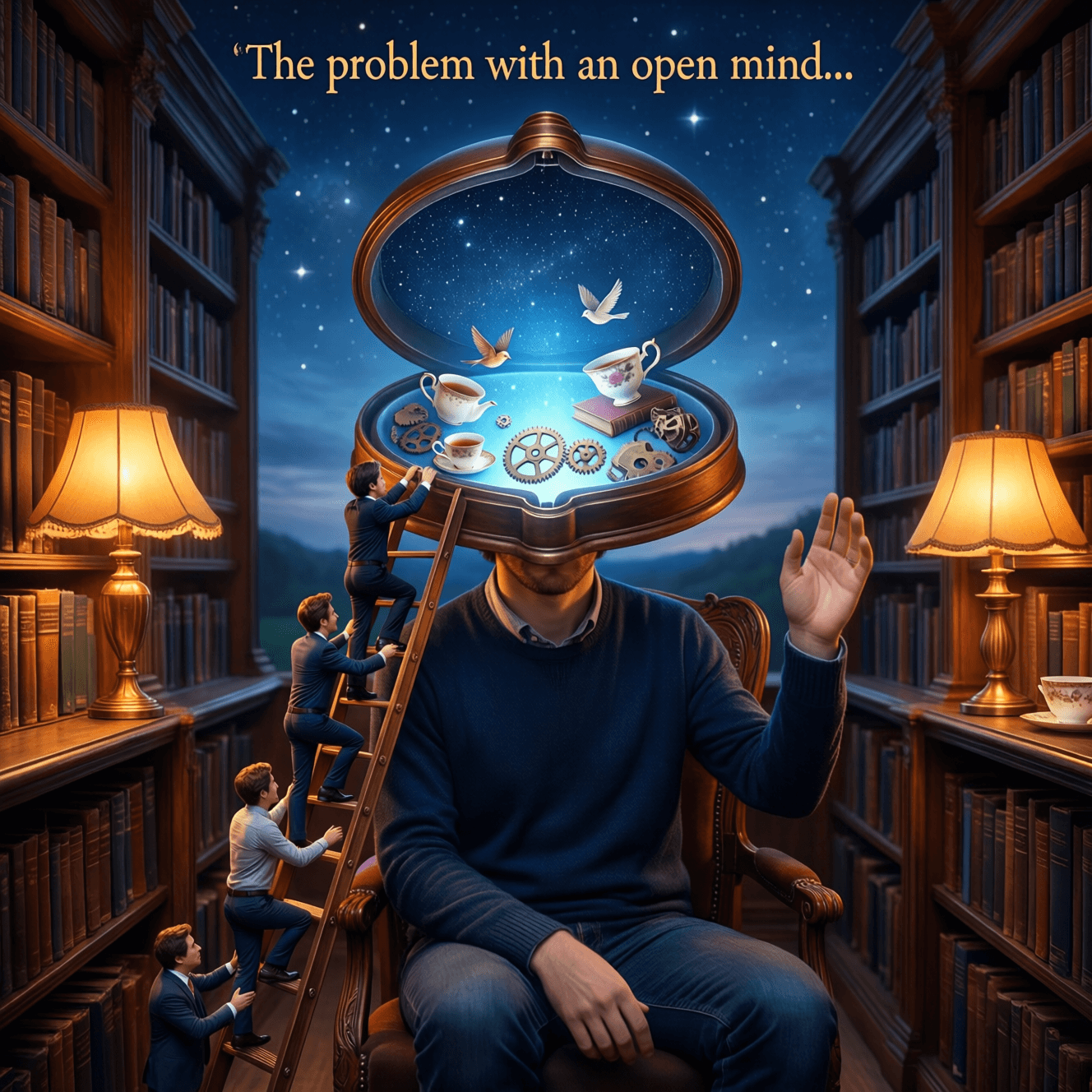
The problem with an open mind is that people will insist on coming along and trying to put things in it. — Terry Pratchett
—What lingers after this line?
A Witty Warning About Vulnerability
Terry Pratchett’s line turns a familiar virtue into a cautionary joke: being open-minded is good, but it can also make you a target. The humor hinges on the physical metaphor—an “open” mind as an unguarded container—suggesting that some people don’t want to exchange ideas so much as deposit their own. From the start, Pratchett frames openness not as passive acceptance but as a condition that requires active boundaries. In other words, curiosity is admirable, yet it can be exploited by anyone eager to fill empty space with certainty.
Open-Mindedness Versus Empty-Headedness
Building on that metaphor, the quote distinguishes between openness and emptiness. An open mind isn’t supposed to be a mind with no structure; it’s a mind willing to revise its structure when evidence demands it. If there’s no framework—no standards for evaluating claims—then “open” becomes indistinguishable from “unprotected.” This is why the line lands: people often praise open-mindedness while quietly redefining it to mean “agreeable to me.” Pratchett exposes that rhetorical trick by implying that the real danger is not thinking widely, but failing to filter what comes in.
The Social Pressure to Accept Ready-Made Beliefs
Once you admit uncertainty, others may rush to resolve it on your behalf. Families, institutions, charismatic leaders, and online communities can treat your curiosity as an invitation to recruit, converting a search for truth into a search for followers. Pratchett’s phrasing captures the pushiness of that dynamic—people “insist on coming along,” as if your mental space is public property. Consequently, the quote hints at a subtle power play: if someone can place their ideas inside your worldview without your scrutiny, they gain influence over how you interpret everything else.
Guardrails: Critical Thinking as a Doorkeeper
To stay genuinely open-minded, you need gatekeeping mechanisms that aren’t ideological but methodological: asking for evidence, checking incentives, and comparing claims against reality. Carl Sagan’s “baloney detection kit” in *The Demon-Haunted World* (1995) similarly argues that skepticism is not cynicism; it’s the toolkit that keeps wonder from being hijacked by nonsense. In that light, Pratchett’s joke becomes practical advice. Openness works best when it’s paired with a habit of evaluation—letting ideas in, but not letting them move in rent-free.
Why Persuasion Often Feels Like Invasion
The discomfort Pratchett describes also has psychological roots: people commonly use persuasion tactics that bypass careful reasoning—repetition, fear, social proof, and identity appeals. When someone frames disagreement as moral failure or disloyalty, they’re not offering information; they’re attempting to install a belief through pressure. This is why an “open mind” can feel like an open door during an aggressive sales pitch. The mind isn’t resisting new ideas; it’s resisting being handled, especially when the goal is compliance rather than understanding.
Openness With Boundaries: A Mature Intellectual Stance
In the end, Pratchett doesn’t argue for closing the mind; he argues for keeping it open on your terms. Openness becomes a strength when it’s selective and self-directed—curious enough to listen, confident enough to question, and disciplined enough to discard what doesn’t hold up. Seen this way, the quote recommends a balanced posture: invite conversation, but keep your standards. That balance preserves the best part of open-mindedness—growth—without surrendering your inner life to whoever shows up with the loudest certainty.
One-minute reflection
What feeling does this quote bring up for you?
Related Quotes
6 selectedNaivety can cost you dearly; wisdom is the rich currency of an open mind. — Aino Kallas
Aino Kallas
This quote emphasizes that being naive, or having a lack of experience or insight, can have tangible negative consequences, indicating that those who approach the world with unguarded innocence might face costly mistakes...
Read full interpretation →To be old and wise you must first be young and stupid. — Terry Pratchett
Terry Pratchett
At first glance, Terry Pratchett’s line turns wisdom into a joke, yet its humor carries a serious truth: good judgment is rarely innate. Instead, it is usually built from errors, embarrassment, and misread situations tha...
Read full interpretation →The future is shaped by your dreams, so stop wasting time and go to sleep! — Terry Pratchett
Terry Pratchett
This quote highlights the importance of dreams—both literal and metaphorical—in shaping one’s future. Terry Pratchett humorously suggests that dreams, which are often born in sleep, are essential for creating and envisio...
Read full interpretation →In ancient times, cats were worshipped as gods; they have not forgotten this. — Terry Pratchett
Terry Pratchett
This quote refers to ancient civilizations, such as Egypt, where cats were revered and even worshipped as sacred beings. They were associated with deities like Bastet, the goddess of home, fertility, and protection.
Read full interpretation →Light thinks it travels faster than anything but it is wrong. No matter how fast light travels, it finds the darkness has always got there first, and is waiting for it. — Terry Pratchett
Terry Pratchett
The quote uses light and darkness as metaphors, likely representing knowledge and ignorance, or good and evil.
Read full interpretation →The whole of life is just like watching a film. Only it’s as though you always get in ten minutes after the big picture has started. — Terry Pratchett
Terry Pratchett
Terry Pratchett’s vivid analogy invites us to imagine our lives as if they were films—stories unfolding on a screen while we watch, interpret, and participate. This comparison immediately draws our attention to the way n...
Read full interpretation →More From Author
More from Terry Pratchett →To be old and wise you must first be young and stupid. — Terry Pratchett
At first glance, Terry Pratchett’s line turns wisdom into a joke, yet its humor carries a serious truth: good judgment is rarely innate. Instead, it is usually built from errors, embarrassment, and misread situations tha...
Read full interpretation →The future is shaped by your dreams, so stop wasting time and go to sleep! — Terry Pratchett
This quote highlights the importance of dreams—both literal and metaphorical—in shaping one’s future. Terry Pratchett humorously suggests that dreams, which are often born in sleep, are essential for creating and envisio...
Read full interpretation →In ancient times, cats were worshipped as gods; they have not forgotten this. — Terry Pratchett
This quote refers to ancient civilizations, such as Egypt, where cats were revered and even worshipped as sacred beings. They were associated with deities like Bastet, the goddess of home, fertility, and protection.
Read full interpretation →Light thinks it travels faster than anything but it is wrong. No matter how fast light travels, it finds the darkness has always got there first, and is waiting for it. — Terry Pratchett
The quote uses light and darkness as metaphors, likely representing knowledge and ignorance, or good and evil.
Read full interpretation →