
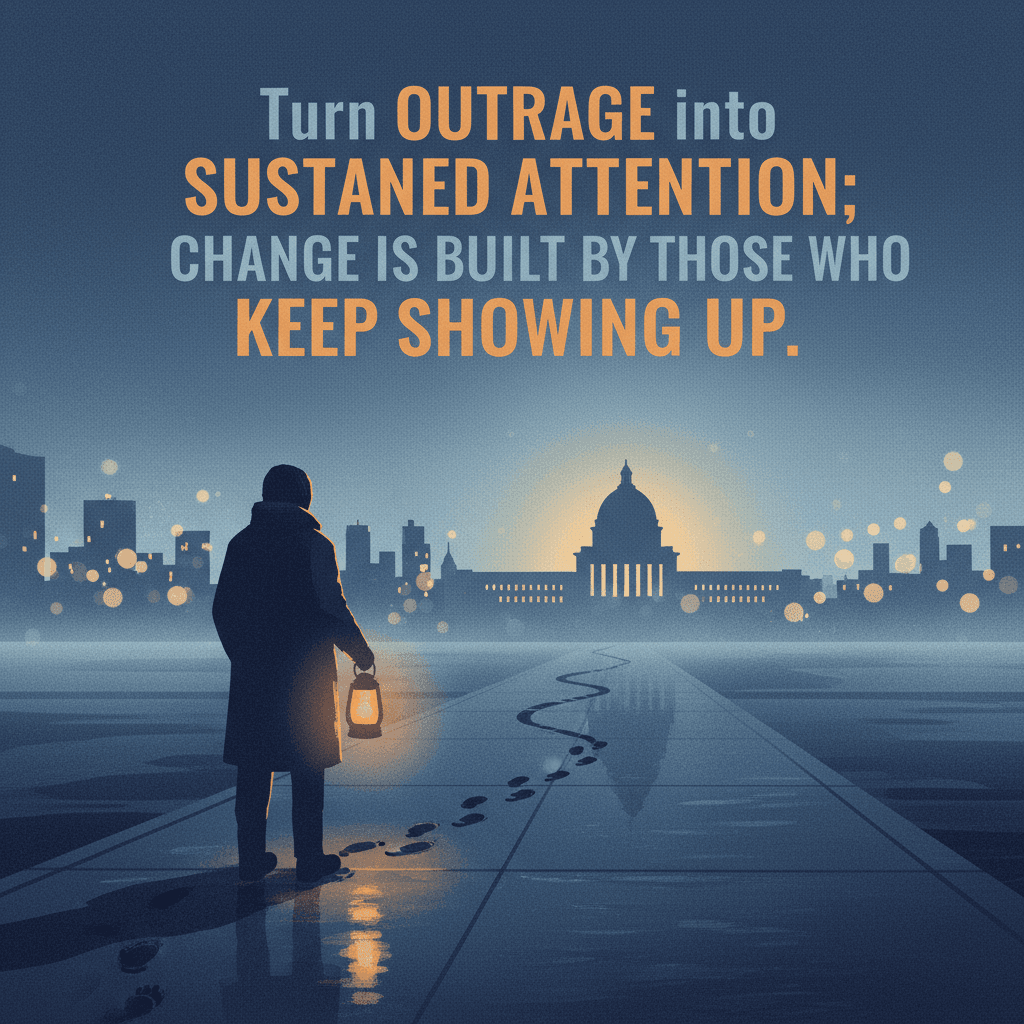
Turn outrage into sustained attention; change is built by those who keep showing up. — James Baldwin
—What lingers after this line?
Outrage as Spark, Attention as Engine
Outrage can ignite a movement, but it rarely sustains one. Baldwin’s line reframes fury as the starter fluid, not the motor: turn heat into focus, then keep that focus alive. In practical terms, sustained attention means returning—again and again—to the site of harm until conditions materially shift. His companion maxim, “Not everything that is faced can be changed, but nothing can be changed until it is faced” (Baldwin, 1962), clarifies the path: repetition, not eruption, moves institutions. This is less about catharsis than continuity, and it sets the stage for an ethic of witness that translates feeling into presence.
Baldwin’s Ethic of Witness
Building on that premise, Baldwin modeled attention as witness: the repeated act of seeing, naming, and returning. In The Fire Next Time (1963), he sits with America’s contradictions long enough to make them undeniable, while in No Name in the Street (1972) he tracks the aftershocks of assassinations with a stamina that refuses amnesia. Even his 1965 Cambridge debate with William F. Buckley Jr. shows this posture: not a one-off performance, but one chapter in a long labor of public truth-telling. Thus, “showing up” is not mere attendance; it is a disciplined presence that compels accountability over time.
Movements Built on Repetition
Moreover, history confirms that durable change rides on routine. The Montgomery Bus Boycott lasted 381 days (1955–56), sustained by carpools, church basements, and nightly meetings—mundane logistics that transformed outrage into a civic habit. Likewise, the 1960 sit-ins and SNCC trainings repeated the same nonviolent script until lunch counters cracked. Ella Baker’s counsel—“Strong people don’t need strong leaders” (1964)—captured this infrastructure-first approach: build local capacity so people can keep showing up without waiting for a spark. Repetition, then, is strategy, not drudgery; it converts moral urgency into social muscle.
Turning Emotion into Habit
In turn, psychology illuminates how to make showing up stick. Habit research suggests that consistent cues and small, repeated actions create automaticity; Lally et al. (2009) found many behaviors stabilize after weeks of steady practice. Implementation intentions—if-then plans like “If it’s Tuesday at 6 p.m., I join the tenants’ meeting” (Gollwitzer, 1999)—bridge intention and action. Pair that with social accountability and feedback loops, and outrage becomes a calendar, then a rhythm, then an identity. By shrinking the action and fixing the time, we make persistence easier than dropout.
Outlasting the Issue-Attention Cycle
Meanwhile, movements must navigate a media environment that inflates spikes and forgets the rest. Anthony Downs’s “issue-attention cycle” (Public Interest, 1972) shows how public focus surges, then wanes; agenda-setting research (McCombs & Shaw, 1972) explains why visibility shapes urgency. Groups that prevail counterprogram the cycle: ACT UP’s sustained die-ins and FDA confrontations (1987–90s) reintroduced urgency until policy shifted; the Mothers of the Plaza de Mayo have marched weekly since 1977 to make disappearance unforgettable. The lesson is clear: schedule the return before the spotlight dims.
Practices for Converting Anger into Attendance
Finally, the craft of showing up is practical. Set a recurring cadence; define small, durable roles; rotate tasks to prevent burnout; and measure progress so effort becomes legible. Pair protest with infrastructure—legal aid, mutual aid, canvassing lists—so each gathering deposits capacity into the bank. Close the loop with reflection, as Baldwin did in essays that turned experience into shared understanding. In this way, outrage doesn’t dissipate; it matures into attention, and attention into institutions. Change, then, belongs to those who keep arriving—until the world must answer.
One-minute reflection
What feeling does this quote bring up for you?
Related Quotes
6 selectedA community is much more than belonging to something; it's about doing something together that makes belonging matter. — Brian Solis
Brian Solis
At first glance, Brian Solis’s remark challenges a passive idea of community. Simply belonging to a group, a neighborhood, or an online network is not enough; membership alone can remain hollow if it asks nothing of peop...
Read full interpretation →Small acts, multiplied across mouths and hands, reshape the contours of culture. — Margaret Mead
Margaret Mead
Margaret Mead frames culture not as a distant monument built by a few famous figures, but as something formed in the ordinary rhythm of daily life. A single gesture—how we greet, how we share food, how we speak to childr...
Read full interpretation →Begin by lighting one candle for the common day; soon the streets will glow. — Octavio Paz
Octavio Paz
Octavio Paz invites us to picture a simple act: lighting a single candle as the day begins. This image is disarmingly humble—no grand gesture, no dramatic change, only a quiet flame against the backdrop of everyday life.
Read full interpretation →Stories change the world when they are carried into action. — Chinua Achebe
Chinua Achebe
Chinua Achebe’s claim insists that a story’s true power is proven not in admiration but in movement. He suggests that narratives become transformative when they shape choices, alter habits, and reorganize collective life...
Read full interpretation →If you want to go fast, go alone. If you want to go far, go together. — African Proverb
African Proverb
This proverb contrasts the speed of individual action with the endurance and sustainability of collective effort. It suggests that while working alone can yield quicker results, working with others leads to longer-lastin...
Read full interpretation →Small acts, when multiplied by millions of people, can transform the world. — Howard Zinn, United States.
Howard Zinn, United States.
This quote highlights the concept that individual actions, no matter how small, can collectively lead to significant change when embraced by many. It suggests that everyone has the power to contribute to a larger cause.
Read full interpretation →More From Author
More from James Baldwin →Perhaps home is not a place but simply an irrevocable condition. — James Baldwin
At first glance, Baldwin overturns a familiar assumption: home is usually imagined as a house, a street, or a homeland on a map. Yet his phrase suggests something deeper and less movable, a condition that lives within a...
Read full interpretation →Rarely are we more exposed than when we are being kind. — James Baldwin
At first glance, Baldwin’s line appears simple, yet it quickly reveals a harder truth: kindness is never merely polite behavior. When we are kind, we lower our defenses and allow another person to see what we value, what...
Read full interpretation →People who shut their eyes to reality simply invite their own destruction. — James Baldwin
James Baldwin frames denial not as a harmless coping mechanism but as a decision with consequences. By “shut[ting] their eyes,” he points to willful blindness—choosing comfort over truth—and suggests that reality does no...
Read full interpretation →People who cannot suffer can never grow up, can never discover who they are. — James Baldwin
James Baldwin’s claim binds two ideas we often separate: maturity and suffering. To “grow up,” in his sense, is not simply to age or acquire skills; it is to undergo experiences that test the stories we tell about oursel...
Read full interpretation →