
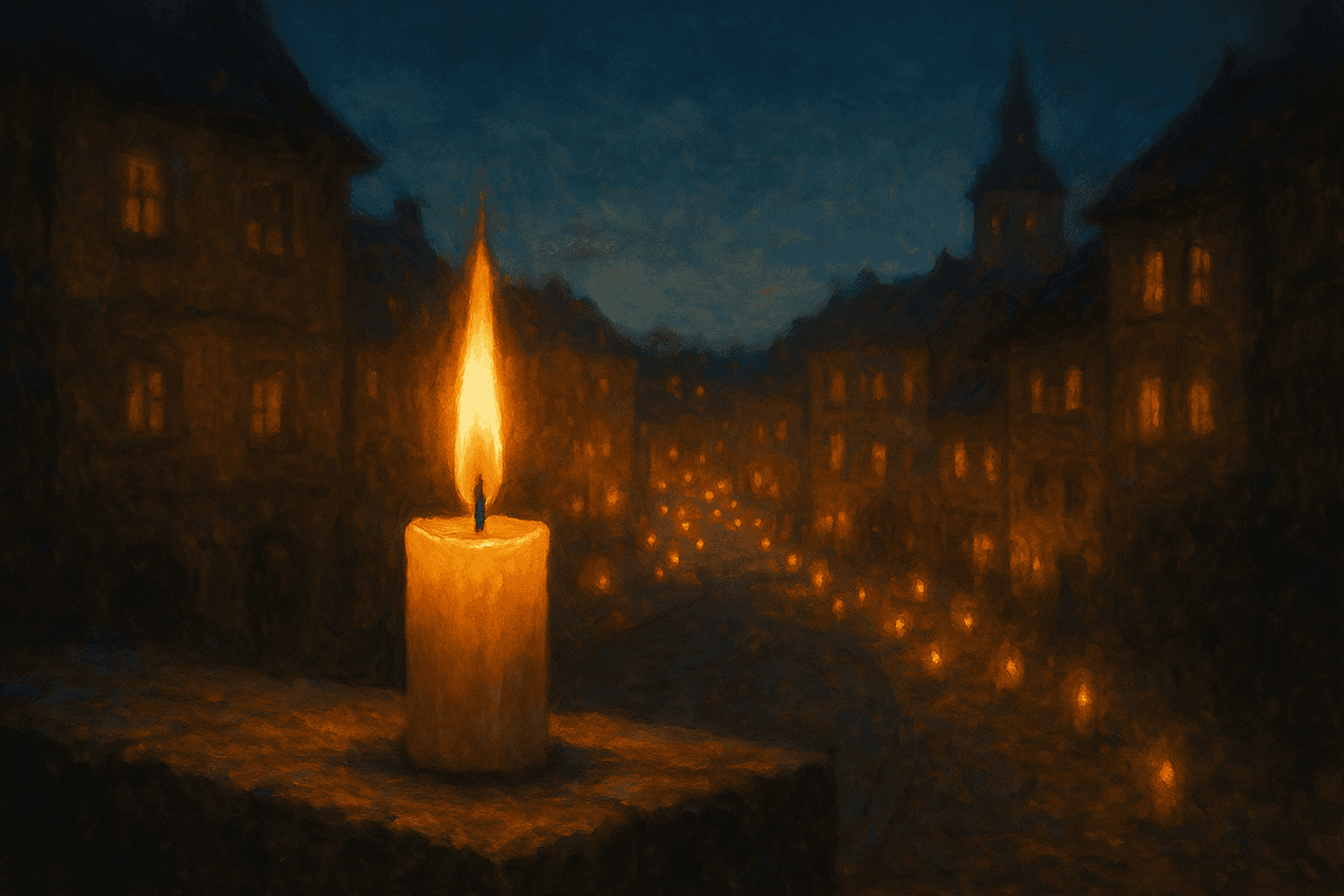
Begin by lighting one candle for the common day; soon the streets will glow. — Octavio Paz
—What lingers after this line?
A Modest Flame in an Ordinary Day
Octavio Paz invites us to picture a simple act: lighting a single candle as the day begins. This image is disarmingly humble—no grand gesture, no dramatic change, only a quiet flame against the backdrop of everyday life. Yet precisely because the day is “common,” the candle’s glow becomes more striking. It suggests that meaning and beauty do not wait for special occasions; they often begin with an intentional choice to introduce a little more light into the routine flow of time.
The Quiet Power of Incremental Actions
From this starting point, the quote unfolds a principle of accumulation: what begins with one candle can spread until “the streets will glow.” The transformation happens not through a single blaze, but through repetition and imitation, much like a small habit practiced daily reshapes a life over years. In social terms, one person’s kindness often inspires another’s, just as one lit candle can kindle many more. Over time, these modest actions aggregate, turning isolated sparks into a shared radiance that alters the character of a whole community.
Individual Responsibility and Contagious Example
Consequently, Paz hints at a form of responsibility that is both personal and relational. Lighting one candle is something anyone can do; it requires neither authority nor wealth, only willingness. However, the larger promise—that streets will glow—depends on others choosing to do likewise. This dynamic resembles what psychologists describe as social contagion: behaviors, moods, and norms spread through networks much like fire along a line of candles. In this sense, the first light is also an invitation, signaling what is possible and encouraging others to participate in illumination.
Transforming Public Space Through Shared Light
As the image widens from a single flame to entire streets, the quote shifts from private gesture to public transformation. Streets are where strangers cross paths, where the anonymous life of a city unfolds. To imagine them glowing is to imagine a change in how we inhabit shared spaces—safer, warmer, less indifferent. Historical scenes such as the candlelit vigils of the Solidarity movement in Poland (1980s) or civil rights marches in the United States show how small lights, held together, can redefine public space. Thus, Paz’s metaphor subtly points to the civic dimension of hope and solidarity.
Hope, Patience, and the Word “Soon”
Central to the quote is the word “soon,” which bridges the gap between a lone act and a collective result. It implies both hope and patience: the streets do not glow instantly, yet their illumination is imagined as imminent rather than distant. This temporal nuance recalls the way social change or personal growth unfolds—often imperceptible at first, then suddenly visible. By compressing this process into a single, poetic line, Paz reassures us that small beginnings are not futile preliminaries but the very seeds of the future we long to see.
Living as a Source of Everyday Light
Ultimately, Paz’s candle is a metaphor for how we might choose to live. To “light one candle for the common day” is to approach ordinary routines with intentional generosity, creativity, or attentiveness. Rather than waiting for extraordinary circumstances, we can let our speech, work, or presence be a steady source of illumination for others. When repeated across many lives, such choices can make the metaphor literal: neighborhoods become more welcoming, institutions more humane, and the mundane world a little less dark. In this way, the glow of the streets begins with the decision to light a single, modest flame.
One-minute reflection
Why might this line matter today, not tomorrow?
Related Quotes
6 selectedGather your small sparks into a bonfire that can be seen from the next town. — Maya Angelou
Maya Angelou
Maya Angelou’s image invites us to treat minor efforts as kindling, not as ends in themselves. A spark is fleeting, but gathered with care it becomes a bonfire—large enough to orient others at a distance.
Read full interpretation →A community is much more than belonging to something; it's about doing something together that makes belonging matter. — Brian Solis
Brian Solis
At first glance, Brian Solis’s remark challenges a passive idea of community. Simply belonging to a group, a neighborhood, or an online network is not enough; membership alone can remain hollow if it asks nothing of peop...
Read full interpretation →Small acts, multiplied across mouths and hands, reshape the contours of culture. — Margaret Mead
Margaret Mead
Margaret Mead frames culture not as a distant monument built by a few famous figures, but as something formed in the ordinary rhythm of daily life. A single gesture—how we greet, how we share food, how we speak to childr...
Read full interpretation →Stories change the world when they are carried into action. — Chinua Achebe
Chinua Achebe
Chinua Achebe’s claim insists that a story’s true power is proven not in admiration but in movement. He suggests that narratives become transformative when they shape choices, alter habits, and reorganize collective life...
Read full interpretation →Turn outrage into sustained attention; change is built by those who keep showing up. — James Baldwin
James Baldwin
Outrage can ignite a movement, but it rarely sustains one. Baldwin’s line reframes fury as the starter fluid, not the motor: turn heat into focus, then keep that focus alive.
Read full interpretation →If you want to go fast, go alone. If you want to go far, go together. — African Proverb
African Proverb
This proverb contrasts the speed of individual action with the endurance and sustainability of collective effort. It suggests that while working alone can yield quicker results, working with others leads to longer-lastin...
Read full interpretation →More From Author
More from Octavio Paz →Harvest resilience from routine; repetition grows muscle in the soul. — Octavio Paz
Octavio Paz’s line frames routine not as drudgery but as a workshop where resilience is made. Instead of waiting for dramatic trials to reveal character, he implies that the small, recurring actions of daily life steadil...
Read full interpretation →Carry silence in one pocket and purpose in the other. — Octavio Paz
Octavio Paz frames a compact ethic: keep silence close at hand while also keeping purpose equally available. The image of “two pockets” suggests portability and readiness, as if these are tools you reach for in different...
Read full interpretation →Let restlessness become a compass guiding you toward meaningful labor. — Octavio Paz
Octavio Paz reframes restlessness as something more instructive than irritating—a signal that our current routines may be too small for our capacities. Rather than treating agitation as a personal defect, the quote invit...
Read full interpretation →If the world asks for your struggle, give it your art — Octavio Paz
Octavio Paz’s line pivots on a subtle refusal: if society demands your “struggle,” you are not obligated to hand over raw suffering as proof of worth. Instead, he proposes a transformation—give “your art,” the shaped and...
Read full interpretation →