
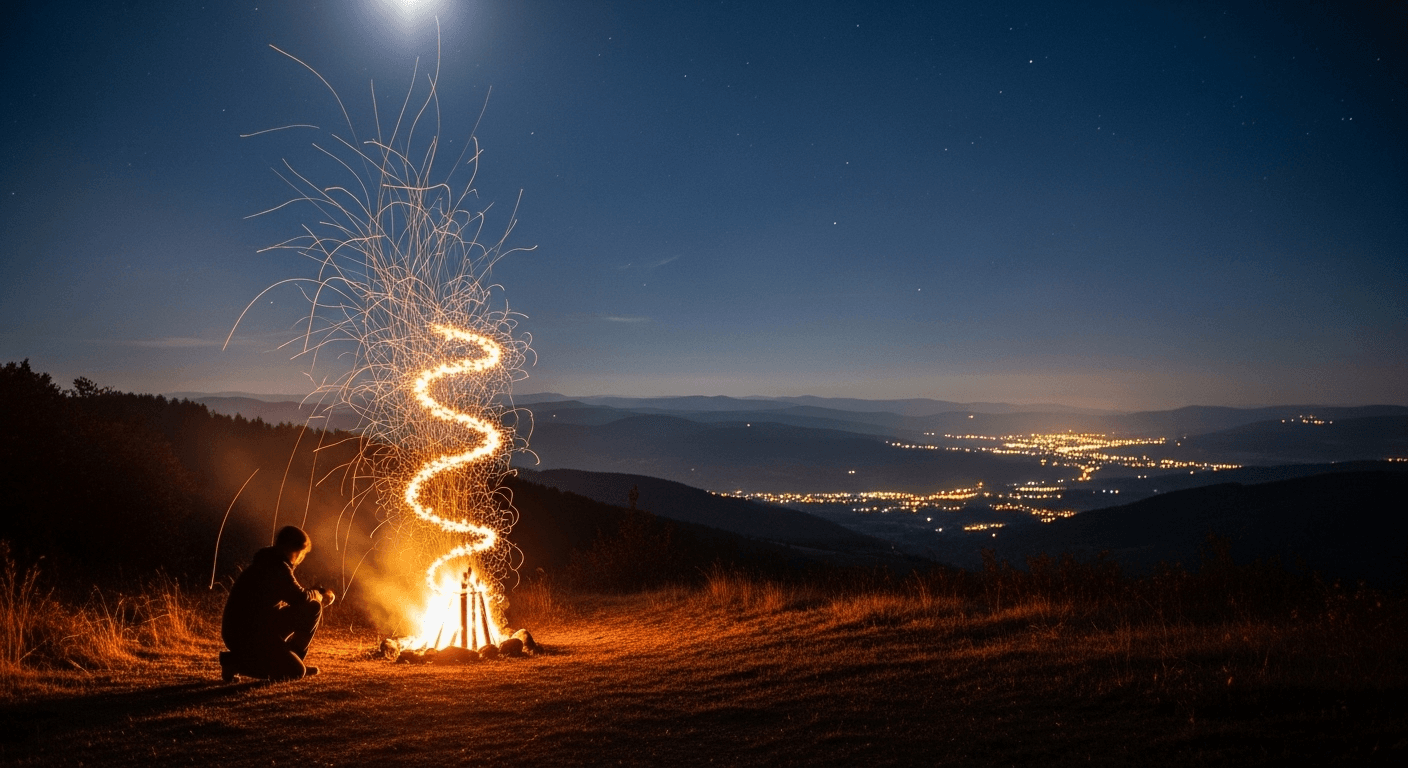
Gather your small sparks into a bonfire that can be seen from the next town. — Maya Angelou
—What lingers after this line?
Reading the Metaphor of Radiant Scale
Maya Angelou’s image invites us to treat minor efforts as kindling, not as ends in themselves. A spark is fleeting, but gathered with care it becomes a bonfire—large enough to orient others at a distance. In other words, the point is not only to act, but to accumulate action until it becomes visible, useful, and contagious. This reframes perfectionism: instead of waiting for one grand gesture, we stack small, imperfect moves until they blaze.
Habits as the First Pile of Kindling
Building on this, the earliest fuel is routine. Tiny daily practices provide steady heat and, when repeated, compound. Research on behavior design shows that small, reliable actions anchor change; James Clear’s Atomic Habits (2018) popularizes how marginal gains accumulate, while BJ Fogg’s Tiny Habits (2019) demonstrates that emotion and simplicity make consistency stick. Thus the promise is cumulative: sparks become embers, then embers cohere into fire, making persistence more important than intensity on any single day.
From Private Glow to Public Beacon
Yet accumulation alone is not enough; the fire must be seen. Storytelling and signal-making turn private progress into public invitation. Derek Sivers’s “first follower” insight (TED, 2010) shows how visible action legitimizes a movement, while a much older image—the relay of watchfires in Aeschylus’s Agamemnon (c. 458 BC)—illustrates how beacons carry news across distance. By sharing milestones, artifacts, and prototypes, we create sight lines for the next town to notice and join.
The Mathematics of Momentum
Consequently, visibility meets networks, and scale accelerates. Mark Granovetter’s The Strength of Weak Ties (1973) explains how acquaintances bridge communities, allowing your bonfire to leap social gaps. Popular accounts like Malcolm Gladwell’s The Tipping Point (2000) describe how a threshold of connected sparks triggers disproportionate impact. In practice, each new participant multiplies reach, so that the growth curve bends upward—not by one heroic act, but by many small flames catching.
Community as Fuel and Wind
Moreover, sustained fires are communal. Benjamin Franklin’s Junto (1727) pooled modest talents into civic innovations, while open-source teams—from the early Linux kernel (1991) onward—turned incremental commits into world-shaping infrastructure. Even the Stone Soup folktale teaches that shared contributions transform scarcity into abundance. By designing rituals of contribution—weekly demos, rotating stewardship, mutual aid—we turn participation into oxygen and ensure the blaze does not rely on a single match.
Historical Flames That Traveled Far
History confirms the pattern. The Montgomery Bus Boycott (1955–56) began with Rosa Parks’s refusal but was sustained by thousands of small choices—walking, carpooling, church organizing—until legal change followed. Decades later, Tarana Burke’s Me Too (2006) became a global bonfire in 2017 when millions shared stories, each post a spark that made others visible. These examples underline Angelou’s premise: collective luminosity emerges from ordinary acts aligned and repeated.
Tending the Fire Without Burning Out
Finally, any bonfire needs care. Without boundaries and rotation, the same fuelers exhaust themselves. Burnout research by Christina Maslach (1981) links chronic overload and low control to depletion; accordingly, build firebreaks: clear roles, rest cycles, and shared decision-making. Just as ash must be cleared for coals to breathe, reflective pauses prevent suffocation. With stewardship as a norm, the flame stays bright enough to guide those in the next town—and warm those gathered nearby.
One-minute reflection
What does this quote ask you to notice today?
Related Quotes
6 selectedA community is much more than belonging to something; it's about doing something together that makes belonging matter. — Brian Solis
Brian Solis
At first glance, Brian Solis’s remark challenges a passive idea of community. Simply belonging to a group, a neighborhood, or an online network is not enough; membership alone can remain hollow if it asks nothing of peop...
Read full interpretation →Small acts, multiplied across mouths and hands, reshape the contours of culture. — Margaret Mead
Margaret Mead
Margaret Mead frames culture not as a distant monument built by a few famous figures, but as something formed in the ordinary rhythm of daily life. A single gesture—how we greet, how we share food, how we speak to childr...
Read full interpretation →Begin by lighting one candle for the common day; soon the streets will glow. — Octavio Paz
Octavio Paz
Octavio Paz invites us to picture a simple act: lighting a single candle as the day begins. This image is disarmingly humble—no grand gesture, no dramatic change, only a quiet flame against the backdrop of everyday life.
Read full interpretation →Stories change the world when they are carried into action. — Chinua Achebe
Chinua Achebe
Chinua Achebe’s claim insists that a story’s true power is proven not in admiration but in movement. He suggests that narratives become transformative when they shape choices, alter habits, and reorganize collective life...
Read full interpretation →Turn outrage into sustained attention; change is built by those who keep showing up. — James Baldwin
James Baldwin
Outrage can ignite a movement, but it rarely sustains one. Baldwin’s line reframes fury as the starter fluid, not the motor: turn heat into focus, then keep that focus alive.
Read full interpretation →If you want to go fast, go alone. If you want to go far, go together. — African Proverb
African Proverb
This proverb contrasts the speed of individual action with the endurance and sustainability of collective effort. It suggests that while working alone can yield quicker results, working with others leads to longer-lastin...
Read full interpretation →More From Author
More from Maya Angelou →We need joy as we need air. We need love as we need water. We need each other as we need the earth we share. — Maya Angelou
Maya Angelou’s words turn emotional needs into elemental ones, placing joy beside air, love beside water, and human connection beside the earth itself. By doing so, she refuses to treat happiness, affection, and communit...
Read full interpretation →The only way to exist in a world that feels increasingly cold is to be the warmth you wish to receive from others. — Maya Angelou
At its core, Maya Angelou’s line reframes loneliness as a call to action rather than a verdict on the world. If life feels impersonal, distant, or harsh, she suggests that waiting passively for kindness may only deepen t...
Read full interpretation →Home is the place where one finally allows the armor to drop and the spirit to breathe. — Maya Angelou
At its core, Maya Angelou’s reflection defines home not merely as a structure but as a sanctuary of emotional safety. The image of letting “the armor drop” suggests that daily life often requires protection—composure, re...
Read full interpretation →The true value of our journey is found in the people who walk beside us, turning simple moments into our most enduring milestones. — Maya Angelou
At its heart, this reflection suggests that life is not valued only by destinations reached, but by the companions who share the road. Maya Angelou’s thought reframes success away from solitary achievement and toward rel...
Read full interpretation →