
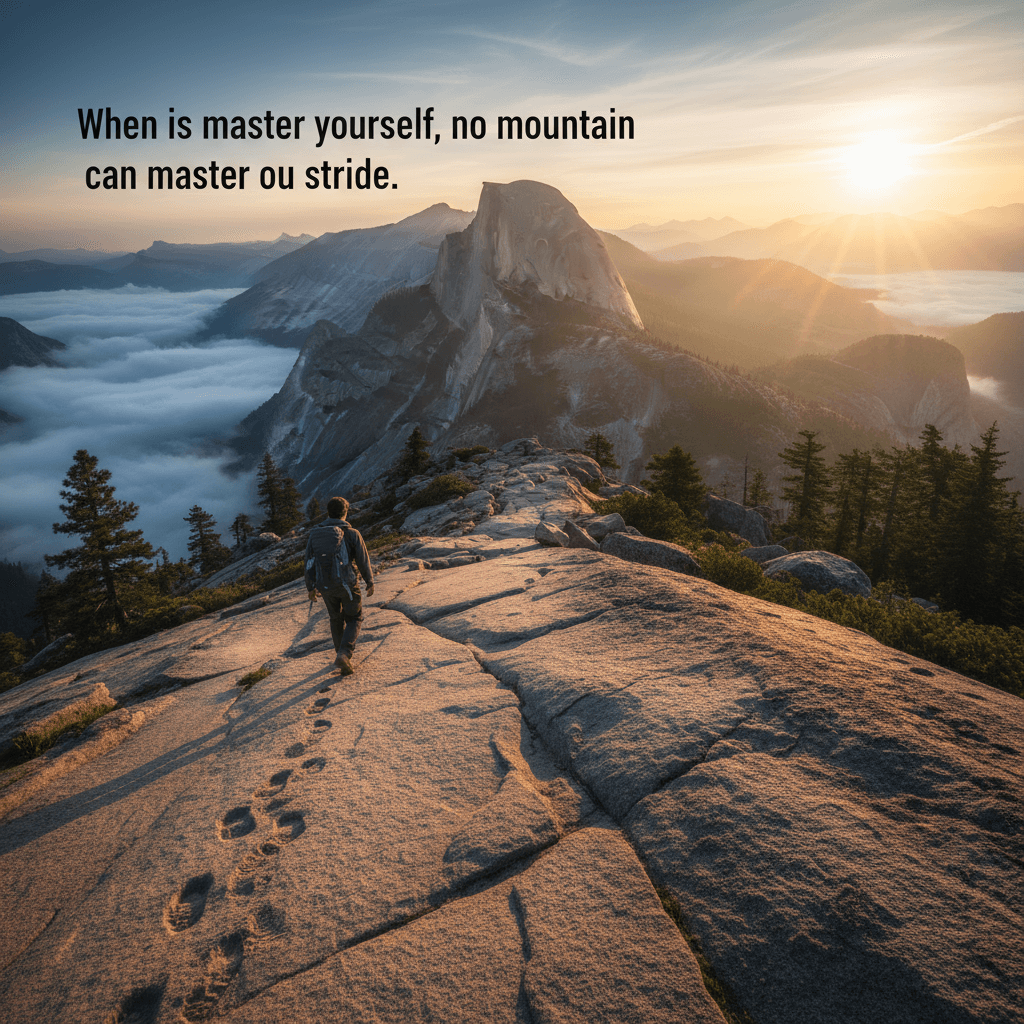
When you master yourself, no mountain can master your stride. — Confucius
—What lingers after this line?
The Inner Summit
The line suggests that the greatest ascent begins within: by governing impulses, clarifying values, and aligning action with purpose, one gains a stride that external obstacles cannot unsettle. Mastery here is not domination but integration—awareness guiding intention, and intention shaping habit. When our footing is set by character rather than circumstance, mountains lose the power to dictate our pace. From this vantage, terrain still matters, yet it no longer commands; it merely informs the route. With that foundation in place, it becomes natural to ask where this vision first took deep root.
Confucian Roots of Self-Cultivation
In Confucian thought, self-mastery is the core of moral life. The Analects (1.4) records Zengzi’s daily self-examination, a ritual of inner accounting that anchors conduct. Moreover, The Great Learning outlines a sequence—rectify the heart, cultivate the person, regulate the family, govern the state—that turns private virtue into public order. In this tradition, mastery is not self-absorption but self-preparation for service; the disciplined person becomes a steady bridge between personal intention and communal harmony. Building on that ethical scaffolding, modern psychology offers tools to translate aspiration into sustained behavior.
The Psychology of Agency
Research on self-efficacy (A. Bandura, 1977) shows that belief in one’s capacity alters performance under stress, effectively widening the path on steep ground. Classic work on delayed gratification (W. Mischel, 1972) and newer strategies like mental contrasting (G. Oettingen, 2014) and implementation intentions (P. Gollwitzer, 1999) convert vague hopes into specific, robust plans. Such methods strengthen the moment of choice, when fatigue or fear tempts retreat. Thus, inner mastery becomes measurable: it is the practiced ability to notice a cue, recall a commitment, and take the next right step—exactly the rhythm needed on any serious ascent. With the psychology in hand, the mountain metaphor turns literal.
Pacing the Climb
Mountaineers teach that pace is strategy: the Swahili mantra pole, pole—slowly, slowly—gets trekkers up Kilimanjaro when haste would fail. A line often attributed to Edmund Hillary captures the ethos: ‘It is not the mountain we conquer, but ourselves.’ Good climbers manage breath, cadence, and judgment, transforming steepness into technique. Likewise, self-mastery chooses sustainable effort over spurts of bravado, balancing rest with resolve. When setbacks appear—weather shifting, altitude pressing—the practiced stride adapts instead of breaks. Translating that wisdom into daily life requires concrete tools that make discipline less a mood and more a system.
Tools for Daily Mastery
Practical scaffolds turn intention into momentum. If–then plans (‘If it’s 6 a.m., then I lace my shoes’) reduce friction at the decision point, while mental contrasting ties vivid goals to the obstacles that must be faced. Environment design—laying out gear, silencing phones, enlisting a partner—handles willpower by removing temptations. Precommitments trace back to Homer’s Odyssey: Odysseus bound himself to hear the Sirens safely, a timeless lesson in outwitting one’s weaker moments. Even brief physiological resets—six deep breaths, a short walk—can reset attention. As these practices accumulate, the stride feels earned rather than willed, preparing character for its social consequences.
From Self to Society
Confucius envisioned the junzi—the exemplary person—whose steadiness nurtures trust. In that spirit, self-mastery does not isolate; it radiates. The Great Learning’s ladder—from self to family to state—implies that composure, fairness, and reliability scale outward. A leader who governs reactions models restraint; a parent who listens teaches dignity; a colleague who keeps promises raises the floor of teamwork. Thus, private discipline becomes public benefit, much as a surefooted climber sets the tempo for the rope team. Yet even noble discipline can harden unless tempered by humane insight.
Compassionate Discipline
Rigid control often fractures under pressure, whereas compassionate discipline bends and returns stronger. Research on self-compassion (K. Neff, 2011) shows that kind accountability—acknowledging errors without self-contempt—improves persistence more than harsh criticism. Acceptance and Commitment Therapy similarly pairs values with present-moment acceptance, letting one carry discomfort without abandoning the trail. In practice, this means adjusting plans without losing direction, and treating stumbles as data. With compassion integrated, self-mastery becomes sustainable: a stride both firm and forgiving, capable of crossing mountains without losing the person who walks.
Recommended Reading
As an Amazon Associate, we earn from qualifying purchases.
One-minute reflection
Why might this line matter today, not tomorrow?
Related Quotes
6 selectedThose who know others are wise; those who know themselves are enlightened. Those who defeat others have strength; those who defeat themselves are strong. -- Laozi
Laozi
Laozi opens by placing “knowing others” and “knowing oneself” side by side, as if they were neighboring skills that lead to very different destinations. Understanding other people—reading motives, predicting reactions, n...
Read full interpretation →Mastering others is strength. Mastering yourself is true power. — Lao Tzu
Lao Tzu
Lao Tzu draws a sharp distinction between the power we exert outwardly and the power we cultivate inwardly. To “master others” is to influence, persuade, command, or outmaneuver—abilities that can look impressive because...
Read full interpretation →Master yourself steadily; the calm within moves mountains without. — Marcus Aurelius
Marcus Aurelius
Marcus Aurelius’ line condenses a Stoic program into a single image: mastery is not sudden conquest but steady training, and its power comes from an inner calm that does not need to announce itself. Rather than urging do...
Read full interpretation →Embrace each challenge as a stepping stone, for it is through the moments of struggle that we uncover our true strength and illuminate the path to our brightest triumphs.
Unknown
This quote encourages individuals to view challenges not as obstacles but as opportunities for personal growth. Each struggle is a chance to develop resilience and discover inner strength.
Read full interpretation →In the heart of the forest, where the trees whisper ancient secrets, a young monk practiced his steps. Each morning, he ran a path known only to him, a journey of solitude and discovery. Discipline, his master had said, is the bridge between dreams and reality. With every step, the forest echoed his silent mantra: Strength in stillness, power in peace. Birds sang his praises, leaves danced in harmony, and the earth felt his determination. In nature's embrace, he found the essence of life, the truth of existence, and the unwavering spirit of perseverance.
Unknown
The young monk's solitary runs through the forest symbolize a personal journey of self-discovery. Away from the distractions of society, he finds clarity and insight within himself.
Read full interpretation →Stand tall like a mountain; let your dreams reach as high as the sky, for within you lies the strength to conquer every peak. — Unknown, Global.
Unknown, Global.
This quote encourages individuals to embody resilience and strength, much like a mountain that stands steadfast against the elements. It conveys the message that inner strength enables one to overcome life's challenges.
Read full interpretation →More From Author
More from Confucius →Anything worth having is worth waiting for, and everything worth doing is worth doing with patience. — Confucius
At its core, this saying ties value to delay. Confucius suggests that truly meaningful things do not arrive instantly; instead, they ask us to endure uncertainty, effort, and time.
Read full interpretation →A common man marvels at uncommon things. A wise man marvels at the commonplace. — Confucius
Confucius draws a quiet but profound distinction between two kinds of attention. The common man, in this saying, is captivated by what appears exceptional—spectacle, rarity, or public greatness.
Read full interpretation →To learn is to admit you do not know. The moment you stop being a student is the moment your growth ends. — Confucius
Confucius frames learning not as the display of knowledge but as the honest recognition of its limits. In that sense, to learn is to begin with humility: one must first admit, without shame, that there is something missi...
Read full interpretation →The craftsman who wants to do good work must first sharpen his tools. — Confucius
Confucius frames good work as something that begins long before the visible task itself. By saying a craftsman must first sharpen his tools, he emphasizes that excellence depends on preparation, not merely effort in the...
Read full interpretation →