
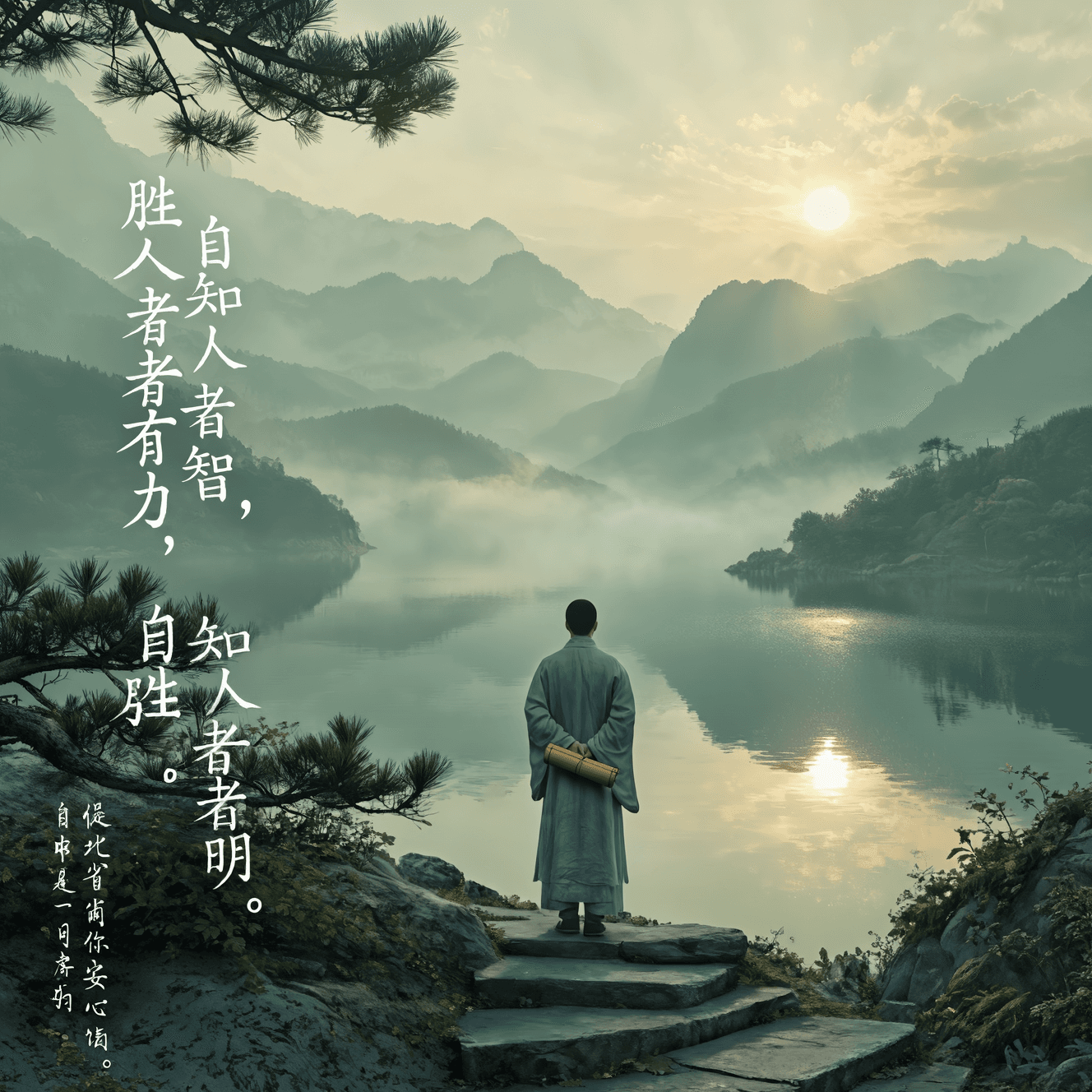
Those who know others are wise; those who know themselves are enlightened. Those who defeat others have strength; those who defeat themselves are strong. -- Laozi
—What lingers after this line?
Two Kinds of Knowing
Laozi opens by placing “knowing others” and “knowing oneself” side by side, as if they were neighboring skills that lead to very different destinations. Understanding other people—reading motives, predicting reactions, navigating social currents—can make a person appear wise, because it helps them act effectively in the world. And yet, he immediately elevates self-knowledge to something rarer: enlightenment. The transition signals a shift from external observation to inward clarity, suggesting that insight into one’s own fears, desires, and blind spots changes not just what you do, but how you perceive life itself.
The Limits of Social Intelligence
Knowing others can be remarkably practical: a diplomat senses when to pause, a manager notices unspoken tension, a friend recognizes grief behind humor. Such awareness often prevents conflict and earns influence, which is why Laozi calls it wisdom. However, this outward skill has a ceiling. Without self-knowledge, people can become excellent at managing impressions while remaining confused about their own motives—pursuing approval, control, or status without admitting it. In that way, Laozi’s contrast implies that social intelligence, though valuable, can still leave a person internally divided.
Self-Knowledge as Inner Illumination
When Laozi calls self-knowledge “enlightenment,” he hints that the self is not merely another object to analyze, but a doorway to a different kind of awareness. Daoist texts such as the Tao Te Ching (traditionally attributed to Laozi, c. 4th–3rd century BC) repeatedly favor returning, emptying, and simplifying—moves that reveal what is authentic beneath habit and craving. Consequently, knowing yourself is less like collecting facts and more like noticing patterns: the moment irritation arises, the story you automatically tell, the comfort you chase. This recognition can dissolve compulsive reactions, making space for a calmer, clearer way of being.
Strength That Overpowers Others
Laozi then pivots from knowledge to victory: defeating others is framed as strength, the kind the world can measure. It might appear in argument, competition, or leadership—where winning proves capability, strategy, and force. Yet the wording subtly narrows this achievement. If strength depends on an opponent, it can become addictive and fragile, because it must be continually demonstrated. By setting up this form of strength first, Laozi prepares the reader to see why a deeper kind of power doesn’t require anyone else to lose.
The Harder Victory: Defeating Oneself
Next, Laozi calls self-defeat true strength, a reversal that reframes the battlefield as internal. To “defeat yourself” is not self-hatred but self-mastery: resisting a familiar temptation, interrupting a reflex to dominate, or refusing the satisfaction of being right. A simple anecdote captures it: someone pauses mid-argument, notices the surge of pride, and chooses curiosity instead of victory—no applause follows, but something sturdier is built. This is harder precisely because the opponent is intimate: your own impulses and narratives. Unlike external triumph, inner victory can’t be faked, and it produces a steadiness that persists even when no one is watching.
A Unified Path: From Insight to Freedom
Taken together, the quote traces a coherent progression: the more attention stays outward, the more success looks like cleverness and conquest; the more attention turns inward, the more success becomes clarity and restraint. In that sense, wisdom and strength are not dismissed—they are re-situated as early stages that mature into enlightenment and true power. Finally, Laozi’s pairing suggests a practical ethic for daily life: learn people, but study yourself more; compete when necessary, but practice the quieter discipline of self-control. Through that transition from outer mastery to inner freedom, the person becomes both effective and unshakable.
One-minute reflection
Where does this idea show up in your life right now?
Related Quotes
6 selectedInstead of trying to build the perfect life in which to dwell, we can fortify and master the vehicle through which we traverse it. — Designing the Mind
Designing the Mind
The quote from Designing the Mind begins by challenging a common assumption: that peace depends on arranging life into ideal conditions. Rather than waiting for the perfect home, career, relationship, or routine, it redi...
Read full interpretation →The strongest person controls the self, not others. — Seneca
Seneca
Seneca’s statement turns the usual idea of power inside out. Instead of praising the person who dominates rivals, commands attention, or bends others to their will, he locates real strength in self-command.
Read full interpretation →Quiet people are not empty; they are contained. Their power does not seek attention—it waits. — Seneca
Seneca
At first glance, Seneca’s line overturns a common social assumption: that quietness signals absence, weakness, or lack of thought. Instead, he frames silence as containment, suggesting that some people hold their ideas,...
Read full interpretation →A magician is strong because he hurts more than others. He has learned to break the world that has tried to break him. — Haruki Murakami
Haruki Murakami
Murakami’s line begins with a striking reversal: the magician is not powerful because he is untouched, but because he has suffered more deeply than others. In this view, strength does not emerge from comfort; rather, it...
Read full interpretation →To have passed through life and never experienced solitude is to have never known oneself. — Joseph Krutch
Joseph Krutch
Joseph Krutch’s statement begins with a striking reversal: what many people avoid—solitude—he treats as essential to a meaningful life. In his view, simply moving through the world surrounded by noise, duties, and compan...
Read full interpretation →True confidence, like deep rivers, flows calmly and silently without the need for continual recognition. — Unknown (Wait: Skipping) -> My limits are not a debate. — Unknown (Wait: Skipping) -> Never bend your head. Always hold it high. Look the world straight in the eye. — Helen Keller
Helen Keller
Helen Keller’s line begins with a physical image, yet it quickly opens into a moral one: to hold one’s head high is to move through the world with unshaken self-respect. In that sense, true confidence does not beg for ap...
Read full interpretation →More From Author
More from Laozi →Few words accord with nature; therefore a whirlwind does not last all morning, and a sudden rain does not last all day. -- Laozi
Laozi begins with a simple observation: even nature’s fiercest displays are temporary. A whirlwind burns itself out, and a sudden downpour cannot sustain its intensity for long.
Read full interpretation →Humans follow Earth, Earth follows Heaven, Heaven follows the Dao, and the Dao follows what is natural. -- Laozi
Laozi sketches a chain of influence that moves upward from human life to the widest patterns of reality: humans take cues from Earth, Earth from Heaven, Heaven from the Dao, and the Dao from what is natural. Rather than...
Read full interpretation →Few words accord with nature; thus a whirlwind does not last all morning, and a torrential rain does not last all day. -- Laozi
Laozi begins with ordinary observations—wind and rain—to make an uncommonly durable point: extremes, however overwhelming they feel, are brief by nature. A whirlwind cannot sustain itself through the morning, and a downp...
Read full interpretation →Know its honor, keep its disgrace, and be the valley of the world. -- Laozi
Laozi’s line—“Know its honor, keep its disgrace, and be the valley of the world”—unfolds like a short spiritual method. First, it asks for clear recognition of “honor,” meaning the visible standards of success, status, a...
Read full interpretation →