
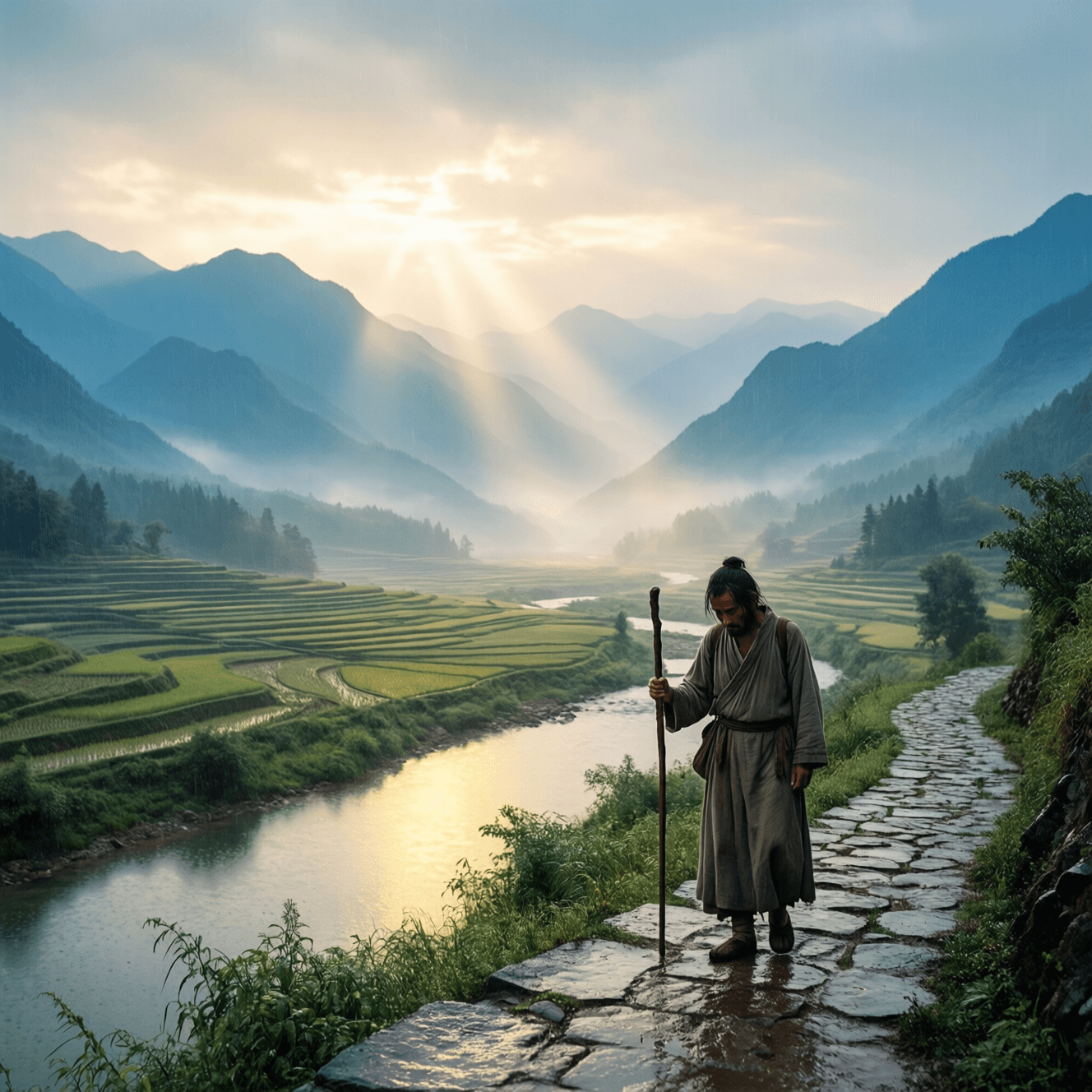
Know its honor, keep its disgrace, and be the valley of the world. -- Laozi
—What lingers after this line?
Reading Laozi’s Three-Part Instruction
Laozi’s line—“Know its honor, keep its disgrace, and be the valley of the world”—unfolds like a short spiritual method. First, it asks for clear recognition of “honor,” meaning the visible standards of success, status, and virtue that societies prize. Next, it reverses our instinct by urging us to “keep” or hold close what we usually avoid: “disgrace,” the low position where blame, misunderstanding, and imperfection collect. From there, the final image resolves the tension: become “the valley of the world.” In the Tao Te Ching (traditionally dated around the 4th–3rd century BCE), valleys symbolize receptive power—the ability to receive waters, nourish life, and remain useful precisely because they do not compete with mountains.
Knowing Honor Without Being Ruled by It
To “know” honor is not to chase it blindly, but to understand how it functions. Honor organizes communities, sets expectations, and can guide excellence; ignoring it entirely can become naïve or irresponsible. Laozi’s point, however, is that honor is unstable: praise rises and falls with fashion, politics, and group mood. Therefore, awareness becomes a form of freedom. A leader or citizen can respect what a culture celebrates—courage, fairness, competence—without turning identity into a performance for applause. This transition from craving approval to simply understanding it prepares the mind for the harder step: willingly carrying what others reject.
Keeping Disgrace as a Practice of Non-Defensiveness
“Keep its disgrace” sounds like an invitation to humiliation, yet it can be read as training in non-defensiveness. Instead of spending life protecting an immaculate image, one learns to tolerate being misread, criticized, or overlooked. In practical terms, this might resemble the colleague who accepts a blunt correction without counterattacking, or the public servant who absorbs complaints while steadily improving a system. As the Tao Te Ching repeatedly suggests, softness can outlast hardness. By holding disgrace without panic, a person gains room to respond rather than react. That steadiness, in turn, makes the final metaphor—becoming a valley—more than poetry: it becomes a posture.
The Valley as Receptive Strength
A valley does not dominate; it gathers. Water runs downhill, not because the valley is weak, but because it is positioned to receive. Laozi often uses water as a model of the Dao: adaptive, persistent, and effective without self-advertisement. In this light, “be the valley of the world” points to a kind of strength that comes from making space for others. This has social consequences. The “valley” person listens more than they broadcast, can hold conflicting views without forcing immediate victory, and becomes trustworthy because they are not fighting to be seen as superior. What looks like lowliness becomes a quiet form of leadership.
A Political Ethic: Leading by Lowering Oneself
Moving from personal character to governance, Laozi’s counsel also fits a political ethic. In Taoist thought, rulers who display their power loudly often provoke resistance, whereas rulers who keep a low profile create conditions where people feel less coerced. The Tao Te Ching frames ideal rule as minimal, responsive, and non-grasping—closer to tending a landscape than commanding an army. Here, “honor” is the prestige of office, while “disgrace” is the willingness to bear blame and remain accountable. The valley metaphor implies that good leadership receives the burdens of the community—conflicts, needs, anxieties—and channels them toward stability, rather than redirecting everything upward into personal glory.
Integrating the Paradox in Daily Life
Taken together, the phrase offers a way to live inside paradox without splitting in two. You can understand honor—do excellent work, respect standards, fulfill roles—while also keeping disgrace—accepting limitation, criticism, and anonymity. Instead of alternating between pride and shame, Laozi points toward a steadier center. In daily life, this might look like choosing the unglamorous task that helps the group, apologizing quickly when wrong, or giving others credit without fearing you will disappear. Over time, the “valley of the world” becomes not a place of defeat, but a place of nourishment: the low ground where the real work of life collects and, quietly, renews everything above it.
One-minute reflection
What feeling does this quote bring up for you?
Related Quotes
6 selectedBe startled by favor and disgrace; value great trouble as you value your own body. - Laozi
Laozi
Laozi’s line from the Taoist tradition, often associated with the Tao Te Ching, jolts ordinary priorities: instead of chasing honor and fleeing hardship, we are told to be “startled” by both favor and disgrace, and to tr...
Read full interpretation →When gold and jade fill the halls, no one can guard them; to be rich and proud is to bring misfortune upon oneself. When achievement is complete, withdraw from the body—this is the way of Heaven. - Laozi
Laozi
Laozi’s image of gold and jade overflowing in great halls first evokes material splendor, yet immediately exposes its hidden weakness: such abundance cannot truly be protected. As wealth accumulates, so too does envy, th...
Read full interpretation →The highest good is like water. Water benefits all things and does not contend; it dwells in places that people disdain, and thus is close to the Dao. - Laozi
Laozi
Laozi’s line distills Chapter 8 of the Daodejing: the highest good is like water—nourishing, impartial, and quietly effective. Water benefits all things, yet does not compete; it seeks low places others avoid, and in doi...
Read full interpretation →I'm a firm believer in quiet confidence. By that I mean knowing inwardly that you are good, and not exhibiting a boastful attitude outwardly. — Dick Van Arsdale
Dick Van Arsdale
Dick Van Arsdale’s reflection begins by separating confidence from performance. In his view, real self-assurance is an inward condition: you know your worth, your ability, and your character without needing to advertise...
Read full interpretation →The more you know, the more you realize you haven't done. You just have to keep working. — Hayao Miyazaki
Hayao Miyazaki
At first glance, Miyazaki’s remark sounds humbling, even severe, yet its logic is deeply creative: the more a person learns, the wider the unfinished landscape becomes. Knowledge does not simply provide answers; rather,...
Read full interpretation →Never call yourself a philosopher; show it. — Epictetus
Epictetus
Epictetus compresses an entire ethical program into a sharp command: do not claim the title, demonstrate the life. In other words, wisdom is not a badge one pins on oneself but a pattern others can recognize in conduct.
Read full interpretation →More From Author
More from Laozi →Few words accord with nature; therefore a whirlwind does not last all morning, and a sudden rain does not last all day. -- Laozi
Laozi begins with a simple observation: even nature’s fiercest displays are temporary. A whirlwind burns itself out, and a sudden downpour cannot sustain its intensity for long.
Read full interpretation →Humans follow Earth, Earth follows Heaven, Heaven follows the Dao, and the Dao follows what is natural. -- Laozi
Laozi sketches a chain of influence that moves upward from human life to the widest patterns of reality: humans take cues from Earth, Earth from Heaven, Heaven from the Dao, and the Dao from what is natural. Rather than...
Read full interpretation →Those who know others are wise; those who know themselves are enlightened. Those who defeat others have strength; those who defeat themselves are strong. -- Laozi
Laozi opens by placing “knowing others” and “knowing oneself” side by side, as if they were neighboring skills that lead to very different destinations. Understanding other people—reading motives, predicting reactions, n...
Read full interpretation →Few words accord with nature; thus a whirlwind does not last all morning, and a torrential rain does not last all day. -- Laozi
Laozi begins with ordinary observations—wind and rain—to make an uncommonly durable point: extremes, however overwhelming they feel, are brief by nature. A whirlwind cannot sustain itself through the morning, and a downp...
Read full interpretation →