
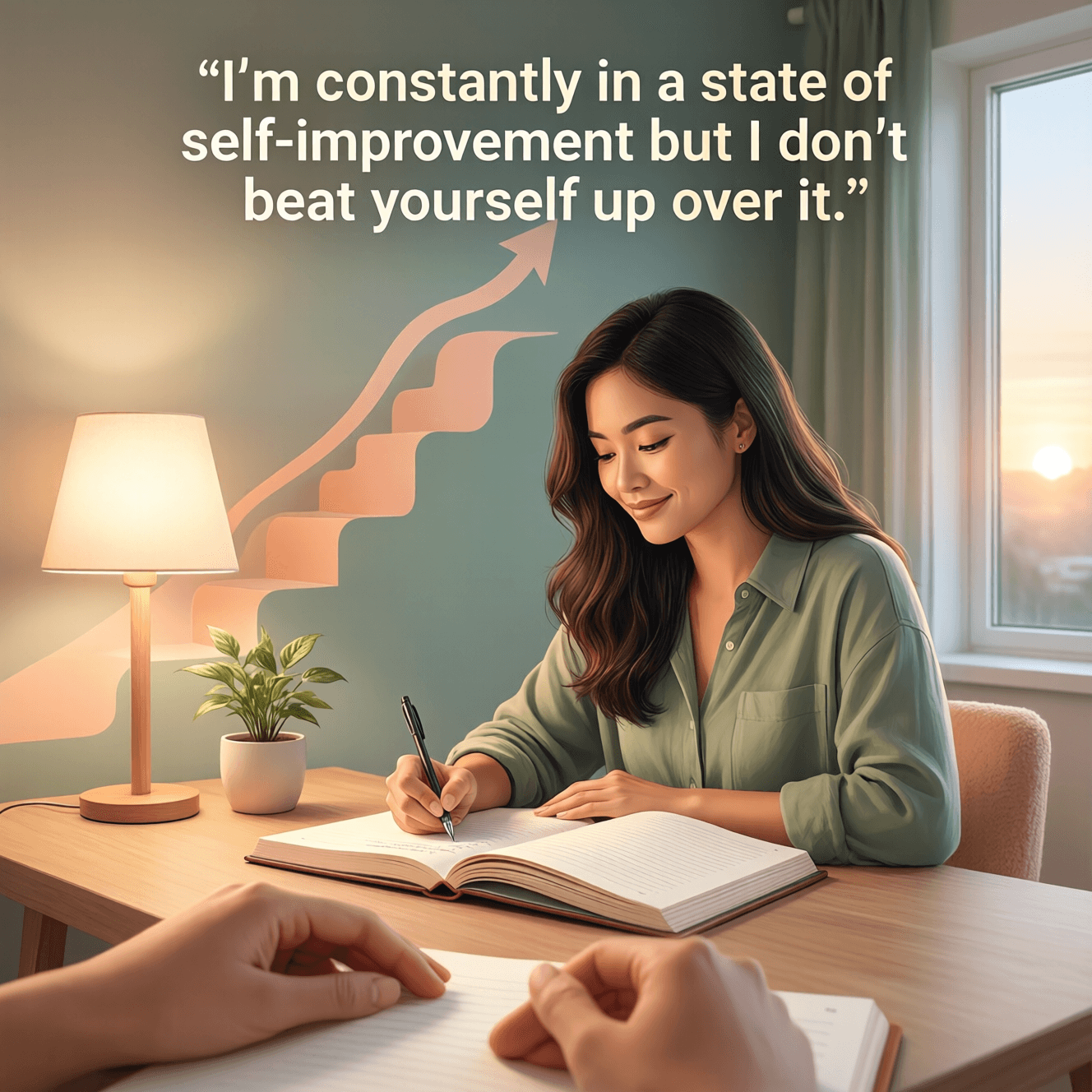
I'm constantly in a state of self-improvement but I don't beat myself up over it. — Mindy Kaling
—What lingers after this line?
A Growth Mindset, Minus the Guilt
Mindy Kaling’s line captures a modern ideal: keep evolving, but refuse to turn the process into a courtroom where you are both defendant and judge. Self-improvement here is not an emergency response to being “not enough,” but an ongoing practice—more like daily hygiene than moral failure. This framing matters because many people confuse ambition with self-criticism. By separating the desire to get better from the impulse to self-attack, Kaling suggests you can be motivated by curiosity and possibility rather than fear and inadequacy.
The Difference Between Discipline and Self-Flagellation
Building on that, the quote distinguishes constructive discipline from self-punishment. Discipline asks, “What’s the next helpful step?” whereas self-flagellation asks, “What’s wrong with me?” The first produces plans; the second produces spirals. In practice, this can look like reviewing a mistake the way a coach would—specific, actionable, forward-facing—rather than replaying it for emotional penance. Kaling’s tone implies that improvement is compatible with kindness, and that harshness is not a prerequisite for high standards.
Self-Compassion as a Performance Strategy
From there, the quote aligns with research on self-compassion as a tool for resilience rather than indulgence. Kristin Neff’s work on self-compassion (e.g., *Self-Compassion*, 2011) argues that treating yourself with warmth during setbacks can reduce shame and support healthier persistence. Seen this way, not “beating yourself up” is pragmatic: shame tends to narrow attention and encourage avoidance, while compassion makes it easier to face feedback honestly. Kaling’s approach implies that the most sustainable self-improvement runs on encouragement, not intimidation.
Progress Through Iteration, Not Reinvention
Next, “constantly” suggests small, continuous upgrades rather than dramatic overhauls. This echoes the logic of incremental improvement often associated with Kaizen practices in business culture, where tiny changes compound over time. Instead of reinventing your identity every January, the quote favors iterative refinement: adjust a habit, strengthen a skill, revise a boundary, repeat. The emotional benefit is that your current self is not discarded; it becomes the foundation for the next version.
Keeping Standards While Staying on Your Side
Finally, Kaling’s statement models a balanced inner relationship: you can hold yourself accountable while still being your ally. Accountability sets direction—deadlines, feedback, practice—while self-respect keeps the journey livable. In a culture that often romanticizes burnout and harsh self-talk as proof of seriousness, this quote offers a quieter credibility: you’re allowed to want more and still like yourself now. The endpoint isn’t perfection; it’s forward motion with dignity intact.
One-minute reflection
What feeling does this quote bring up for you?
Related Quotes
6 selectedLearning to love yourself is like learning to walk – essential, life-changing, and the only way to stand tall. — Vironika Tugaleva
Vironika Tugaleva
Vironika Tugaleva’s comparison begins with a simple but powerful truth: self-love is not a luxury, but a basic human necessity. Just as walking allows a child to move through the world with growing independence, learning...
Read full interpretation →Recovery is not a race. You don't have to feel guilty if it takes you longer than you thought it would. — Anne Lamott
Anne Lamott
Anne Lamott’s reminder begins by challenging one of the quiet cruelties of recovery: the belief that healing should follow a predictable schedule. Whether the wound is physical, emotional, or spiritual, people often comp...
Read full interpretation →Confidence is not arrogance; it is the natural outcome of self-compassion. — Kristin Neff
Kristin Neff
Kristin Neff’s statement begins by separating two qualities often confused: confidence and arrogance. Arrogance tries to stand above others, while confidence rests on an inward steadiness that does not require comparison...
Read full interpretation →The most gifted members of the human species are at their creative best when they cannot have their way, and must compensate for what they miss by realizing and cultivating their capacities. — Bryant H. McGill
Bryant H. McGill
Bryant H. McGill’s observation begins with a striking reversal: gifted people may not reach their highest potential when everything comes easily, but when something blocks their path.
Read full interpretation →A mind grows by staying with difficulty long enough for the experience to change it. — Mary Catherine Bateson
Mary Catherine Bateson
Mary Catherine Bateson’s observation begins with a quiet but demanding truth: the mind does not grow merely by encountering difficulty, but by remaining with it. Challenge becomes transformative only when we resist the u...
Read full interpretation →Consistency is a superpower. — Ryan Holiday
Ryan Holiday
Ryan Holiday’s line begins with a deceptively simple idea: greatness is rarely built through dramatic gestures. More often, it emerges from repeated actions that seem ordinary in isolation but become extraordinary over t...
Read full interpretation →More From Author
More from Mindy Kaling →Gratitude is the closest thing to beauty manifested in an emotion. — Mindy Kaling
At first glance, Mindy Kaling’s line suggests that beauty is not only something we see but something we feel. Gratitude becomes a kind of inward radiance, transforming an ordinary emotional response into something almost...
Read full interpretation →Write your own part. It's the only way to get exactly what you want. — Mindy Kaling
Mindy Kaling’s advice reads like a simple directive, but it carries a larger philosophy: if you want a role that truly fits you, you may have to create it. Rather than waiting for permission or perfect circumstances, she...
Read full interpretation →If you don't see a clear path for a career, sometimes you have to make it yourself. — Mindy Kaling
Mindy Kaling’s line begins with a candid observation: not everyone is handed a clear career roadmap. In many fields, the “path” is more myth than method—job titles are ambiguous, internships are scarce, and the steps fro...
Read full interpretation →Confidence is just entitlement. Entitlement has a bad rap, but it's just the belief that you should be there. — Mindy Kaling
Mindy Kaling’s line starts by deliberately colliding two concepts that usually live on opposite sides of a moral judgment: confidence and entitlement. Because “entitlement” often evokes arrogance or unearned demands, the...
Read full interpretation →