
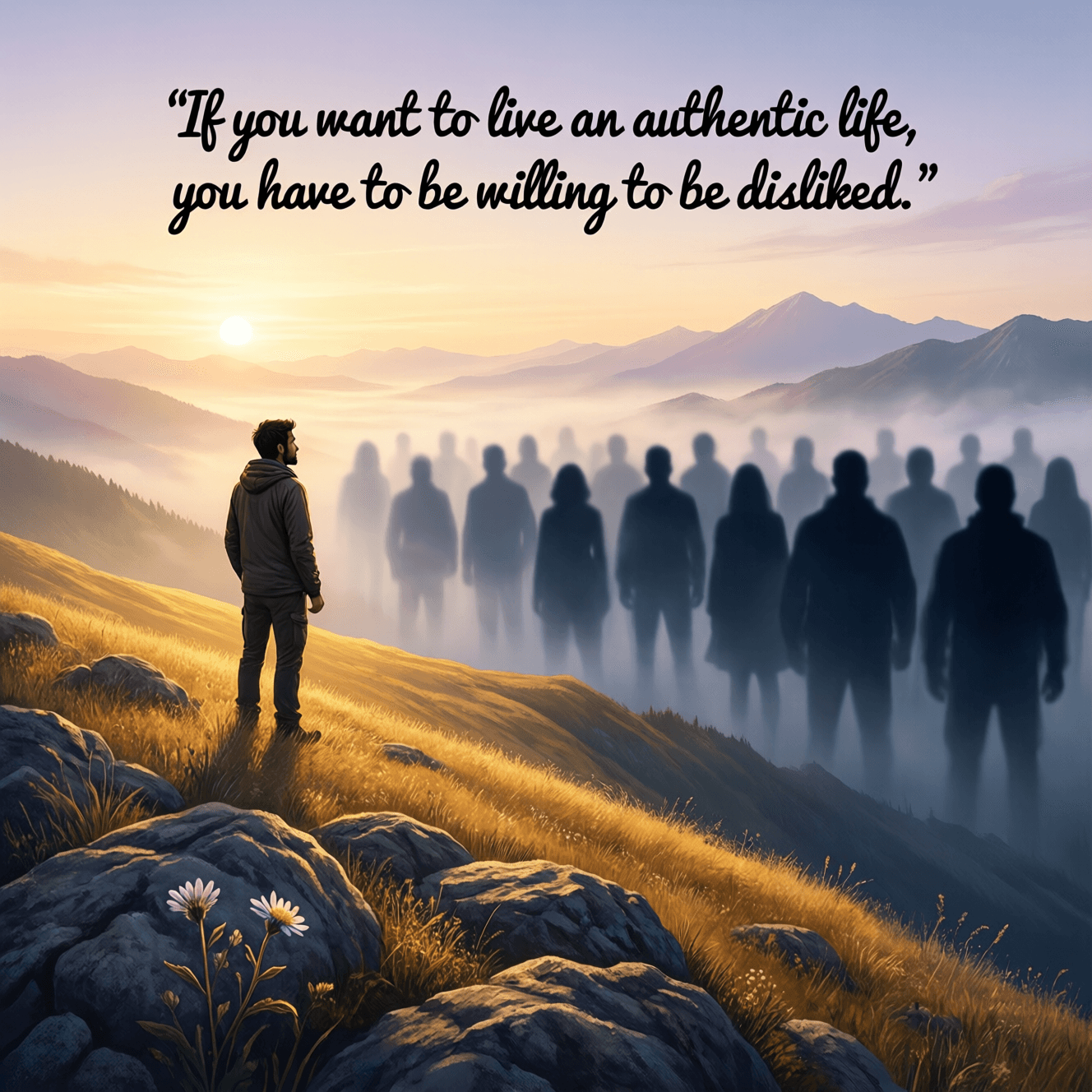
If you want to live an authentic life, you have to be willing to be disliked. — Ichiro Kishimi
—What lingers after this line?
Why Authenticity Has a Social Cost
Ichiro Kishimi’s line compresses a hard truth: authenticity isn’t just self-expression; it’s a decision to stop managing other people’s impressions. The moment your choices reflect your values rather than your audience’s expectations, you inevitably disappoint someone—because preferences and priorities differ, and no single life can satisfy every onlooker. This is why being “liked” often becomes an invisible contract: you stay predictable, agreeable, and easy to approve of, and in return you receive acceptance. Kishimi suggests that an authentic life breaks that contract, not out of arrogance, but out of fidelity to one’s own convictions.
Approval-Seeking as a Hidden Lifestyle
Once you notice it, approval-seeking appears everywhere: saying yes when you mean no, softening beliefs to avoid friction, or choosing “safe” goals that earn praise. These habits can look like kindness, yet they frequently function as self-protection—a way to avoid the discomfort of rejection. From there, a subtle trade-off emerges. The more your identity depends on applause, the more your decisions become negotiated performances. Kishimi’s point pushes the reader to ask whether harmony is being purchased at the price of self-betrayal, and whether peace built on concealment is peace at all.
Adlerian Roots: Separating Tasks
Kishimi is widely associated with Adlerian psychology through Ichiro Kishimi and Fumitake Koga’s The Courage to Be Disliked (2013), which emphasizes “separating tasks”—distinguishing what belongs to you (your choices, effort, values) from what belongs to others (their judgments, feelings, reactions). This framework makes the quote more practical than inspirational. In that light, being disliked is not the goal; it is collateral. When you stop trying to control other people’s evaluations, you free yourself to focus on your own responsibilities, accepting that disapproval is part of living in a world where everyone has their own standards.
Boundaries: The Mechanics of Being Disliked
The quickest way to test this idea is to set a boundary. Decline an invitation, renegotiate a workload, or state a preference plainly, and you may meet disappointment or irritation. That reaction can feel like failure if you equate love with agreement, but it may simply be evidence that you are no longer overfunctioning for others. As a result, authenticity often looks ordinary rather than dramatic: a calm “I can’t,” an unembellished “I don’t want that,” or a refusal to offer a long defense. In many relationships, the first honest boundary changes the emotional economy—and some people will dislike losing the benefits of your constant compliance.
Authenticity Versus Antagonism
Still, Kishimi’s claim isn’t permission to be harsh. Authenticity without care can become self-justifying bluntness, where “I’m just being real” excuses needless damage. The deeper challenge is to hold both truths: you can act from your values while remaining respectful and humane. This distinction matters because being disliked can come from integrity or from inconsideration. The quote points to integrity—accepting the discomfort of honest living—while implying that relational maturity involves communicating clearly, apologizing when appropriate, and recognizing that authenticity is not the same as refusing feedback.
What You Gain When You Stop Performing
Over time, the willingness to be disliked clarifies your life. Decisions become less tangled in guesswork about others’ reactions, and relationships become more truthful: those who remain are responding to the real you rather than to a curated version built for approval. Finally, this courage creates a steadier self-respect. Even when others disagree, you can feel internally aligned, because your life is being authored from within. In Kishimi’s framing, that alignment is the core of authentic living—accepting that disapproval may be unavoidable, but self-abandonment is optional.
One-minute reflection
What feeling does this quote bring up for you?
Related Quotes
6 selectedIf you want to live an authentic life, you have to be willing to disappoint people. — Nedra Glover Tawwab
Nedra Glover Tawwab
Nedra Glover Tawwab’s line captures an uncomfortable truth: living authentically often means choosing your values over other people’s preferences. Because families, workplaces, and friendships rely on implicit agreements...
Read full interpretation →There is a quiet power in the ability to simply be, to exist without the need for constant performance. — Eileen Caddy
Eileen Caddy
Eileen Caddy’s words begin with a gentle challenge to modern restlessness: we often feel compelled to prove our worth through productivity, charm, achievement, or constant visibility. Yet her phrase “quiet power” suggest...
Read full interpretation →To be courageous is to act with the heart. — Molière
Molière
Molière’s line suggests that courage is not merely the absence of fear, but the decision to move despite it. By connecting courage with the heart, he frames bravery as an emotional and moral act rather than a simple disp...
Read full interpretation →Be who you are and say what you feel, because those who mind don't matter, and those who matter don't mind. — Bernard M. Baruch
Bernard M. Baruch
Baruch’s quote begins with a simple but demanding instruction: be yourself and speak honestly. At its core, the line argues that authenticity is not merely a personality trait but an act of courage, especially in a world...
Read full interpretation →The best people possess a feeling for beauty, the courage to take risks, the discipline to tell the truth, the capacity for sacrifice. — Ernest Hemingway
Ernest Hemingway
Hemingway’s line presents goodness not as politeness or success, but as a demanding inner code. The “best people” are those who combine sensitivity, bravery, honesty, and self-denial—qualities that do not always coexist...
Read full interpretation →If you are not willing to look stupid, nothing great is ever going to happen to you. — Julia Cameron
Julia Cameron
Julia Cameron’s remark begins with a hard truth: many people do not fail because they lack talent, but because they fear embarrassment. In that sense, ‘looking stupid’ becomes shorthand for being seen trying, stumbling,...
Read full interpretation →More From Author
More from Ichiro Kishimi →