
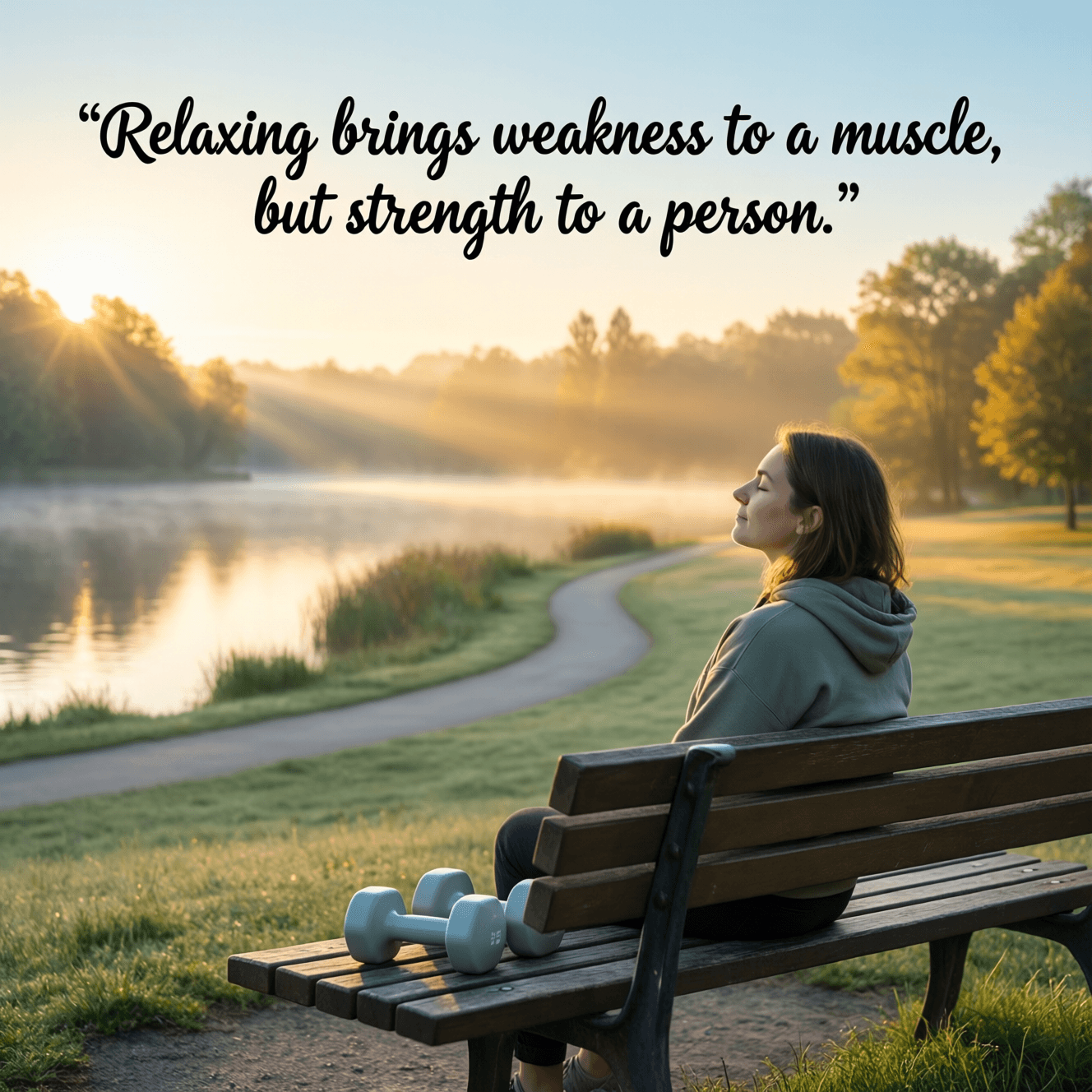
Relaxing brings weakness to a muscle, but strength to a person. — Mokokoma Mokhonoana
—What lingers after this line?
A Deliberate Paradox
Mokokoma Mokhonoana frames relaxation as a paradox: what looks like decline in one domain can be growth in another. A resting muscle may lose a bit of conditioning, yet the person behind the muscle can gain clarity, patience, and resilience. In other words, the quote separates raw physical output from the broader human capacity to endure and recover. This distinction matters because we often treat constant exertion as a universal virtue. However, the body and the mind operate on different clocks. The muscle responds to load and adaptation, while the person responds to meaning, stress, and restoration—so “doing less” can sometimes produce “being more.”
What Happens to an Idle Muscle
Physically, the statement nods to a real principle: without use, muscle can weaken through deconditioning and atrophy. Medicine describes this plainly—extended inactivity, such as bed rest or immobilization, reduces strength and muscle size over time, and even aerobic capacity declines (NASA’s research on microgravity and disuse frequently documents these effects). Yet the quote doesn’t romanticize weakness; it simply locates it. Muscle strength is highly specific and somewhat “use it or lose it,” which is why athletes train consistently. But this sets up the larger point: if muscle can’t be pushed forever without consequence, then neither can the whole person.
Rest as Human Strength-Building
Transitioning from physiology to psychology, relaxation can strengthen a person by restoring self-control and emotional balance. Stress narrows attention and increases reactivity, whereas periods of calm improve perspective and decision quality. Even ancient reflections echo this: Aristotle’s *Nicomachean Ethics* (c. 350 BC) treats the good life as more than labor, implying that leisure and contemplation are part of human flourishing. In practical terms, someone who pauses before responding—taking a walk, breathing, sleeping on a decision—often returns steadier. The “strength” here is not force production, but the capacity to respond rather than react.
Recovery Is Where Adaptation Happens
Then comes the bridging insight: muscles themselves ultimately get stronger during recovery, not during exertion. Strength training tears down tissue and stresses systems; rest and nutrition rebuild them. Exercise science repeatedly emphasizes this cycle, and sleep research links adequate sleep to better physical performance and cognitive functioning. So the quote can be read as a warning against confusing strain with progress. A person who never relaxes may keep moving while quietly breaking down. By contrast, someone who schedules recovery—whether through sleep, downtime, or light activity—often becomes more capable over time, even if a single resting day looks like “less effort.”
Identity Beyond Productivity
Moreover, Mokhonoana’s line critiques a culture that measures worth only through output. If you treat yourself like a machine, relaxation feels like failure; if you treat yourself like a human, relaxation becomes maintenance—and sometimes medicine. This is why a burnt-out student may find their best ideas arrive after stepping away, or why a grieving person may need quiet before they can function again. The person is not identical to their “muscle”—not identical to performance. Relaxation strengthens the deeper layers: self-knowledge, creativity, empathy, and the ability to keep going over the long arc rather than the short sprint.
A Practical Balance: Train, Then Unclench
Finally, the quote implies balance rather than an excuse for permanent inactivity. Too much rest can weaken both body and spirit, but purposeful relaxation—paired with purposeful effort—creates durability. A simple pattern illustrates it: train with intensity, recover with intention, and return with renewed capacity. In everyday life, this might mean taking real breaks, protecting sleep, and allowing guilt-free leisure, while still honoring movement and challenge. The muscle may briefly soften when it rests, but the person—more regulated, more centered, and more sustainable—often returns stronger.
One-minute reflection
What does this quote ask you to notice today?
Related Quotes
6 selectedRelaxing brings weakness, when done by a muscle; but brings strength, when done by a person. — Mokokoma Mokhonoana
Mokokoma Mokhonoana
Mokokoma Mokhonoana frames relaxation as a paradox: the same act can degrade a muscle while renewing a person. The line works because it forces a distinction between a body part governed by simple use-and-adaptation rule...
Read full interpretation →When I hear somebody sigh, 'Life is hard,' I am always tempted to ask, 'Compared to what?' — Sydney J. Harris
Sydney J. Harris
Sydney J. Harris’s remark begins with an ordinary expression of fatigue: “Life is hard.” Yet his response, “Compared to what?” quietly turns complaint into inquiry.
Read full interpretation →Don't fight the challenges. Just find a new way to stand. — Germany Kent
Germany Kent
Germany Kent’s words begin with a quiet reversal of instinct: instead of treating every challenge as an enemy to defeat, she invites us to reconsider our posture toward difficulty. The emphasis is not on surrender, but o...
Read full interpretation →Relaxing brings weakness to a muscle, but strength to a person. — Mokokoma Mokhonoana
Mokokoma Mokhonoana
Mokokoma Mokhonoana frames relaxation as a paradox: it can diminish a muscle’s capacity while improving a person’s resilience. At first glance, this sounds like a simple warning against inactivity, yet the quote is more...
Read full interpretation →Optimist: someone who figures that taking a step backward after taking a step forward is not a disaster, it's more like a cha-cha. — Robert Brault
Robert Brault
Robert Brault’s line begins with a witty redefinition: an optimist is not someone who denies backward motion, but someone who interprets it differently. Instead of treating a setback as proof of failure, the optimist see...
Read full interpretation →A mind grows by staying with difficulty long enough for the experience to change it. — Mary Catherine Bateson
Mary Catherine Bateson
Mary Catherine Bateson’s observation begins with a quiet but demanding truth: the mind does not grow merely by encountering difficulty, but by remaining with it. Challenge becomes transformative only when we resist the u...
Read full interpretation →More From Author
More from Mokokoma Mokhonoana →People can't drive you crazy if you don't give them the keys. — Mokokoma Mokhonoana
At first glance, Mokokoma Mokhonoana’s line turns emotional distress into a vivid image: other people can only ‘drive’ you crazy if you hand over the keys. The metaphor suggests that influence is not always forced upon u...
Read full interpretation →Relaxing brings weakness, when done by a muscle; but brings strength, when done by a person. — Mokokoma Mokhonoana
Mokokoma Mokhonoana frames relaxation as a paradox: the same act can degrade a muscle while renewing a person. The line works because it forces a distinction between a body part governed by simple use-and-adaptation rule...
Read full interpretation →Relaxing brings weakness to a muscle, but strength to a person. — Mokokoma Mokhonoana
Mokokoma Mokhonoana frames relaxation as a paradox: it can diminish a muscle’s capacity while improving a person’s resilience. At first glance, this sounds like a simple warning against inactivity, yet the quote is more...
Read full interpretation →The wise rest at least as hard as they work. — Mokokoma Mokhonoana
Mokokoma Mokhonoana’s line reframes wisdom as something more practical than intelligence or ambition: the wise treat rest with the same seriousness they give to effort. Rather than seeing downtime as a reward for finishi...
Read full interpretation →