
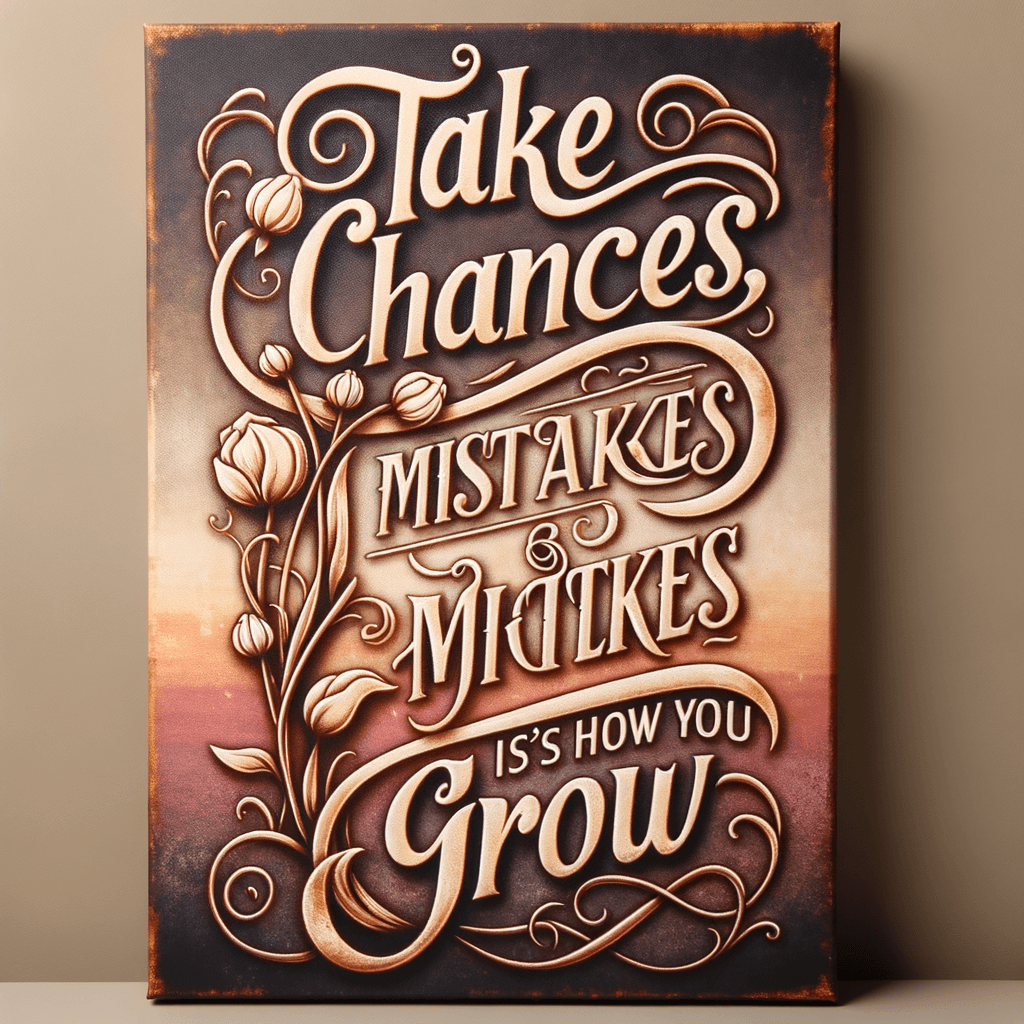
Take chances, make mistakes. That's how you grow. — Mary Tyler Moore
—What lingers after this line?
Embracing Risk
This quote encourages individuals to embrace risk-taking as a fundamental part of personal development. It suggests that stepping outside of one's comfort zone can lead to new experiences and insights.
Learning Through Experience
Making mistakes is presented as a vital component of the learning process. Each error offers valuable lessons that contribute to growth and understanding, making mistakes a necessary aspect of success.
Resilience and Adaptability
Taking chances and facing the reality of making mistakes builds resilience. The ability to bounce back and adapt after setbacks is crucial for personal and professional growth.
Positive Mindset about Failure
The quote reflects a positive attitude towards failure, suggesting that it should not be feared but rather embraced as an opportunity for improvement and innovation.
Influence of Mary Tyler Moore
Mary Tyler Moore was a renowned actress and producer known for her groundbreaking work in television. Her career was marked by her ability to challenge societal norms, and this quote encapsulates her belief in the importance of courage in the face of uncertainty.
One-minute reflection
Where does this idea show up in your life right now?
Related Quotes
6 selectedThe most gifted members of the human species are at their creative best when they cannot have their way, and must compensate for what they miss by realizing and cultivating their capacities. — Bryant H. McGill
Bryant H. McGill
Bryant H. McGill’s observation begins with a striking reversal: gifted people may not reach their highest potential when everything comes easily, but when something blocks their path.
Read full interpretation →You can’t be brave if you’ve only had wonderful things happen to you. — Mary Tyler Moore
Mary Tyler Moore
This quote suggests that bravery is demonstrated through overcoming challenges and adversity. If life only presents ease and pleasant circumstances, there is no opportunity to show courage.
Read full interpretation →A mind grows by staying with difficulty long enough for the experience to change it. — Mary Catherine Bateson
Mary Catherine Bateson
Mary Catherine Bateson’s observation begins with a quiet but demanding truth: the mind does not grow merely by encountering difficulty, but by remaining with it. Challenge becomes transformative only when we resist the u...
Read full interpretation →Consistency is a superpower. — Ryan Holiday
Ryan Holiday
Ryan Holiday’s line begins with a deceptively simple idea: greatness is rarely built through dramatic gestures. More often, it emerges from repeated actions that seem ordinary in isolation but become extraordinary over t...
Read full interpretation →Confidence is silent. Insecurities are loud. — Unknown (Wait—skip/replace with: True nobility is being superior to your former self. — Ernest Hemingway)
Ernest Hemingway
At its core, Hemingway’s line redefines nobility as an inward achievement rather than a social rank. Instead of measuring worth by wealth, pedigree, or dominance over others, it points to a quieter standard: becoming bet...
Read full interpretation →You can be cautious or you can be creative, but there's no such thing as a cautious creative. — George Lois
George Lois
George Lois draws a sharp line between two mindsets: caution protects what already exists, while creativity risks making something new. At first glance, the statement sounds absolute, yet that severity is exactly its poi...
Read full interpretation →More From Author
More from Mary Tyler Moore →