
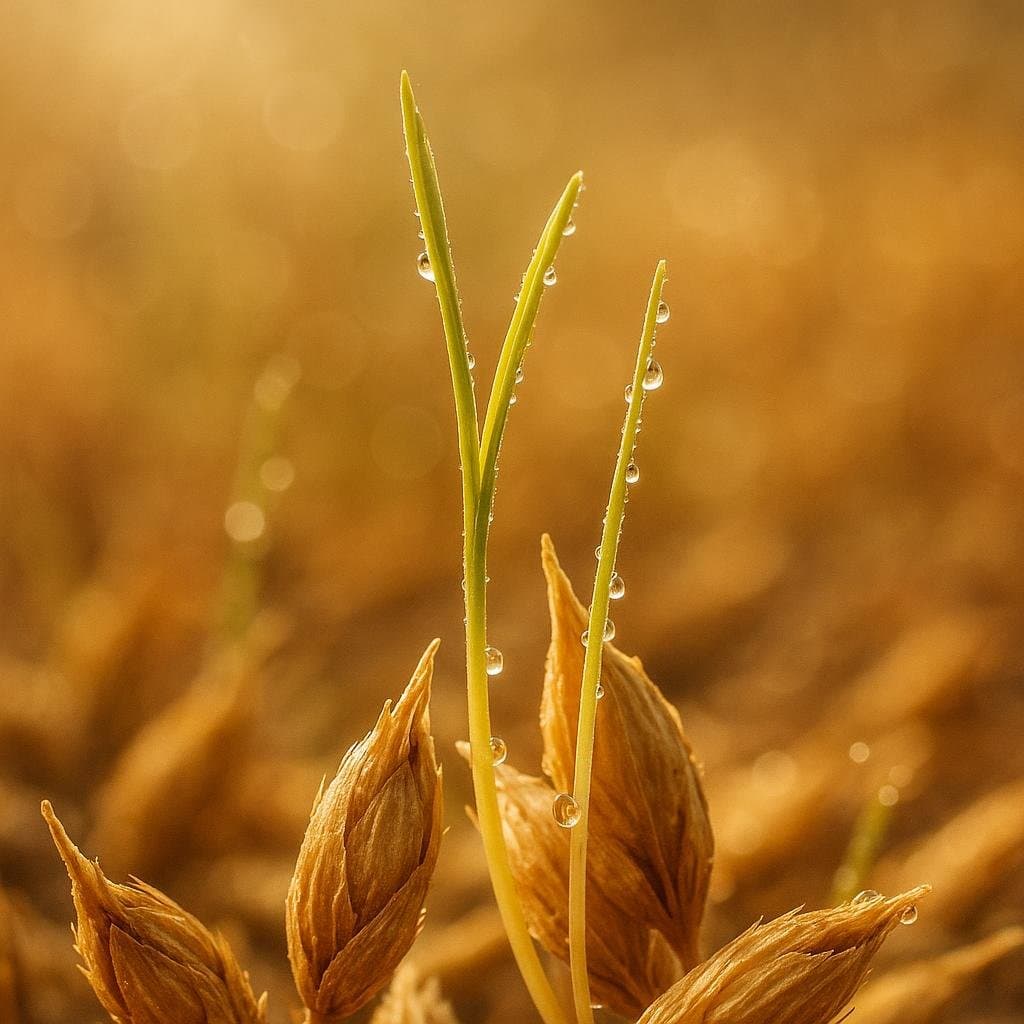
The grain must grow amid the husks. — African Proverb
—What lingers after this line?
Understanding the Proverb’s Imagery
At its core, the African proverb 'The grain must grow amid the husks' draws a vivid parallel between agriculture and personal development. Just as the delicate seed matures encased within protective husks, individuals and ideas also evolve surrounded by external influences or constraints. The proverb encapsulates the necessity of growing not in isolation, but within the very environments that both nurture and challenge us.
The Role of Adversity in Progress
Delving deeper, the proverb acknowledges that growth often requires contending with obstacles. The husks, representing barriers or circumstances, are not merely impediments but essential companions in the journey toward maturity. This perspective brings to mind James Baldwin’s assertion that ‘not everything that is faced can be changed, but nothing can be changed until it is faced,’ suggesting that our surroundings and struggles provide indispensable context for our advancement.
Community and Individual Flourishing
Furthermore, the proverb subtly emphasizes the role of community and environment in fostering growth. Just as the grain relies on its husk for protection until it is strong enough to stand alone, people depend on family, mentors, and cultural frameworks to cultivate their potential. In Chinua Achebe’s ‘Things Fall Apart’ (1958), the protagonist Okonkwo’s journey is intricately shaped by both supportive traditions and rigid societal expectations, illustrating this dynamic interplay.
Balancing Protection and Release
Transitioning from nurture to independence, the proverb hints at the inevitable yet gradual shedding of protective layers. The grain’s eventual emergence parallels the moment when individuals step beyond comfort zones, ready to pursue their purpose. This process of letting go is reminiscent of rites of passage found across African societies, where youth transition into adulthood through both guidance and the challenge of autonomy.
A Universal Lesson in Resilience
Ultimately, 'The grain must grow amid the husks' delivers a timeless message: growth is inextricably linked to resilience amid one’s context. Whether facing challenges or drawing strength from one’s community, true maturity arises not despite, but because of, the environment that surrounds us. In a globalized world where change is constant, this proverb reminds us to see every circumstance as fertile ground for personal and collective transformation.
One-minute reflection
What feeling does this quote bring up for you?
Related Quotes
6 selectedWhen the roots are deep, there is no reason to fear the wind. — African Proverb
African Proverb
The proverb frames life as weather and character as a tree: when roots run deep, wind becomes something to endure rather than something to dread. In that image, fear is not denied so much as put in its place—storms still...
Read full interpretation →We are gardeners of our own resilience, tending to the soil of our minds with the quiet, persistent care that growth requires. — Robin Wall Kimmerer
Robin Wall Kimmerer
Robin Wall Kimmerer’s image begins by turning resilience into something living rather than fixed. Instead of portraying strength as hard armor, she imagines it as a garden that must be tended, suggesting that the mind is...
Read full interpretation →Everything that is great in life is the product of slow growth; the newer, and greater, and higher, and nobler the work, the slower is its growth. — William George Jordan
William George Jordan
William George Jordan’s reflection begins with a quiet but demanding truth: the most meaningful achievements rarely arrive quickly. He suggests that greatness is not manufactured in sudden bursts but cultivated through t...
Read full interpretation →A mind grows by staying with difficulty long enough for the experience to change it. — Mary Catherine Bateson
Mary Catherine Bateson
Mary Catherine Bateson’s observation begins with a quiet but demanding truth: the mind does not grow merely by encountering difficulty, but by remaining with it. Challenge becomes transformative only when we resist the u...
Read full interpretation →When you are friends with your storm, you dance, instead of getting blown away. — Michael Bassey Johnson
Michael Bassey Johnson
Michael Bassey Johnson’s line begins with a striking reversal: the storm is not merely an enemy to survive, but a force one can learn to understand. In this sense, the storm may represent grief, fear, conflict, uncertain...
Read full interpretation →We are powerful because we have survived, and that is what it is all about—survival and growth. — Audre Lorde
Audre Lorde
At its core, Audre Lorde’s statement redefines power not as domination, status, or control, but as the hard-won strength that comes from continuing despite adversity. To survive is already to have resisted erasure, and L...
Read full interpretation →More From Author
More from African Proverb →When the roots are deep, there is no reason to fear the wind. — African Proverb
The proverb frames life as weather and character as a tree: when roots run deep, wind becomes something to endure rather than something to dread. In that image, fear is not denied so much as put in its place—storms still...
Read full interpretation →The closer one comes to truth, the simpler everything becomes. — African Proverb
The proverb suggests that truth has a clarifying power: as you approach what is real, the extra clutter—misdirection, anxiety, and needless complication—falls away. In other words, complexity often signals that we are st...
Read full interpretation →The sun does not hurry to rise, yet it never misses its mark. — African Proverb
The proverb begins with an image so familiar it’s easy to overlook: sunrise. The sun appears without strain, without haste, and without visible anxiety about being “on time.” And yet, day after day, it arrives.
Read full interpretation →Do not look where you fell, but where you slipped. — African Proverb
The proverb urges a subtle but powerful change in attention: don’t fixate on the place where you landed in pain or embarrassment; instead, examine the moment your footing first failed. In other words, the visible setback...
Read full interpretation →