
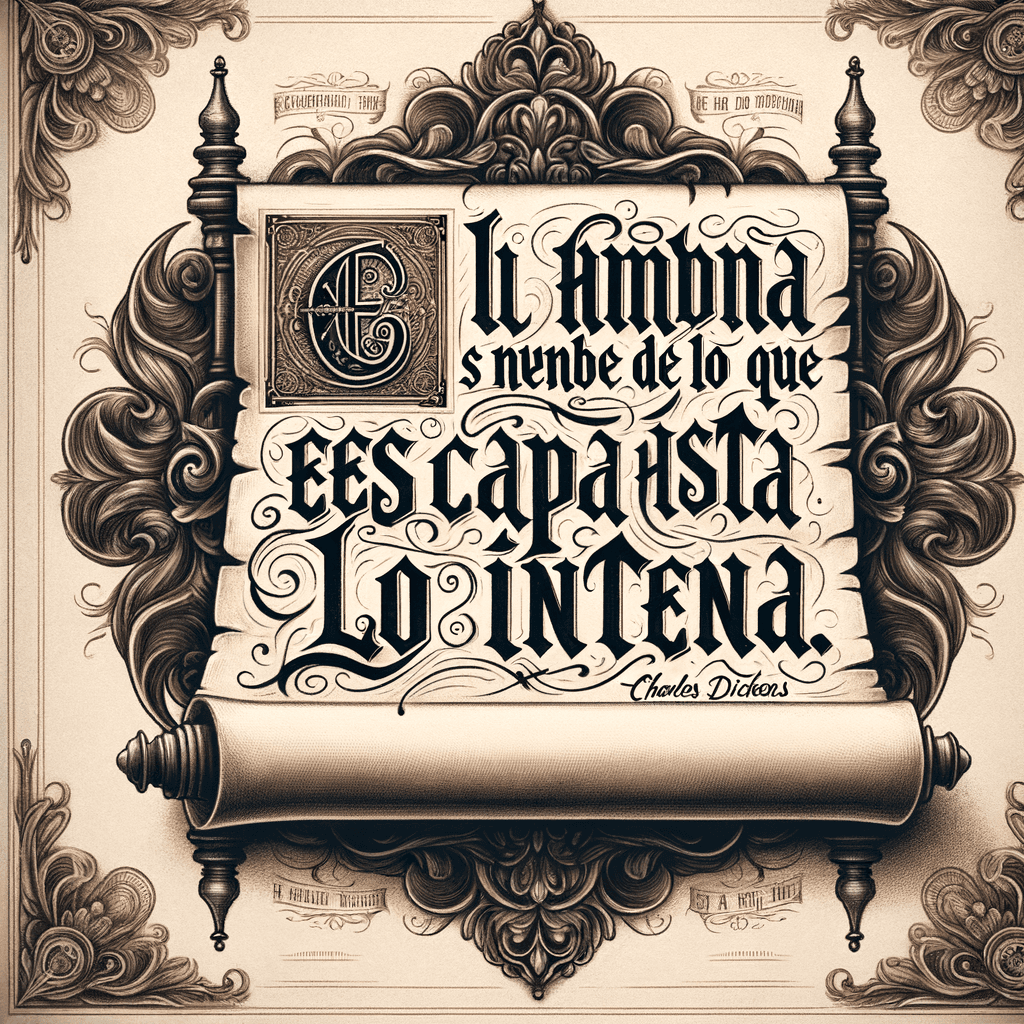
The man never knows what he is capable of until he tries. - Charles Dickens
—What lingers after this line?
Self-Discovery
This quote emphasizes the importance of taking action to discover one's true potential. It suggests that self-awareness and understanding of one's abilities only come through effort and experience.
Overcoming Limitations
It highlights the notion that perceived limits are often self-imposed. By trying new things, individuals can overcome their perceived barriers and expand their capabilities.
Taking Initiative
The quote underscores the value of being proactive. It encourages individuals to take the first step and make attempts, instead of doubting their abilities or fearing failure.
Personal Growth
Through trying and experimenting, people learn and grow. This process of trial and error is essential for personal development and gaining new skills.
Charles Dickens' Perspective
Charles Dickens, a renowned English writer of the Victorian era, often explored themes of social justice, personal growth, and self-improvement in his works. This quote reflects his belief in the intrinsic potential of individuals, often highlighted in his literary characters.
One-minute reflection
What's one small action this suggests?
Related Quotes
6 selectedThe man never knows what he is capable of until he attempts it. - Charles Dickens
Charles Dickens
This quote highlights the journey of self-discovery. It suggests that true understanding of one's abilities and potential only comes through action and effort.
Read full interpretation →The man never knows what he is capable of until he tries. - Charles Dickens
Charles Dickens
This quote emphasizes the importance of attempting tasks and challenges in order to discover one's true potential and capabilities. It suggests that people often underestimate their abilities until they put themselves to...
Read full interpretation →Courage is found in unlikely places. — J. R. R. Tolkien
J.R.R. Tolkien
Tolkien’s line gently overturns the usual image of courage as something reserved for warriors, rulers, or legendary heroes. Instead, it suggests that bravery often appears in ordinary people and modest settings, where no...
Read full interpretation →The sun himself is weak when he first rises, and gathers strength and courage as the day gets on. — Charles Dickens
Charles Dickens
This quote uses the sun as a symbol to represent growth and development. Just as the sun starts weak in the early morning and becomes stronger as the day progresses, humans also grow stronger and more confident over time...
Read full interpretation →To be courageous is to act with the heart. — Molière
Molière
Molière’s line suggests that courage is not merely the absence of fear, but the decision to move despite it. By connecting courage with the heart, he frames bravery as an emotional and moral act rather than a simple disp...
Read full interpretation →The best people possess a feeling for beauty, the courage to take risks, the discipline to tell the truth, the capacity for sacrifice. — Ernest Hemingway
Ernest Hemingway
Hemingway’s line presents goodness not as politeness or success, but as a demanding inner code. The “best people” are those who combine sensitivity, bravery, honesty, and self-denial—qualities that do not always coexist...
Read full interpretation →More From Author
More from Charles Dickens →Reflect upon your present blessings, of which every man has plenty; not on your past misfortunes, of which all men have some. — Charles Dickens
At its heart, Dickens’s sentence asks for a deliberate shift in attention. Rather than denying pain, he urges us to look first at the blessings still present in our lives, however ordinary they may seem.
Read full interpretation →The man never knows what he is capable of until he attempts it. - Charles Dickens
This quote highlights the journey of self-discovery. It suggests that true understanding of one's abilities and potential only comes through action and effort.
Read full interpretation →The man never knows what he is capable of until he tries. - Charles Dickens
This quote emphasizes the importance of attempting tasks and challenges in order to discover one's true potential and capabilities. It suggests that people often underestimate their abilities until they put themselves to...
Read full interpretation →The sun himself is weak when he first rises, and gathers strength and courage as the day gets on. — Charles Dickens
This quote uses the sun as a symbol to represent growth and development. Just as the sun starts weak in the early morning and becomes stronger as the day progresses, humans also grow stronger and more confident over time...
Read full interpretation →