
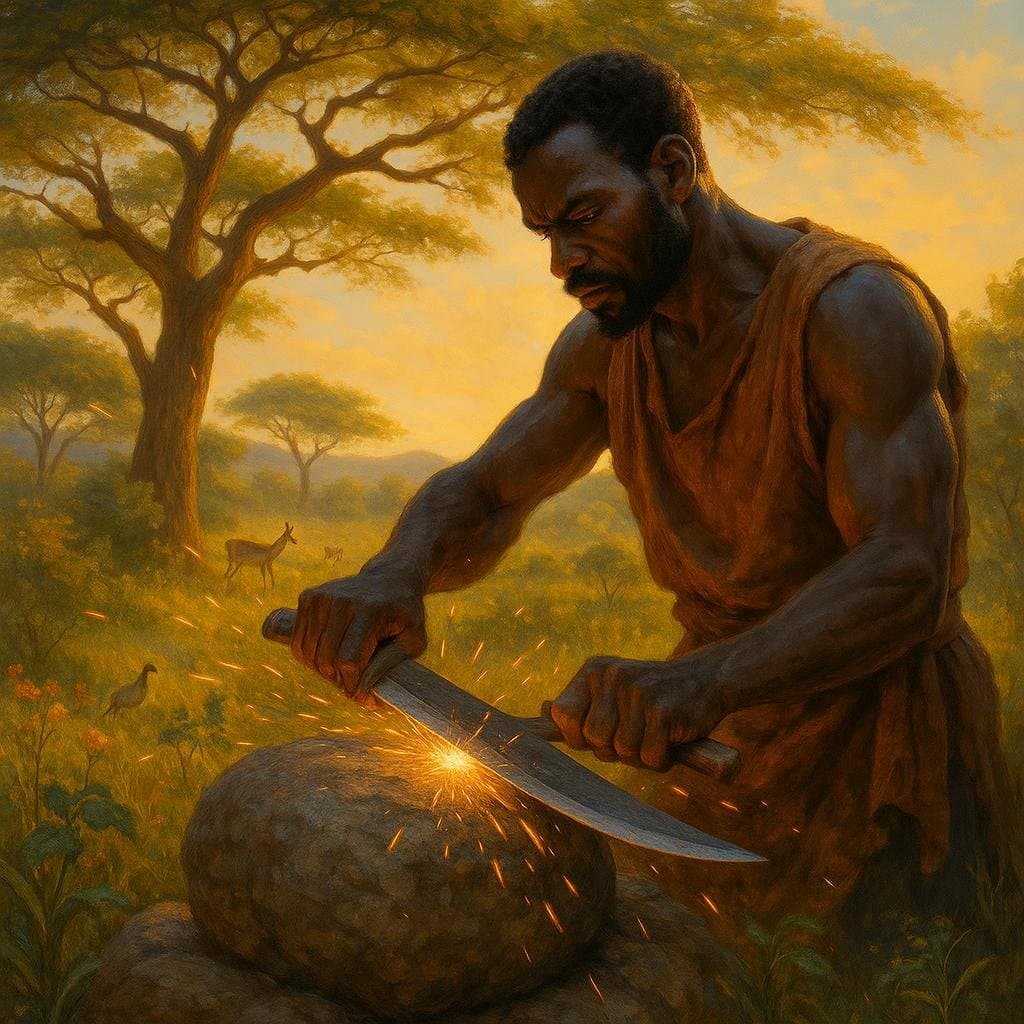
To struggle with a stone is to sharpen a blade. — African Proverb
—What lingers after this line?
The Metaphor of the Blade and Stone
At the heart of this African proverb lies a powerful metaphor: the act of sharpening a blade against stone mirrors how individuals grow stronger through challenges. Just as friction refines metal, so too does adversity hone character and skill. The stone, seemingly an obstacle, becomes essential to the blade’s transformation from dull to keen—a process that holds true not only for physical tools but also for human development.
Learning Through Struggle
Building on the metaphor, we see that struggle is not merely hardship, but an opportunity for growth. In Ancient Greece, Heraclitus asserted, 'strife is justice,' reasoning that opposition leads to improvement. Similarly, in many African communities, stories and parables teach the necessity of ‘stones’—the difficult tasks, critiques, or failures that ultimately forge resilience and mastery.
Cultural Perspectives on Adversity
Delving deeper, cultures across the globe echo this wisdom. For example, the Japanese concept of kintsugi finds beauty in brokenness by mending pottery with gold, illustrating that imperfection and repair yield strength and value. These intersecting traditions reflect a universal recognition: setbacks are not solely detriments, but catalysts for a sharper, wiser self.
Real-World Application: Growth Through Hardship
Transitioning from philosophy to lived experience, countless individuals and communities have emerged stronger after confronting difficulties. For instance, Nelson Mandela’s decades of imprisonment became a crucible refining his resolve, eventually empowering him to lead South Africa toward reconciliation. These stories remind us that endurance in the face of obstacles often generates transformative insight and capability.
Embracing the Stone in Daily Life
Finally, this proverb encourages us to reevaluate our own ‘stones’—whether at work, in relationships, or within ourselves. Instead of avoiding friction, we can view challenges as necessary tools for improvement. By shifting perspective, we honor the age-old recognition that to struggle with a stone is not to be worn down, but to become, over time, as sharp and purposeful as a well-honed blade.
One-minute reflection
What's one small action this suggests?
Related Quotes
6 selectedWithout the rain, there would be no flowers. — African Proverb
African Proverb
This proverb teaches that difficulties (rain) are necessary for growth and beauty (flowers) in life.
Read full interpretation →Tides do not rise without winds; neither do we grow without challenges. — African Proverb
African Proverb
Much like tides rely on the stirring winds to reach their peak, growth in life is often precipitated by the challenges we face. This African proverb beautifully ties natural phenomena to human development, suggesting tha...
Read full interpretation →Not to be touched by misfortune is not to be truly tested. — African Proverb
African Proverb
At its core, this African proverb highlights that adversity is not merely an obstacle but a necessary element in the formation of character. To live without ever facing misfortune is, according to this wisdom, to miss ou...
Read full interpretation →Trouble is a chance to learn something new. — African Proverb
African Proverb
The African proverb expresses a profound truth: adversity, rather than being merely a source of distress, often contains valuable life lessons. By casting trouble as an opportunity for learning, it reframes hardship as a...
Read full interpretation →Forge meaning from challenge; it is the smith of character — Albert Camus
Albert Camus
Camus’s line invites us to treat hardship not as a verdict but as raw ore. In a world he calls absurd—where events rarely match our hunger for order—meaning is not discovered, it is fashioned.
Read full interpretation →We don't develop courage by being happy in our relationships every day. We develop it by surviving difficult times and challenging adversity. — Epicurus
Epicurus
At first glance, Epicurus seems to challenge the common belief that healthy relationships are defined by uninterrupted happiness. Instead, he points to a deeper truth: courage is not formed in comfort, but in the moments...
Read full interpretation →More From Author
More from African Proverb →When the roots are deep, there is no reason to fear the wind. — African Proverb
The proverb frames life as weather and character as a tree: when roots run deep, wind becomes something to endure rather than something to dread. In that image, fear is not denied so much as put in its place—storms still...
Read full interpretation →The closer one comes to truth, the simpler everything becomes. — African Proverb
The proverb suggests that truth has a clarifying power: as you approach what is real, the extra clutter—misdirection, anxiety, and needless complication—falls away. In other words, complexity often signals that we are st...
Read full interpretation →The sun does not hurry to rise, yet it never misses its mark. — African Proverb
The proverb begins with an image so familiar it’s easy to overlook: sunrise. The sun appears without strain, without haste, and without visible anxiety about being “on time.” And yet, day after day, it arrives.
Read full interpretation →Do not look where you fell, but where you slipped. — African Proverb
The proverb urges a subtle but powerful change in attention: don’t fixate on the place where you landed in pain or embarrassment; instead, examine the moment your footing first failed. In other words, the visible setback...
Read full interpretation →