
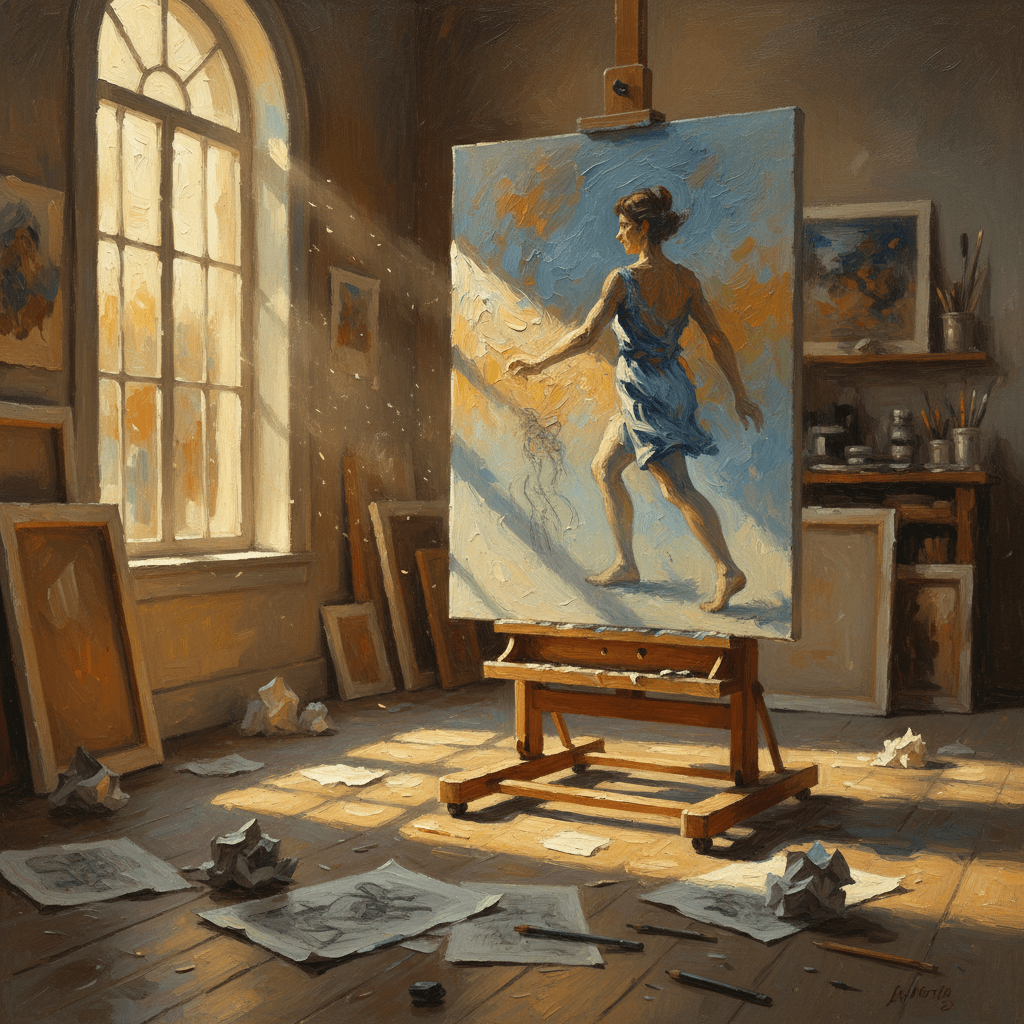
Turn your setbacks into sketches; every revision brings the portrait closer to truth. — Vincent van Gogh
—What lingers after this line?
From Setback to Sketch
The aphorism reframes failure as a preliminary drawing—useful, provisional, and alive with possibility. A sketch is not a verdict; it is a question that invites the next line. In this spirit, setbacks stop being indictments and become information, suggesting where to darken a contour, lighten a tone, or change the vantage point. By thinking this way, disappointment becomes a studio tool rather than a final judgment. This perspective prepares us to see revision not as erasure, but as continuity—each attempt carrying forward what was learned into the next draft.
Van Gogh’s Iterative Practice
Van Gogh’s working life models this ethos in concrete ways. His letters to Theo often describe sustained series of studies before a finished canvas, most notably around The Potato Eaters (1885), where he painted heads of peasants again and again to grasp their character. He treated repetition as apprenticeship, turning imperfect trials into stepping-stones. That method did not merely increase output; it shaped vision, allowing insight to accumulate line by line. This habit of serial work set the stage for his later breakthroughs, demonstrating how persistence transforms missteps into momentum.
Repetitions, Series, and Refinement
From Arles onward, he pursued entire families of images—Sunflowers, the sower, and the Bedroom—revisiting themes to refine structure and feeling. The Bedroom exists in three versions (1888–1889), each a recalibration of color and balance to better evoke rest. Likewise, multiple Sunflowers canvases let him test harmony and intensity until the bouquet felt luminous rather than merely bright. In moving from one version to the next, he treated the prior canvas as a sketch for the next truth. This serial rhythm illustrates the quote’s promise: revision is not retreat, but approach.
Visible Layers, Hidden Revisions
Technical studies make this process tangible. X-ray and infrared analyses have revealed underpaintings and reworkings beneath several canvases, including a concealed portrait beneath Patch of Grass (1887), documented by the Van Gogh Museum’s research efforts. These buried images are not failures so much as foundations—earlier ideas recycled into stronger compositions. Just as a drawing’s ghost lines guide the final contour, these palimpsests show how artists build truth in layers. Thus the painter’s studio becomes a laboratory, where each alteration preserves a trace that quietly informs the surface we see.
Truth as Emotional Fidelity
For van Gogh, truth was not photographic accuracy but felt equivalence. In his letters from Arles (1888), he describes using color “more arbitrarily” to express the intensity of experience—an approach that privileges emotional fidelity over literal depiction. Revision, then, is the patient calibration of resonance: altering hue, contour, and rhythm until the picture aligns with what one knows inwardly. This understanding bridges technique and vision, turning technical corrections into ethical ones—the duty to depict not just what is there, but what is true.
Beyond Art: Iteration as a Universal Method
This artistic logic echoes across fields. The scientific method advances through conjecture and refutation; prototypes in design thinking evolve via test-and-learn cycles; and the build–measure–learn loop popularized by The Lean Startup (Eric Ries, 2011) treats each release as a sketch of a better product. Psychology underscores the same pattern: a growth mindset (Carol Dweck, Mindset, 2006) reframes setbacks as signals for strategy change. Across disciplines, revision shifts identity from perfection-seeker to learner, so progress becomes cumulative rather than brittle.
Practicing Resilient Revision
To enact this mindset, structure your workflow like a sketchbook. Time-box drafts so you ship versions rather than wait for certainty; keep a revision log noting what changed and why; and solicit critiques early, when course corrections are cheap. Step back regularly—literally, with a few meters of distance, and figuratively, with a cooling-off period—to see what the work wants. Above all, treat each attempt as a conversation with the next. In doing so, you will find that setbacks redraw themselves as guides, and each revision brings the portrait closer to truth.
One-minute reflection
Why might this line matter today, not tomorrow?
Related Quotes
6 selectedDon't fight the challenges. Just find a new way to stand. — Germany Kent
Germany Kent
Germany Kent’s words begin with a quiet reversal of instinct: instead of treating every challenge as an enemy to defeat, she invites us to reconsider our posture toward difficulty. The emphasis is not on surrender, but o...
Read full interpretation →Optimist: someone who figures that taking a step backward after taking a step forward is not a disaster, it's more like a cha-cha. — Robert Brault
Robert Brault
Robert Brault’s line begins with a witty redefinition: an optimist is not someone who denies backward motion, but someone who interprets it differently. Instead of treating a setback as proof of failure, the optimist see...
Read full interpretation →A mind grows by staying with difficulty long enough for the experience to change it. — Mary Catherine Bateson
Mary Catherine Bateson
Mary Catherine Bateson’s observation begins with a quiet but demanding truth: the mind does not grow merely by encountering difficulty, but by remaining with it. Challenge becomes transformative only when we resist the u...
Read full interpretation →When you are friends with your storm, you dance, instead of getting blown away. — Michael Bassey Johnson
Michael Bassey Johnson
Michael Bassey Johnson’s line begins with a striking reversal: the storm is not merely an enemy to survive, but a force one can learn to understand. In this sense, the storm may represent grief, fear, conflict, uncertain...
Read full interpretation →Just because your light flickers does not mean it is about to go out. — Yohancé Salimu
Yohancé Salimu
At first glance, Yohancé Salimu’s line separates appearance from reality. A flicker suggests instability, fatigue, or interruption, yet it does not automatically signal extinction.
Read full interpretation →When something in your life dies—whether it be a job, a hobby, or a dream—I encourage you not to focus on what could have been but instead to look for the new life and the new opportunities that result. — Ryan Hall
Ryan Hall
Ryan Hall frames loss as a kind of death, and that metaphor immediately broadens the quote beyond grief in the literal sense. A job can end, a cherished hobby can fade, and a long-held dream can collapse; yet in each cas...
Read full interpretation →More From Author
More from Vincent van Gogh →Learning technique is a way to make your soul grow. So do it. — Vincent van Gogh
Van Gogh’s brief statement turns learning into more than a practical task; it becomes an ethical and spiritual imperative. By saying that learning technique helps the soul grow, he suggests that disciplined study does no...
Read full interpretation →A great fire burns within me, but no one stops to warm themselves at it, and passers-by only see a wisp of smoke. — Vincent van Gogh
Van Gogh’s image begins with a painful contrast: immense inner warmth exists, yet it goes unreceived. The “great fire” suggests passion, generosity, and creative force, while the absence of anyone who “stops to warm them...
Read full interpretation →I cannot rest, I must draw, however poor the result, and when I have a bad time come over me it is a stronger desire than ever. — Vincent van Gogh
Van Gogh’s words present drawing not as a hobby or even a disciplined profession, but as an inner command he cannot silence. The phrase “I must draw” carries the force of survival, suggesting that artistic creation answe...
Read full interpretation →As we advance in life it becomes more and more difficult, but in fighting the difficulties the inmost strength of the heart is developed. — Vincent van Gogh
Van Gogh’s sentence begins with a sober observation: life does not necessarily become simpler as we grow older. Instead, responsibilities deepen, losses accumulate, and choices carry heavier consequences.
Read full interpretation →