
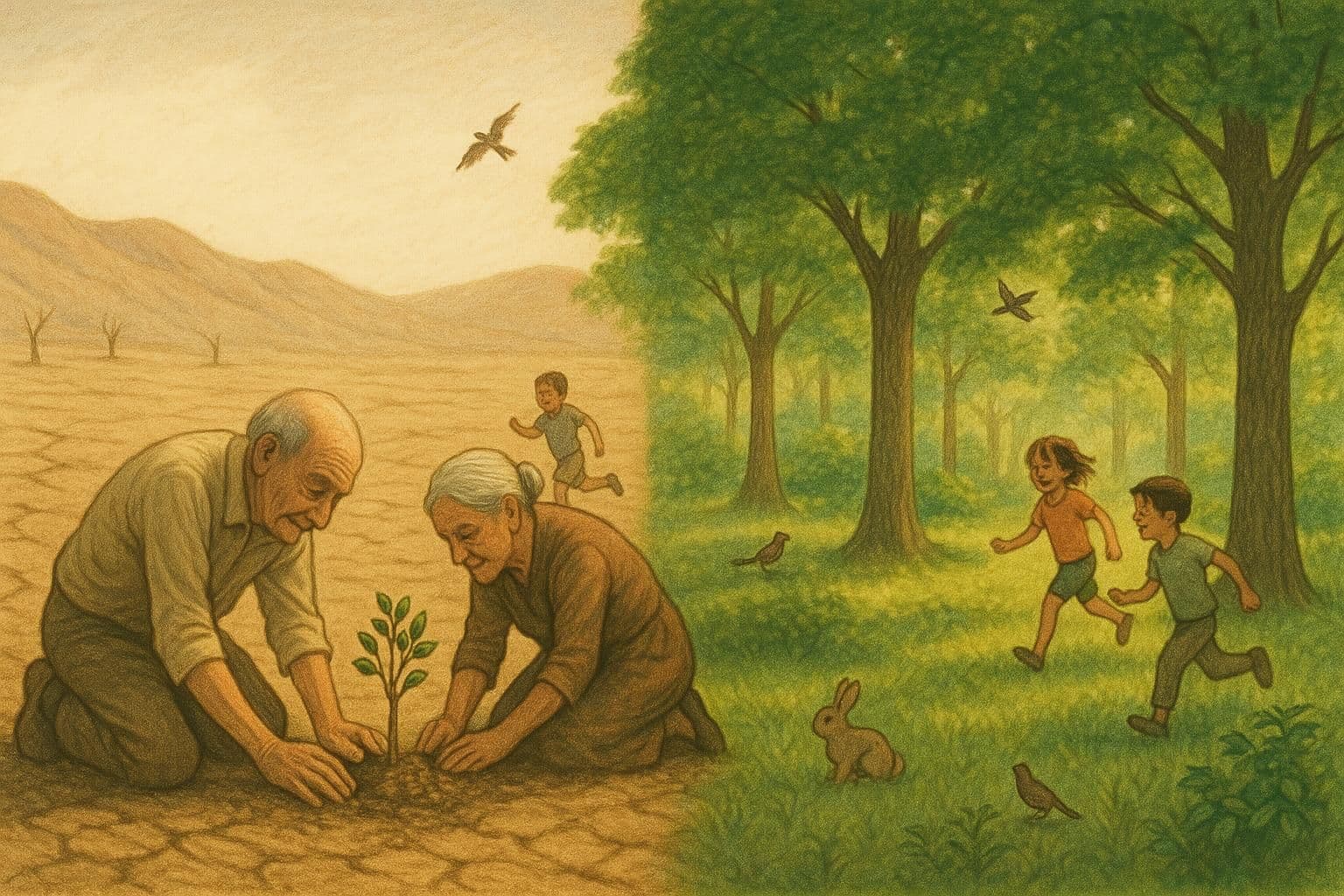
A society grows great when old men plant trees whose shade they know they shall never sit in. — Greek Proverb
—What lingers after this line?
Legacy and Selflessness
The proverb epitomizes the virtue of acting for future generations. Instead of immediate personal gain, individuals invest effort with no expectation of direct benefit. This echoes the ancient Athenians, who built enduring public works like the Parthenon not for themselves but as a legacy for posterity (as recounted in Thucydides' *History of the Peloponnesian War*).
Long-term Thinking vs. Short-term Selfishness
Contrasting short-termism with thoughtful foresight, this saying criticizes societies focused solely on present comfort. Jared Diamond's *Collapse* (2005) gives the example of Easter Island, where resource depletion marginalized future welfare, unlike societies that prioritized sustainability.
Civic Responsibility
By highlighting generational responsibility, the proverb frames civic duty as an unpaid debt to both ancestors and descendants. In the Roman notion of *pietas*, individuals were expected to maintain and improve society for those yet unborn—Cicero’s *On Duties* prescribed such virtues.
Social Cohesion and Trust
Acts like tree-planting, whose benefits are delayed, reflect deep social trust and help bind communities. Robert Putnam’s *Bowling Alone* (2000) describes how cultures rich in social capital foster volunteering and public-minded actions, which strengthen democratic societies.
Nature as a Metaphor for Progress
The tree serves as a symbol of incremental, often unobserved progress. Just as saplings grow into mighty oaks over decades, social advances blossom from countless altruistic acts. In John Evelyn’s *Sylva* (1664), essaying on forestry, he argues planting trees is an act of faith in the future.
One-minute reflection
Where does this idea show up in your life right now?
Related Quotes
6 selectedThe one who plants trees, knowing that he will never sit in their shade, has started to understand the meaning of life. — Rabindranath Tagore
Rabindranath Tagore
Tagore’s reflection centers on the profound impact of actions performed without expectation of personal gain. Planting trees whose shade we’ll never enjoy is a metaphor for investing effort into a future that may benefit...
Read full interpretation →The things that you do for yourself are gone when you are gone, but the things that you do for others remain as your legacy. — Kalu K. Ndukwe Kalu
Kalu K. Ndukwe Kalu
At its heart, Kalu K. Ndukwe Kalu’s quote redirects attention from personal gain to shared impact.
Read full interpretation →The most important aspect of gratitude is that it spurs action—that it compels us to go outside ourselves to express our gratitude in a way that makes a difference in someone else's life. — Rebecca Solnit
Rebecca Solnit
Rebecca Solnit shifts gratitude away from being a private sentiment and turns it into a moral impulse. In her view, thankfulness matters most not when it remains an inward glow, but when it pushes us outward toward other...
Read full interpretation →One of the deep secrets of life is that all that is really worth the doing is what we do for others. — Lewis Carroll
Lewis Carroll
Lewis Carroll’s line turns attention away from achievement for its own sake and toward a quieter measure of value: whether our actions help someone beyond ourselves. At first glance, this may sound like simple moral advi...
Read full interpretation →The only thing to do with good advice is to pass it on. It is never of any use to oneself. — Oscar Wilde
Oscar Wilde
Oscar Wilde’s line turns a familiar moral expectation on its head: instead of treating advice as a tool for self-improvement, he treats it as a social commodity best circulated outward. The joke lands because it exposes...
Read full interpretation →Measure success by the lives you lift, not the titles you earn — Kahlil Gibran
Kahlil Gibran
Gibran’s line shifts the measure of achievement away from what can be printed on a business card and toward what can be felt in other people’s lives. Titles are visible, quickly understood, and easy to compare, which is...
Read full interpretation →More From Author
More from Greek Proverb →The heart that loves is always young. — Greek Proverb
This proverb suggests that the act of loving keeps one feeling youthful, regardless of their actual age. Love transcends time and age, offering a sense of renewal and vitality.
Read full interpretation →To begin is to be half done. — Greek Proverb
This proverb emphasizes the importance of taking the first step towards any goal. Often, starting a task can be the hardest part, but once that hurdle is overcome, the rest tends to fall into place more easily.
Read full interpretation →