
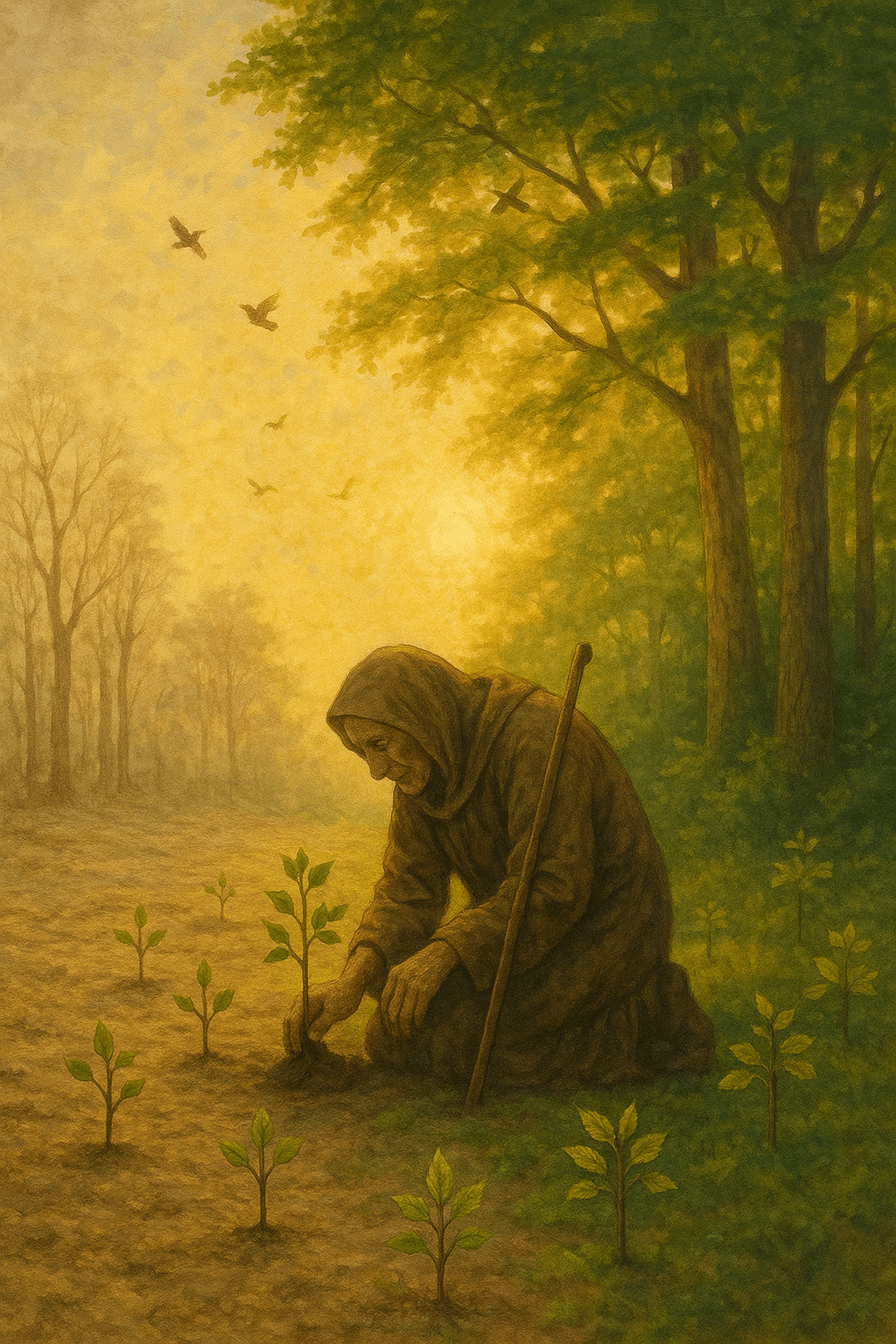
The one who plants trees, knowing that he will never sit in their shade, has started to understand the meaning of life. — Rabindranath Tagore
—What lingers after this line?
The Philosophy of Selfless Giving
Tagore’s reflection centers on the profound impact of actions performed without expectation of personal gain. Planting trees whose shade we’ll never enjoy is a metaphor for investing effort into a future that may benefit others, not ourselves. This philosophy emphasizes the virtue of selflessness, a cornerstone in various ethical and religious traditions, from Buddhist notions of compassion to the concept of stewardship in Christianity.
Legacy Beyond the Individual
Building upon this, such acts of foresight are deeply tied to the idea of legacy. The notion of working for a future beyond one’s lifespan echoes in the ancient proverb: 'A society grows great when old men plant trees whose shade they know they shall never sit in.' By considering the well-being of future generations, individuals participate in a continuum that transcends the boundaries of a single lifetime.
Interconnectedness with Future Generations
Furthermore, Tagore’s metaphor invites us to consider our connections to those who come after us. Actions taken today reverberate through time, influencing lives yet unborn. In environmental movements, for example, activists fight for sustainability not only for present comfort but for the inheritance left to descendants—mirroring the unseen beneficiaries of the planter’s shade.
The Fulfillment Found in Purpose
This form of altruism, while outwardly self-denying, often brings deep personal fulfillment. Viktor Frankl, in his work 'Man's Search for Meaning' (1946), argued that true meaning is found not in pleasure or power, but in dedicating oneself to causes greater than the self. Planting trees for others to enjoy embodies this orientation, providing purpose even in the absence of personal reward.
Cultivating Empathy and Responsibility
Lastly, Tagore’s insight serves as a call to cultivate empathy and a sense of collective responsibility. By acting with future generations in mind, societies foster a spirit of community and interconnectedness. The simple, selfless gesture of planting a tree thus teaches us to measure our lives not solely by immediate returns, but by the hope, shelter, and shade we can offer to others—now and in the distant future.
One-minute reflection
Why might this line matter today, not tomorrow?
Related Quotes
6 selectedThe one who plants trees, knowing that he will never sit in their shade, has started to understand the meaning of life. — Rabindranath Tagore
Rabindranath Tagore
Tagore’s quote highlights a profound aspect of human nature: the capacity to act with no expectation of immediate personal reward. By planting trees whose shade they will never enjoy, individuals embody a form of altruis...
Read full interpretation →In seeking happiness for others, you find it for yourself. — Rabindranath Tagore
Rabindranath Tagore
This quote highlights the idea that by making others happy, you inadvertently bring happiness to yourself.
Read full interpretation →The true meaning of life is to plant trees, under whose shade you do not expect to sit. — Nelson Henderson
Nelson Henderson
The quote emphasizes the value of doing good deeds without expecting personal rewards or benefits.
Read full interpretation →I awoke and saw that life was service. — Rabindranath Tagore
Rabindranath Tagore
Tagore’s line suggests that awakening is not a private epiphany but a reorientation of attention—from self-enclosure to outward care. To truly ‘see’ life, he implies, is to recognize that our capacities find their fulles...
Read full interpretation →I awoke and saw that life was service. — Rabindranath Tagore
Rabindranath Tagore
Tagore’s line pivots on a simple transformation: awakening. Sleep stands for a private world of dreams—desire, fear, and solitary meanings—while waking indicates clarity about our place among others.
Read full interpretation →A farmer is helpless to grow grain; all he can do is provide the right conditions for the growing of grain. — Richard J. Foster
Richard J. Foster
At first glance, Foster’s farming metaphor shifts attention away from control and toward humility. A farmer cannot command a seed to sprout, just as a person cannot force true growth—whether spiritual, personal, or relat...
Read full interpretation →More From Author
More from Rabindranath Tagore →Adaptability is not imitation. It means power of resistance and assimilation. — Rabindranath Tagore
At the heart of Tagore’s statement lies a careful distinction between changing and merely copying. Adaptability, he argues, is not the passive act of becoming like one’s surroundings; rather, it is an active power that a...
Read full interpretation →It is not the speed of the work, but the intention behind it that grants it value. — Rabindranath Tagore
At first glance, Tagore’s statement challenges a modern habit of equating worth with speed. In many settings, quick results are praised as signs of competence, yet he redirects attention to the inner motive that shapes t...
Read full interpretation →When I stand before thee at the day's end, thou shalt see my scars and know that I had my wounds and also my healing. — Rabindranath Tagore
At its heart, Tagore imagines an ultimate moment of reckoning in which nothing essential can be hidden. To stand before another “at the day’s end” suggests the close of life, a spiritual homecoming, or simply the end of...
Read full interpretation →A home is not a mere transient shelter of brick and stone, but a place where hearts dwell and souls are nurtured. — Rabindranath Tagore
At its core, Tagore’s statement rejects the idea that a home can be defined by architecture alone. Walls, roofs, and doors may provide protection, yet they do not automatically create belonging.
Read full interpretation →