
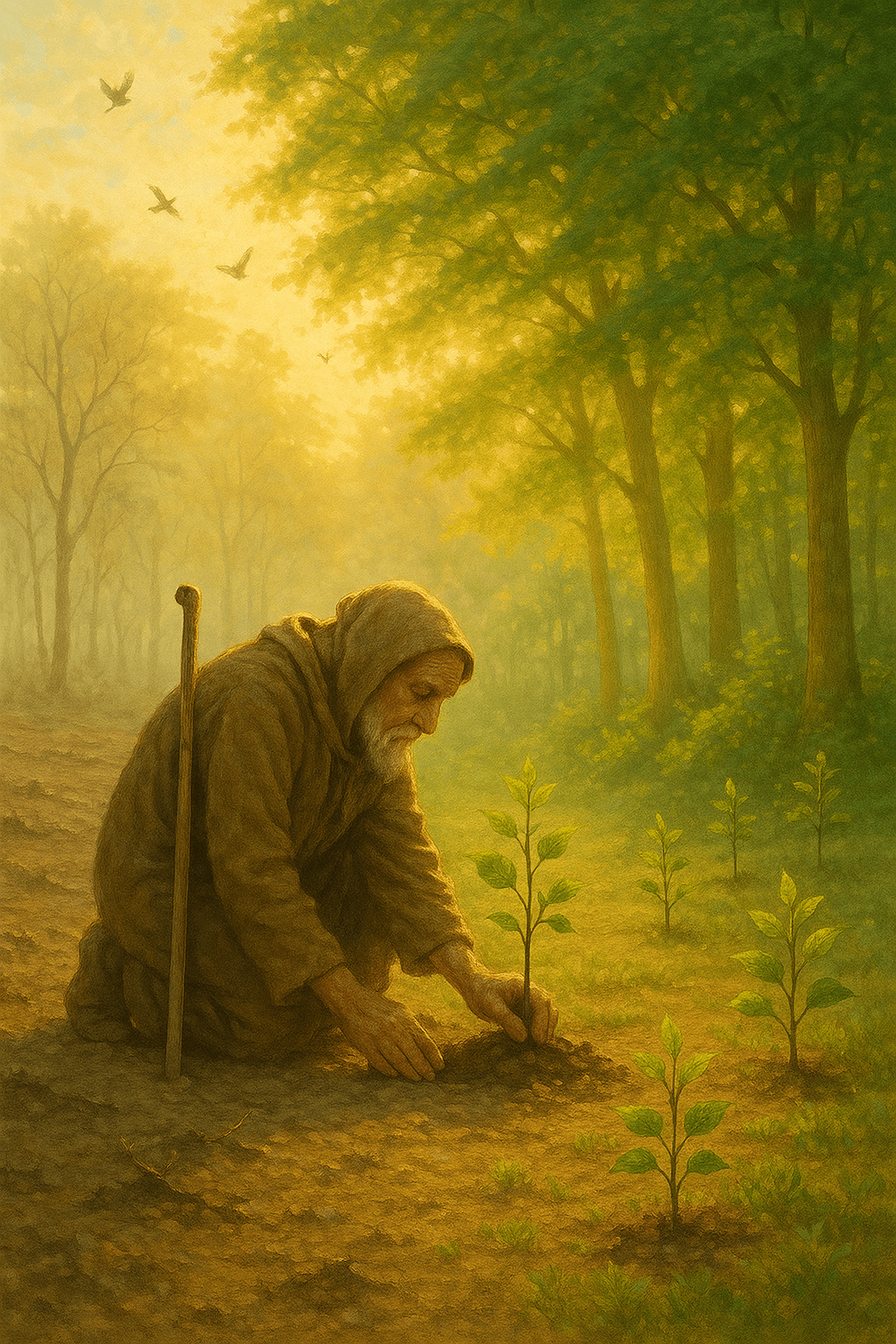
The one who plants trees, knowing that he will never sit in their shade, has started to understand the meaning of life. — Rabindranath Tagore
—What lingers after this line?
The Essence of Selfless Generosity
Tagore’s quote highlights a profound aspect of human nature: the capacity to act with no expectation of immediate personal reward. By planting trees whose shade they will never enjoy, individuals embody a form of altruism that extends beyond personal gain. This spirit of generosity is central to many philosophical and spiritual traditions, suggesting that true fulfillment arises from acts that benefit others rather than oneself.
Legacy and the Continuity of Life
Building upon the foundation of selfless giving, the concept of legacy emerges. Planting a tree for future generations speaks to humanity’s desire to leave a lasting mark on the world. In ancient Greek society, for example, elders planted olive groves whose fruits would nourish descendants for centuries—demonstrating how individuals contribute to a broader, ongoing narrative that connects the past, present, and future.
Interconnectedness Across Generations
This act also manifests our intrinsic connection to those who come after us. When we plant trees, we become part of a silent, ongoing conversation between generations—one rooted in hope and responsibility. Joan Chittister, in her work 'The Gift of Years' (2008), reflects on how our actions ripple outward, shaping environments we may never physically encounter but are nevertheless bound to.
Transcending Immediate Gratification
Transitioning from personal legacy, the quote counters our instinct for instant gratification. Modern society often prizes short-term results, yet Tagore’s wisdom reminds us that certain meaningful efforts require patience and self-restraint. Like cathedral builders of the Middle Ages who knew they would not live to see the completion of their work, those who act selflessly reveal a deeper understanding of life’s temporal horizons.
The Meaning of Life: Giving Beyond Ourselves
Ultimately, Tagore’s words invite reflection on life's highest purpose: giving to something greater than ourselves. When we act so that others may benefit—even if we ourselves will not—we touch on a collective meaning that transcends individual existence. In this steady, selfless contribution to the greater good, we begin to unravel what it truly means to lead a meaningful life.
One-minute reflection
What feeling does this quote bring up for you?
Related Quotes
6 selectedThe one who plants trees, knowing that he will never sit in their shade, has started to understand the meaning of life. — Rabindranath Tagore
Rabindranath Tagore
Tagore’s reflection centers on the profound impact of actions performed without expectation of personal gain. Planting trees whose shade we’ll never enjoy is a metaphor for investing effort into a future that may benefit...
Read full interpretation →In seeking happiness for others, you find it for yourself. — Rabindranath Tagore
Rabindranath Tagore
This quote highlights the idea that by making others happy, you inadvertently bring happiness to yourself.
Read full interpretation →The true meaning of life is to plant trees, under whose shade you do not expect to sit. — Nelson Henderson
Nelson Henderson
The quote emphasizes the value of doing good deeds without expecting personal rewards or benefits.
Read full interpretation →I awoke and saw that life was service. — Rabindranath Tagore
Rabindranath Tagore
Tagore’s line suggests that awakening is not a private epiphany but a reorientation of attention—from self-enclosure to outward care. To truly ‘see’ life, he implies, is to recognize that our capacities find their fulles...
Read full interpretation →I awoke and saw that life was service. — Rabindranath Tagore
Rabindranath Tagore
Tagore’s line pivots on a simple transformation: awakening. Sleep stands for a private world of dreams—desire, fear, and solitary meanings—while waking indicates clarity about our place among others.
Read full interpretation →The things that you do for yourself are gone when you are gone, but the things that you do for others remain as your legacy. — Kalu K. Ndukwe Kalu
Kalu K. Ndukwe Kalu
At its heart, Kalu K. Ndukwe Kalu’s quote redirects attention from personal gain to shared impact.
Read full interpretation →More From Author
More from Rabindranath Tagore →Adaptability is not imitation. It means power of resistance and assimilation. — Rabindranath Tagore
At the heart of Tagore’s statement lies a careful distinction between changing and merely copying. Adaptability, he argues, is not the passive act of becoming like one’s surroundings; rather, it is an active power that a...
Read full interpretation →It is not the speed of the work, but the intention behind it that grants it value. — Rabindranath Tagore
At first glance, Tagore’s statement challenges a modern habit of equating worth with speed. In many settings, quick results are praised as signs of competence, yet he redirects attention to the inner motive that shapes t...
Read full interpretation →When I stand before thee at the day's end, thou shalt see my scars and know that I had my wounds and also my healing. — Rabindranath Tagore
At its heart, Tagore imagines an ultimate moment of reckoning in which nothing essential can be hidden. To stand before another “at the day’s end” suggests the close of life, a spiritual homecoming, or simply the end of...
Read full interpretation →A home is not a mere transient shelter of brick and stone, but a place where hearts dwell and souls are nurtured. — Rabindranath Tagore
At its core, Tagore’s statement rejects the idea that a home can be defined by architecture alone. Walls, roofs, and doors may provide protection, yet they do not automatically create belonging.
Read full interpretation →