
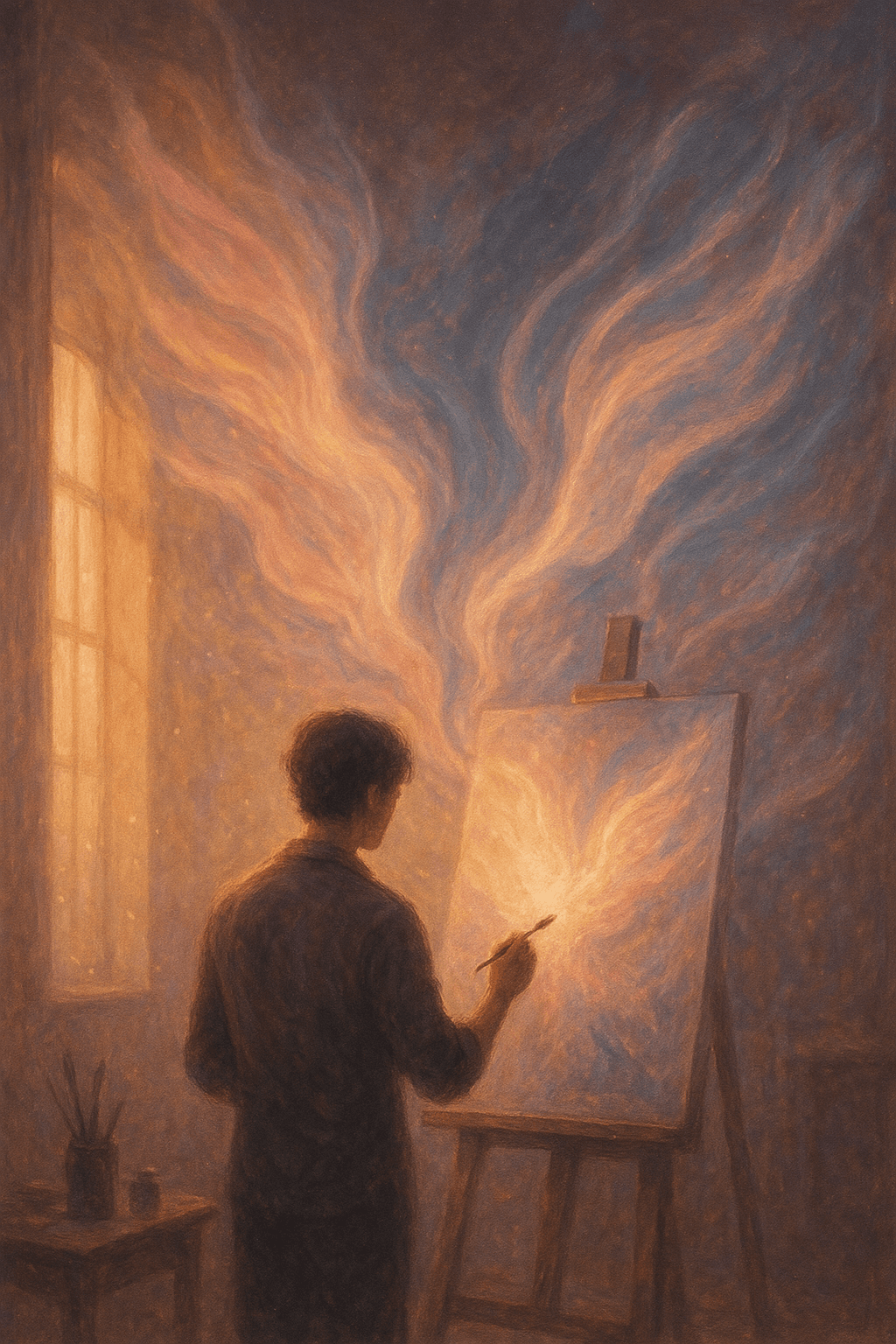
Let desire for beauty guide your work; passion crafts enduring art — Sappho
—What lingers after this line?
Desire as the Spark of Creation
Sappho’s imperative, “Let desire for beauty guide your work,” places longing at the very origin of artistic effort. Rather than treating art as a cool exercise of technique, she suggests that genuine creativity begins with an ache for what is beautiful—whether a face, a landscape, a feeling, or an ideal. This yearning focuses attention and sharpens perception, allowing the artist to notice subtleties that indifference would overlook. In this way, desire does not merely decorate the process; it determines what is worth shaping and showing to others. Thus, the first movement of enduring art is inward, as the creator recognizes a beauty they cannot ignore.
Beauty as a Guiding North Star
From this initial spark, beauty becomes a compass that orients every decision in the work. Greek thought often intertwined the beautiful (*kalon*) with the good and the true, implying that the pursuit of beauty is also a pursuit of order and meaning. When Sappho urges beauty as a guide, she implies that the artist should constantly ask: does this line, color, phrase, or gesture move closer to the vision that first stirred my desire? In this way, beauty is less a fixed standard and more a direction of travel, keeping the work from drifting into empty showmanship or mechanical routine.
Passion as the Engine of Craft
The second half of the quote—“passion crafts enduring art”—shifts from guidance to labor. Desire identifies the goal, but passion, understood as sustained and fiery commitment, does the slow work of making. Ancient traditions from Homer to Sappho portray passion not only as intense feeling but as a force that endures hardship for the sake of what it loves. In artistic practice, this means revising, failing, starting again, and refining skills long after novelty fades. Passion keeps the artist at the desk, the easel, or the instrument when progress is invisible, transforming raw inspiration into a coherent, lasting form.
From Fleeting Inspiration to Lasting Memory
By linking passion to endurance, Sappho hints at the difference between momentary inspiration and art that outlives its maker. A single flash of beauty can move anyone; what distinguishes the artist is the willingness to translate that flash into something others can return to. Sappho’s own fragments, preserved across millennia, exemplify this transformation: brief lyrics about love, jealousy, and longing still resonate because they were crafted with care, rhythm, and structure. Thus, passion does not simply feel intensely; it organizes feeling into patterns that memory can hold and future generations can rediscover.
Integrating Emotion and Discipline in Practice
Ultimately, Sappho’s line proposes a balanced model of creation in which emotion and discipline continually inform each other. Desire for beauty ensures the work remains alive, personal, and meaningful, preventing technique from becoming hollow display. At the same time, passionate craft prevents feeling from dissolving into chaos or cliché, shaping it into a form that communicates clearly. In modern terms, a musician practicing scales, a programmer polishing code, or a poet pruning lines can all let their sense of beauty steer their choices while allowing passion to fuel the unglamorous repetitions. Through this union, work becomes more than output: it becomes a durable imprint of what the creator loved most deeply.
One-minute reflection
Where does this idea show up in your life right now?
Related Quotes
6 selectedTo sing a wrong note is insignificant; to sing without passion is inconceivable. — Ludwig van Beethoven
Ludwig van Beethoven
Beethoven’s assertion prioritizes emotion over technical perfection in music. For him, conveying deep feeling is the essence of performance: a missed note is trivial next to the absence of passion.
Read full interpretation →Create with love; your work will speak louder than your doubts. — Kahlil Gibran
Kahlil Gibran
Kahlil Gibran’s counsel begins with orientation: when we create with love, we shift the purpose of our efforts from self-justification to service. In The Prophet (1923), he writes, “Work is love made visible,” a line tha...
Read full interpretation →Paint with the urgency of your heartbeat, and the canvas will answer. — Vincent van Gogh
Vincent van Gogh
The line urges a maker to trade deliberation for necessity—the kind of urgency your heart keeps time for without asking permission. Rather than endorsing haste, it proposes a living metronome: when pulse and gesture alig...
Read full interpretation →Let desire fuel your craft but let kindness steady the heart. — Sappho
Sappho
Sappho’s line sets up a deliberate pairing: desire as the engine of making, and kindness as the stabilizer of being. Desire pushes the artist toward intensity—toward risk, experimentation, and the hunger to shape experie...
Read full interpretation →One's own self is well worth knowing. — Sappho
Sappho
At first glance, Sappho’s brief statement seems simple, yet its force lies in its directness: the self is not a trivial subject but a worthy one. In a world that often rewards attention to status, duty, or appearance, he...
Read full interpretation →Sow a single clear word and let it bloom into a chorus. — Sappho
Sappho
Sappho’s line begins by shrinking expression down to its smallest unit: a single clear word. The emphasis on clarity suggests intention rather than verbosity, as if meaning can be planted only when it is cleanly chosen.
Read full interpretation →More From Author
More from Sappho →One's own self is well worth knowing. — Sappho
At first glance, Sappho’s brief statement seems simple, yet its force lies in its directness: the self is not a trivial subject but a worthy one. In a world that often rewards attention to status, duty, or appearance, he...
Read full interpretation →Sow a single clear word and let it bloom into a chorus. — Sappho
Sappho’s line begins by shrinking expression down to its smallest unit: a single clear word. The emphasis on clarity suggests intention rather than verbosity, as if meaning can be planted only when it is cleanly chosen.
Read full interpretation →Let desire fuel your craft but let kindness steady the heart. — Sappho
Sappho’s line sets up a deliberate pairing: desire as the engine of making, and kindness as the stabilizer of being. Desire pushes the artist toward intensity—toward risk, experimentation, and the hunger to shape experie...
Read full interpretation →Let your voice fracture the silence; even a small sound reshapes the air. — Sappho
Sappho’s line begins by treating silence not as emptiness, but as a kind of held breath—an atmosphere with shape and tension. When she urges, “Let your voice fracture the silence,” she implies that quiet has weight, and...
Read full interpretation →