
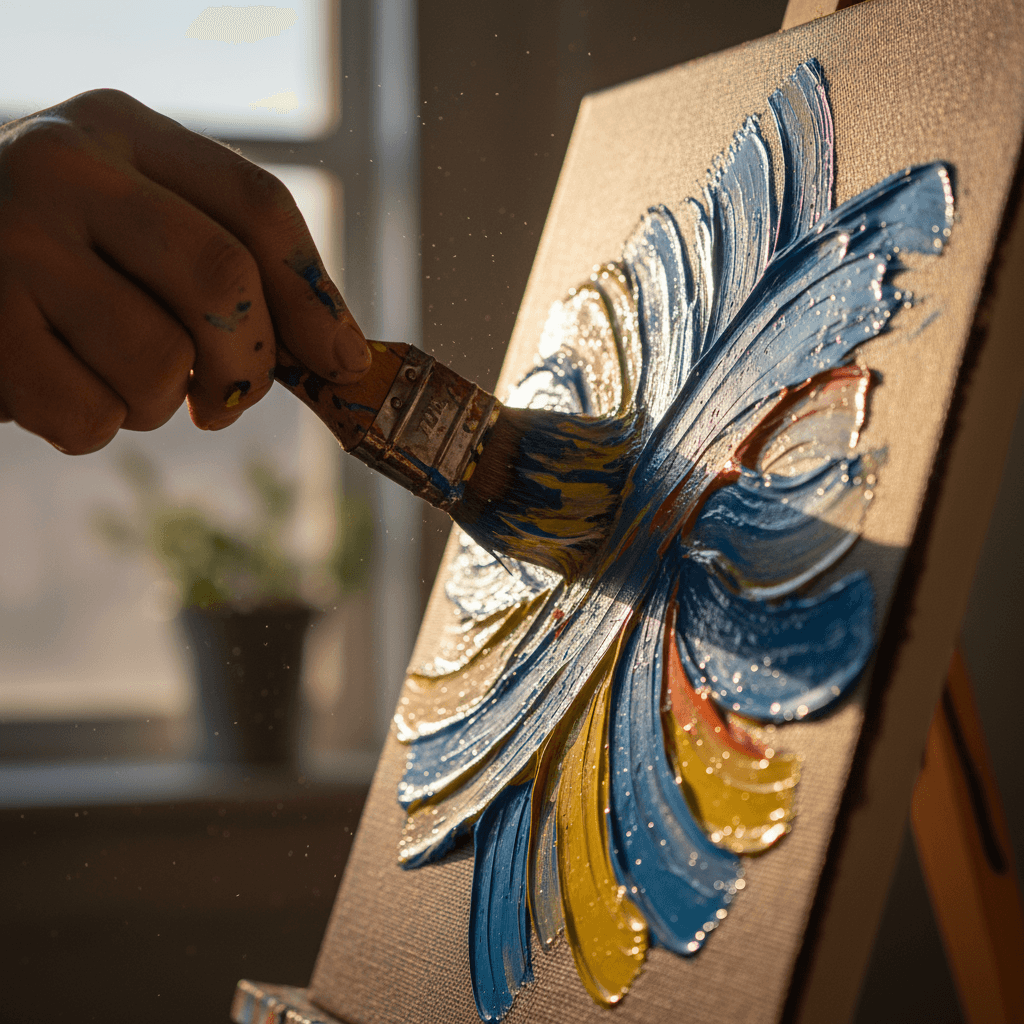
Paint with the urgency of your heartbeat, and the canvas will answer. — Vincent van Gogh
—What lingers after this line?
The Rhythm of Urgency
The line urges a maker to trade deliberation for necessity—the kind of urgency your heart keeps time for without asking permission. Rather than endorsing haste, it proposes a living metronome: when pulse and gesture align, intention stops stalling and begins moving. That momentum carries emotion straight into form, before self-consciousness can interfere. In this light, the canvas “answers” because it finally has something vital to answer to: energy made visible. The concept invites a shift from planning to presence, a move that van Gogh himself pursued in both practice and prose.
Van Gogh’s Letters and Lived Pace
In his letters to his brother Theo, van Gogh repeatedly described working in rapid, concentrated bursts to catch a vanishing mood or light. From Arles (1888) to Saint‑Rémy (1889), he wrote of painting “very quickly,” layering impasto while colors were still wet so the stroke retained its charge (Letters, Van Gogh Museum edition). The Night Café’s feverish reds and greens, for instance, were conceived to convey “terrible human passions,” not polished decorum. Thus, speed was not a stunt; it was a fidelity to feeling. That fidelity made each brushstroke a heartbeat-length decision, which in turn set up the essential conversation between mark and response.
A Dialogue with the Surface
Once urgency initiates the first mark, the eye and hand begin reading what the paint proposes. This is the classic call-and-response of materials: a stroke suggests a counter‑stroke; a vivid note demands a muted neighbor. Pollock’s drip paintings (c. 1947–50) show this dance in the extreme, but the logic is older, echoing in Japanese ink painting where a single breath can anchor a composition. In practice, the “answer” from the canvas is simply feedback—edges too sharp, a rhythm too even, a hue that dulls the field. Listening to that reply requires the same attention that started the piece, keeping the tempo alive rather than returning to timid correction.
Body, Brain, and the Flow of Making
Psychology calls the sought-after tempo flow, a state Mihaly Csikszentmihalyi (1990) described as full absorption with clear feedback. Neuroscience adds that interoception—the sensing of internal signals like heartbeat—shapes timing and emotional salience (see Garfinkel et al., 2014). When a painter is attuned to pulse and breath, movement becomes economical, and decisions arrive at the speed of feeling. Therefore, what sounds poetic is also practical physiology: a stable internal rhythm steadies external gestures. The body sets the meter, and the brain, freed from overcontrol, improvises within it.
Urgency as a Form of Truth
Urgency here is not the enemy of accuracy; it is a bid for honesty. Henri Matisse’s “Exactitude is not truth” (Notes of a Painter, 1908) underlines the point: a perfectly rendered apple can still miss the taste of it. Van Gogh’s swirls and slabs, likewise, hold truth because they refuse to lie about the feeling that made them. Consequently, the canvas answers most clearly when it is asked a sincere question. The beat of the heart poses it; the brush translates it; the surface replies in kind.
Practices to Hear the Canvas Answer
Begin with timed bursts—two to five minutes per passage—to synchronize hand and pulse. Stand when possible; breathe audibly to pace strokes; limit your palette so choices stay decisive. After each burst, step back for thirty seconds and let the painting “speak”: what demands reinforcement, what needs silence? Additionally, try painting to a steady drum track, switching it off mid‑session to rely on your own cadence. As with van Gogh’s wet‑into‑wet urgency, keep sections alive by working while they still carry energy. In this cadence of act, listen, and act again, you will find the canvas answering more readily—and more truthfully.
One-minute reflection
Where does this idea show up in your life right now?
Related Quotes
6 selectedLet desire for beauty guide your work; passion crafts enduring art — Sappho
Sappho
Sappho’s imperative, “Let desire for beauty guide your work,” places longing at the very origin of artistic effort. Rather than treating art as a cool exercise of technique, she suggests that genuine creativity begins wi...
Read full interpretation →To sing a wrong note is insignificant; to sing without passion is inconceivable. — Ludwig van Beethoven
Ludwig van Beethoven
Beethoven’s assertion prioritizes emotion over technical perfection in music. For him, conveying deep feeling is the essence of performance: a missed note is trivial next to the absence of passion.
Read full interpretation →Create with love; your work will speak louder than your doubts. — Kahlil Gibran
Kahlil Gibran
Kahlil Gibran’s counsel begins with orientation: when we create with love, we shift the purpose of our efforts from self-justification to service. In The Prophet (1923), he writes, “Work is love made visible,” a line tha...
Read full interpretation →Paint your goals with bold colors; then live as if they are already true. — Vincent van Gogh
Vincent van Gogh
Van Gogh’s invitation to “paint your goals with bold colors” begins with imagination. Rather than holding vague wishes, he urges us to see our aims as vivid scenes, almost like canvases hung in the gallery of the mind.
Read full interpretation →Paint with your hands and let the world feel the colors of your effort. — Vincent van Gogh
Vincent van Gogh
At first glance, the line urges us to close the gap between idea and medium by literally reaching in with our hands. It reframes creativity as contact—pigment meeting skin—so that the labor of making becomes visible rath...
Read full interpretation →"I dream my painting and I paint my dream." — Vincent van Gogh
Vincent van Gogh
At first glance, van Gogh’s line fuses intention with action: imagination drafts the plan, and the hand ratifies it on canvas. The saying proposes a circular vow—what he envisions, he renders; what he renders, he then re...
Read full interpretation →More From Author
More from Vincent van Gogh →Learning technique is a way to make your soul grow. So do it. — Vincent van Gogh
Van Gogh’s brief statement turns learning into more than a practical task; it becomes an ethical and spiritual imperative. By saying that learning technique helps the soul grow, he suggests that disciplined study does no...
Read full interpretation →A great fire burns within me, but no one stops to warm themselves at it, and passers-by only see a wisp of smoke. — Vincent van Gogh
Van Gogh’s image begins with a painful contrast: immense inner warmth exists, yet it goes unreceived. The “great fire” suggests passion, generosity, and creative force, while the absence of anyone who “stops to warm them...
Read full interpretation →I cannot rest, I must draw, however poor the result, and when I have a bad time come over me it is a stronger desire than ever. — Vincent van Gogh
Van Gogh’s words present drawing not as a hobby or even a disciplined profession, but as an inner command he cannot silence. The phrase “I must draw” carries the force of survival, suggesting that artistic creation answe...
Read full interpretation →As we advance in life it becomes more and more difficult, but in fighting the difficulties the inmost strength of the heart is developed. — Vincent van Gogh
Van Gogh’s sentence begins with a sober observation: life does not necessarily become simpler as we grow older. Instead, responsibilities deepen, losses accumulate, and choices carry heavier consequences.
Read full interpretation →