
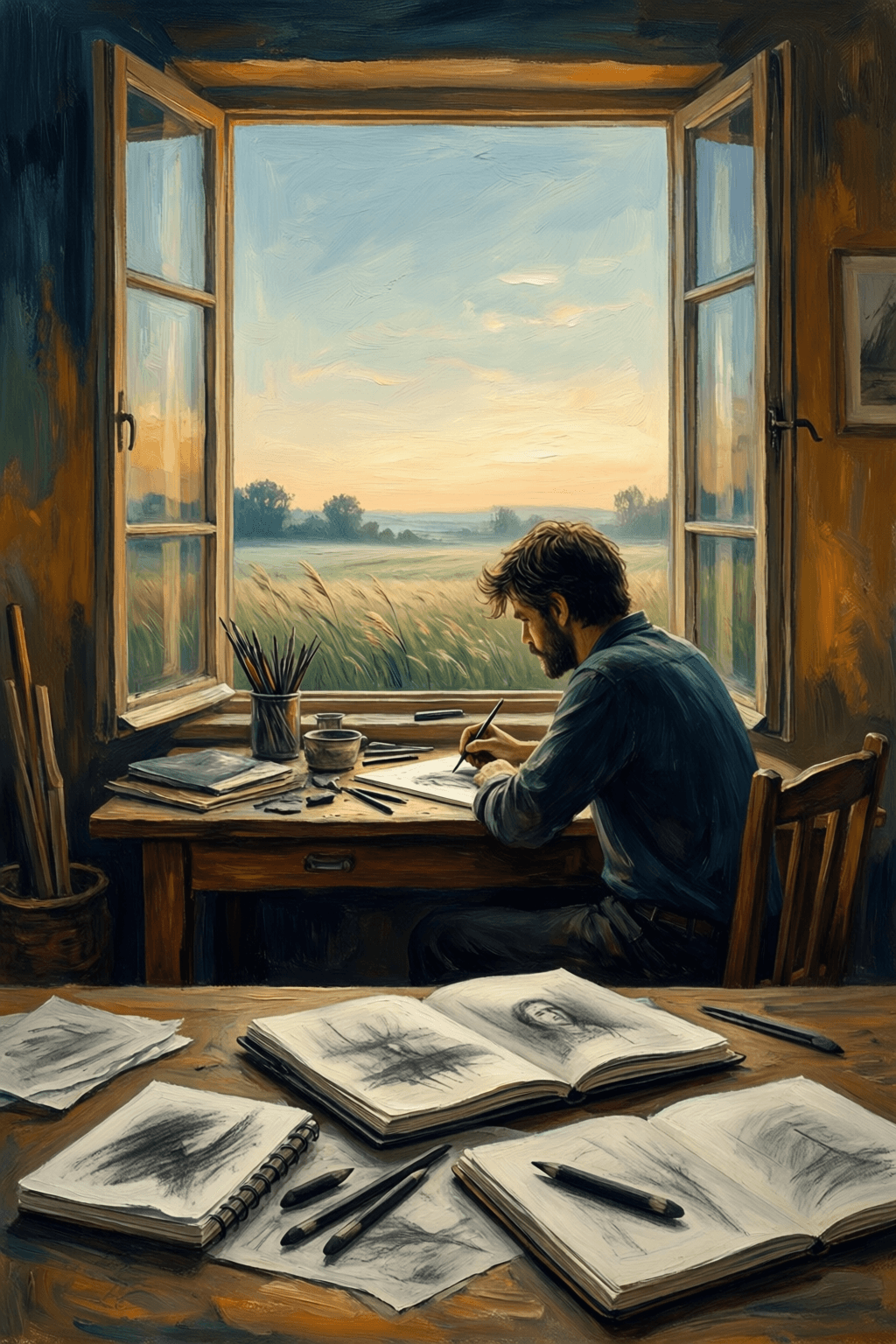
I cannot rest, I must draw, however poor the result, and when I have a bad time come over me it is a stronger desire than ever. — Vincent van Gogh
—What lingers after this line?
Art as an Irresistible Urge
Van Gogh’s words present drawing not as a hobby or even a disciplined profession, but as an inner command he cannot silence. The phrase “I must draw” carries the force of survival, suggesting that artistic creation answered a need deeper than ambition or praise. Even his acceptance of “however poor the result” shows that expression mattered more than perfection. From the beginning, then, the quote frames art as necessity rather than luxury. This urgency helps explain why Van Gogh worked with such persistence despite repeated disappointment, poverty, and criticism. In his letters, especially those collected in The Letters of Vincent van Gogh, he often returns to the idea that making images was bound up with simply enduring life.
Persistence Beyond Imperfection
Just as striking is Van Gogh’s indifference to whether the result is good. By admitting the work may be poor, he rejects the paralyzing belief that creation is worthwhile only when it succeeds. Instead, the act itself becomes meaningful, and this shifts attention from outcome to necessity. Consequently, the quote reads as a quiet manifesto for perseverance. Van Gogh’s career offers many examples: his early figure studies, often rough and searching, were not polished masterpieces, yet they were crucial steps toward later works such as The Potato Eaters (1885). In this way, he reminds us that imperfect practice is often the true engine of artistic growth.
Suffering Deepening the Need to Create
The most moving turn in the sentence comes when Van Gogh says that during “a bad time” the desire grows stronger than ever. Rather than shutting him down, distress intensifies his need to draw. This suggests that art served as a counterforce to despair, a way to convert inner turbulence into visible form. Accordingly, the quote reveals a profound relationship between pain and creation. Van Gogh’s life, marked by loneliness, financial insecurity, and recurring mental crises, makes this especially poignant. His letters to Theo repeatedly show him turning to work in periods of anguish, as though drawing and painting gave structure to emotions that might otherwise overwhelm him.
Creation as a Form of Self-Preservation
From there, the quote can be read not only as an artistic statement but as a psychological one. If hardship increases the urge to draw, then drawing becomes a way of holding oneself together. The page or canvas offers a place where confusion can be ordered into line, color, and form. Indeed, many artists have described similar impulses. Frida Kahlo later wrote through paint about physical and emotional suffering, while Edvard Munch linked art to anxiety and illness in works like The Scream (1893). Yet Van Gogh’s phrasing is especially bare and immediate: he does not romanticize suffering, but shows creation as one response to it, almost like breathing through pain.
The Honest Discipline of Van Gogh
At the same time, the quote should not be mistaken for pure spontaneity. Beneath its emotional force lies discipline. To say “I must draw” is also to submit to work, again and again, regardless of mood, success, or failure. His urgency was emotional, but it was expressed through repeated practice. This is what gives the statement its lasting power. Van Gogh joins passion with labor, showing that authenticity is not merely feeling deeply but returning faithfully to the task. As a result, the quote speaks to anyone engaged in difficult work: when life darkens, meaningful effort may become not harder to value, but more necessary than ever.
Why the Quote Still Resonates
Finally, Van Gogh’s words endure because they capture a universal truth about human expression. Many people, whether artists or not, know the strange moment when distress sharpens rather than dulls the need to make, write, sing, or build. In that sense, his confession reaches beyond art history into the broader experience of being human. Thus the quote remains compelling because it refuses easy consolation. It does not promise that drawing will erase suffering or guarantee brilliance. Instead, it offers something more believable: in difficult times, the act of making can become indispensable. Van Gogh’s insight is that creation may not solve pain, but it can give pain direction, shape, and endurance.
One-minute reflection
What feeling does this quote bring up for you?
Related Quotes
6 selectedInvent a future that makes your heart beat faster and build toward it. — Ada Lovelace
Ada Lovelace
Ada Lovelace’s line frames the future as something made, not merely awaited. Rather than treating tomorrow as a distant inevitability, she urges a stance of agency: choose a direction, decide what matters, and begin shap...
Read full interpretation →Turn the ache of longing into the fuel for your finest creations. — Kahlil Gibran
Kahlil Gibran
Longing often feels like an absence, a hollow ache where something should be. Yet, viewed differently, it is compressed energy—pressure that can drive motion if given form.
Read full interpretation →"I dream my painting and I paint my dream." — Vincent van Gogh
Vincent van Gogh
At first glance, van Gogh’s line fuses intention with action: imagination drafts the plan, and the hand ratifies it on canvas. The saying proposes a circular vow—what he envisions, he renders; what he renders, he then re...
Read full interpretation →Learning technique is a way to make your soul grow. So do it. — Vincent van Gogh
Vincent van Gogh
Van Gogh’s brief statement turns learning into more than a practical task; it becomes an ethical and spiritual imperative. By saying that learning technique helps the soul grow, he suggests that disciplined study does no...
Read full interpretation →A great fire burns within me, but no one stops to warm themselves at it, and passers-by only see a wisp of smoke. — Vincent van Gogh
Vincent van Gogh
Van Gogh’s image begins with a painful contrast: immense inner warmth exists, yet it goes unreceived. The “great fire” suggests passion, generosity, and creative force, while the absence of anyone who “stops to warm them...
Read full interpretation →As we advance in life it becomes more and more difficult, but in fighting the difficulties the inmost strength of the heart is developed. — Vincent van Gogh
Vincent van Gogh
Van Gogh’s sentence begins with a sober observation: life does not necessarily become simpler as we grow older. Instead, responsibilities deepen, losses accumulate, and choices carry heavier consequences.
Read full interpretation →More From Author
More from Vincent van Gogh →Learning technique is a way to make your soul grow. So do it. — Vincent van Gogh
Van Gogh’s brief statement turns learning into more than a practical task; it becomes an ethical and spiritual imperative. By saying that learning technique helps the soul grow, he suggests that disciplined study does no...
Read full interpretation →A great fire burns within me, but no one stops to warm themselves at it, and passers-by only see a wisp of smoke. — Vincent van Gogh
Van Gogh’s image begins with a painful contrast: immense inner warmth exists, yet it goes unreceived. The “great fire” suggests passion, generosity, and creative force, while the absence of anyone who “stops to warm them...
Read full interpretation →As we advance in life it becomes more and more difficult, but in fighting the difficulties the inmost strength of the heart is developed. — Vincent van Gogh
Van Gogh’s sentence begins with a sober observation: life does not necessarily become simpler as we grow older. Instead, responsibilities deepen, losses accumulate, and choices carry heavier consequences.
Read full interpretation →Work with wild curiosity; a single brushstroke can begin a new horizon. — Vincent van Gogh
Van Gogh’s line opens by treating curiosity not as a casual interest, but as a way of moving through the world—“wild” enough to break routine perception. Rather than waiting for certainty, the artist begins by wondering,...
Read full interpretation →