
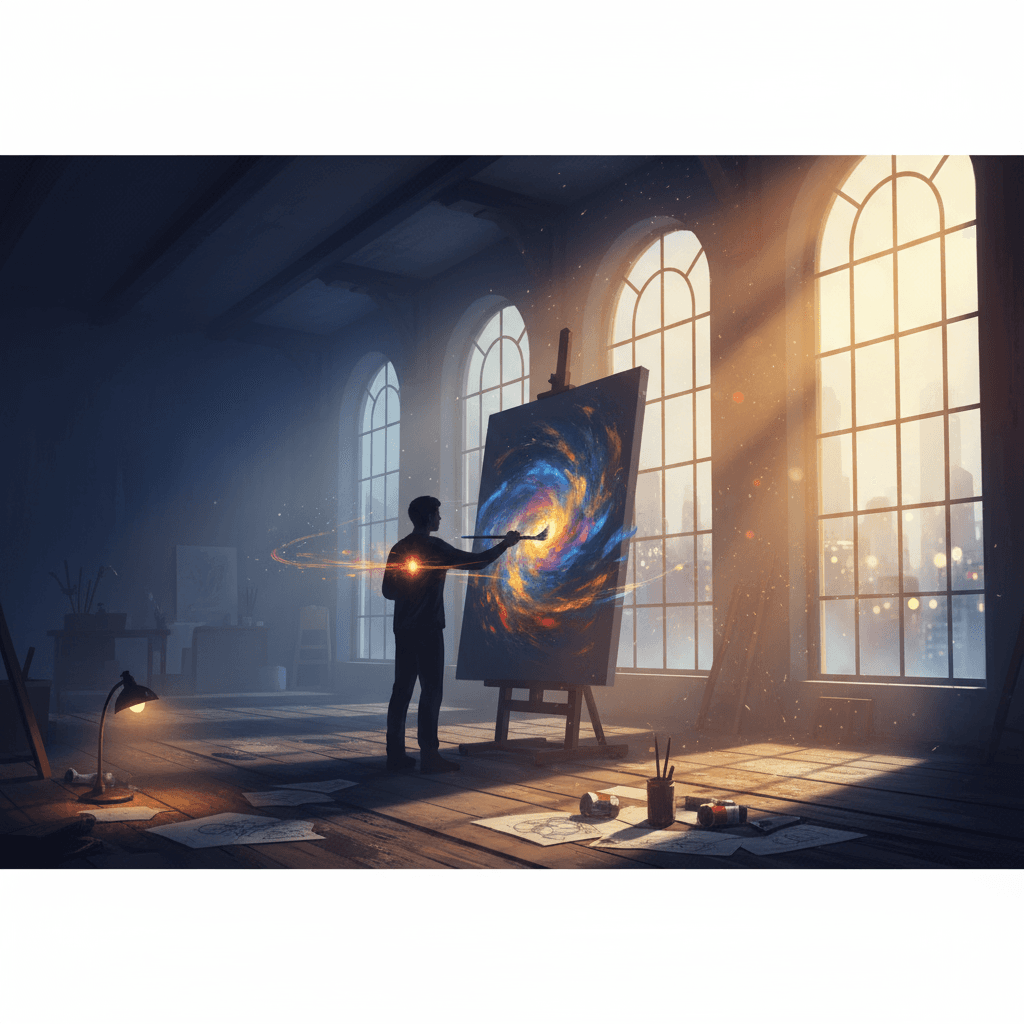
Turn the ache of longing into the fuel for your finest creations. — Kahlil Gibran
—What lingers after this line?
The Spark Hidden in Yearning
Longing often feels like an absence, a hollow ache where something should be. Yet, viewed differently, it is compressed energy—pressure that can drive motion if given form. Gibran’s exhortation invites us to reinterpret that ache not as a void but as propellant, the way a bow stores tension before release. By naming desire as fuel, he shifts us from passive wishing to active making, and in doing so, he hints that our finest work may arise not despite our hunger, but because of it.
Gibran’s Vision of Redemptive Pain
Kahlil Gibran repeatedly cast pain as transformative rather than merely punitive. In The Prophet (1923), the chapter “On Joy and Sorrow” observes that “the deeper that sorrow carves into your being, the more joy you can contain,” suggesting that wounds widen the vessel of the self. This image reframes ache as a sculptor’s chisel—harsh, yet generative. Consequently, longing becomes a tool for enlargement: it carves space for vision, and that enlarged space can hold the breadth required for original creation.
Sublimation: Psychology’s Name for Alchemy
Moving from poetry to psychology, Freud described sublimation (1905) as the channeling of intense drives into socially valued work—art, invention, inquiry. Modern research complements this view: expressive writing studies (Pennebaker, 1997) show that articulating emotional upheaval can improve well-being and coherence of story, both useful for creators. Moreover, motivational science distinguishes raw wanting from fulfilled liking; that anticipatory tension sharpens attention and persistence, capacities that art-making demands. Thus, when longing is given a concrete task—draft the scene, sketch the form, refine the motif—it becomes a disciplined current rather than a riptide.
Cultural Poetics of Longing
Across cultures, longing is treated as a creative atmosphere rather than a problem to be solved. Rumi opens the Masnavi (13th c.) with the reed flute lamenting its separation from the reed bed, making separation itself the song’s origin. Likewise, Japanese mono no aware names the tender awareness of impermanence as an aesthetic sensitivity, while Portuguese saudade saturates fado with a sweetness of absence. These traditions do not rush to close the gap; instead, they cultivate it into resonance, showing how ache becomes timbre, color, and form.
Artists Who Forged Beauty from Ache
History offers lived templates for this transmutation. Beethoven’s Heiligenstadt Testament (1802) reveals despair over encroaching deafness, yet it ends in resolve to continue composing, a pivot that prefigures the late quartets’ audacity. Frida Kahlo transformed chronic pain and heartbreak into visual language—works like The Broken Column (1944) turn bodily ache into architectural metaphor. And Rainer Maria Rilke, in Letters to a Young Poet (1903–1908), urged artists to treat difficulty as raw material, not an interruption. In each case, longing did not vanish; rather, it was orchestrated, its energy scored into craft.
Practices to Transmute the Ache
So how do we operationalize this? First, give longing a container: daily pages or timed sketches convert diffuse ache into steady output (see Julia Cameron’s “morning pages,” 1992). Next, recast desire as questions—How might this absence change perspective? What form expresses its texture?—so feeling becomes inquiry. Add constraints that focus force: a sonnet’s meter, a limited palette, a 200-word scene. Finally, engage the body as conduit: walking drafts rhythm, while voice notes catch ideas before they evaporate. Over time, these rituals refine heat into light.
Keeping the Fuel Clean
Even so, sustainable creation requires care. Romanticizing suffering can corrode both art and artist; the aim is not to seek pain, but to steward the pain that arrives. Build recovery into the process—sleep, community, therapy when needed—so the engine runs without burning out. In this ethical frame, longing becomes a teacher rather than a tyrant, and the work becomes a conversation with the ache: you bring the discipline, it brings the voltage, and together you make something worthy of the fire.
One-minute reflection
Why might this line matter today, not tomorrow?
Related Quotes
6 selectedTransform longing into art; the soul does its work through making. — Kahlil Gibran
Kahlil Gibran
Gibran frames longing not as a deficit to be cured but as a force that can be transmuted. The ache for someone, somewhere, or some meaning becomes raw material—an emotional pigment waiting to be mixed into form.
Read full interpretation →I cannot rest, I must draw, however poor the result, and when I have a bad time come over me it is a stronger desire than ever. — Vincent van Gogh
Vincent van Gogh
Van Gogh’s words present drawing not as a hobby or even a disciplined profession, but as an inner command he cannot silence. The phrase “I must draw” carries the force of survival, suggesting that artistic creation answe...
Read full interpretation →I searched for him a thousand times in the crowd. Suddenly I turned my head, and there he was, at the dimly lit place where the lanterns were few. -- Xin Qiji
Xin Qiji
Xin Qiji frames love as a relentless act of looking: the speaker scans a crowd again and again, as if repetition might conjure the beloved into view. The exaggeration of “a thousand times” is less a statistic than a port...
Read full interpretation →Invent a future that makes your heart beat faster and build toward it. — Ada Lovelace
Ada Lovelace
Ada Lovelace’s line frames the future as something made, not merely awaited. Rather than treating tomorrow as a distant inevitability, she urges a stance of agency: choose a direction, decide what matters, and begin shap...
Read full interpretation →Sing so your longing becomes fuel, then walk toward the light you name — Sappho
Sappho
Sappho’s line begins by treating longing not as a weakness to hide but as raw material to work with. Instead of letting desire pool into paralysis, she frames it as something already full of energy—an inner pressure seek...
Read full interpretation →Translate longing into craft, and the world will begin to answer. — Frida Kahlo
Frida Kahlo
Kahlo’s line treats longing not as a weakness to outgrow but as a potent substance—like pigment or clay—waiting to be shaped. Rather than asking us to suppress desire, grief, or yearning, she implies these feelings can b...
Read full interpretation →More From Author
More from Kahlil Gibran →Your home is your larger body. It grows in the sun and sleeps in the stillness of the night. — Kahlil Gibran
At first glance, Gibran transforms the idea of home from a mere structure into something intimate and organic: “your larger body.” In this image, a dwelling is not separate from the person who inhabits it, but an outward...
Read full interpretation →March on. Do not tarry. To go forward is to move toward perfection. — Kahlil Gibran
Gibran’s opening imperative—“March on. Do not tarry.”—sets a tone of disciplined urgency.
Read full interpretation →There must be spaces in your togetherness, and let the winds of the heavens dance between you. — Kahlil Gibran
Gibran’s line opens with a gentle paradox: he speaks to people who are already “together,” yet insists that togetherness is healthiest when it includes room. Rather than portraying love as fusion, he frames it as a relat...
Read full interpretation →Our anxiety does not come from thinking about the future, but from wanting to control it. — Kahlil Gibran
Kahlil Gibran reframes anxiety as something more specific than mere anticipation. The future itself—uncertain, unfolding, and not yet real—doesn’t automatically distress us; rather, distress appears when we demand certai...
Read full interpretation →