
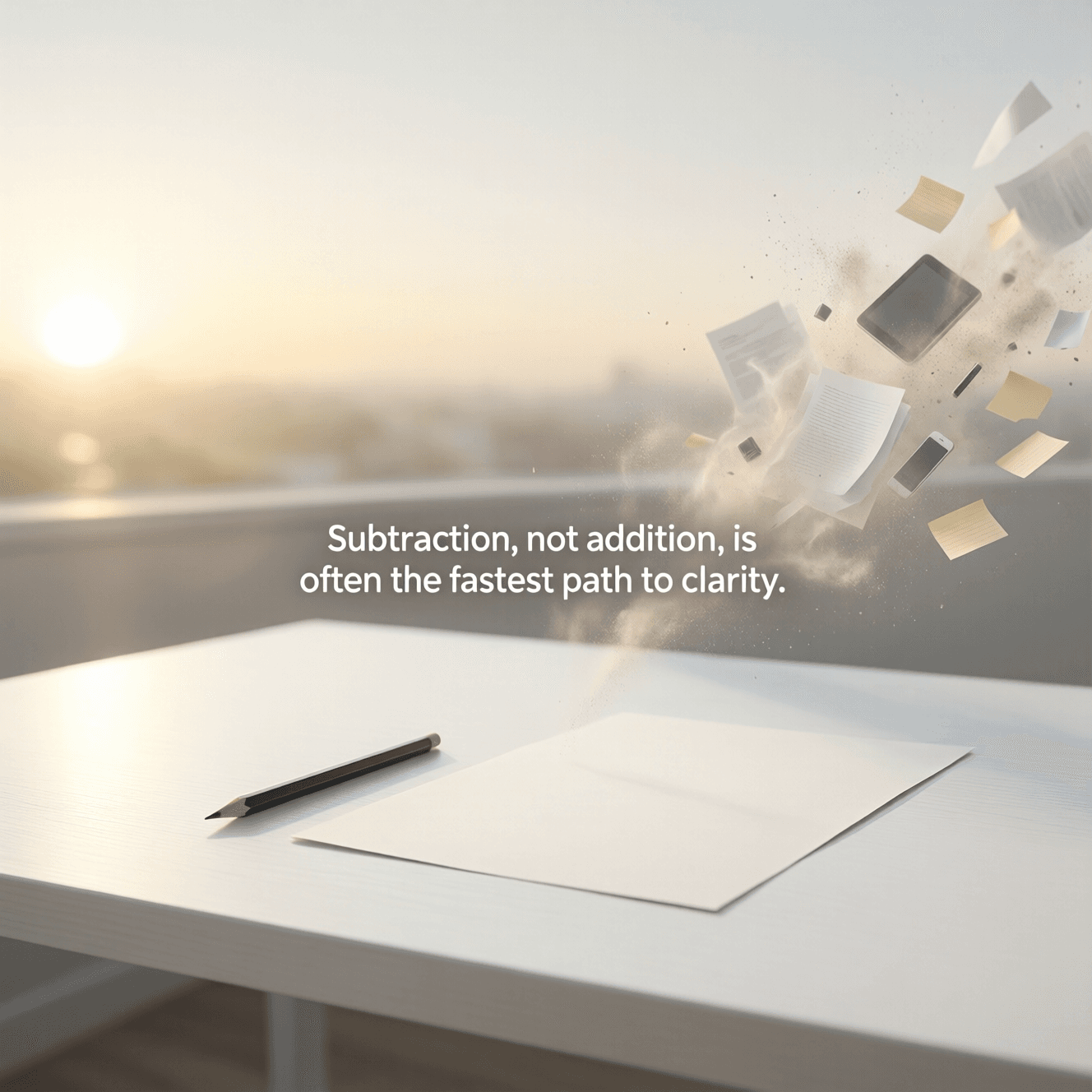
Subtraction, not addition, is often the fastest path to clarity. — April Rinne
—What lingers after this line?
Why Less Can Reveal More
April Rinne’s line reframes clarity as an act of removal rather than accumulation. Instead of assuming confusion comes from missing information, it suggests the opposite: we often have too many options, too many priorities, and too much noise competing for attention. When we subtract what is nonessential, the remaining elements become easier to see, name, and act on. This perspective also challenges a common cultural reflex—adding features, meetings, tools, or advice—whenever outcomes feel uncertain. By starting with what can be removed, we treat clarity as something already present but obscured, like a signal drowned out by static.
The Cognitive Cost of Excess
Building on that idea, subtraction works because human attention is limited. Psychology and behavioral economics repeatedly show that more choices can reduce satisfaction and slow decisions; Sheena Iyengar and Mark Lepper’s “jam study” (2000) became famous for illustrating how too many options can discourage action altogether. So when Rinne points to subtraction as “fast,” she is pointing to how quickly mental bandwidth returns once choices and inputs are reduced. Fewer competing demands lowers the friction of deciding, and the mind can shift from evaluation to execution.
Subtraction as a Design Principle
From cognition, the logic extends naturally into design. Dieter Rams’ modernist ethos—often summarized as “Less, but better”—treats subtraction not as austerity, but as respect for the user’s time and attention. A product becomes clearer when unnecessary steps, buttons, and features are removed. In practice, this is why many “improvements” feel like relief: a simplified interface, a shorter form, or a cleaner process. Subtraction reduces the need for explanation because the thing itself communicates more directly.
Organizational Clarity: Fewer Priorities, Better Work
Moving from objects to organizations, subtraction becomes a strategy for leadership. Teams often lose clarity not because they lack goals, but because they have too many. When every initiative is “critical,” nothing is. Leaders who prune priorities make it easier for people to understand what good work looks like today rather than what might be valuable someday. This is why methods like OKRs emphasize focus and why effective managers sometimes cancel projects or meetings to create momentum. Removing commitments can feel risky, yet it often produces the sharpest alignment because it forces explicit trade-offs.
Personal Life: Editing to Find Direction
The same approach applies at the individual level. When someone feels stuck, the temptation is to add—another self-help book, another habit tracker, another new goal. But clarity can arrive faster by subtracting: dropping one obligation, reducing screen time, or saying no to a role that no longer fits. A common anecdote illustrates the point: people who declutter a room often report a surprising lift in mood and decisiveness. The environment becomes easier to navigate, and that external simplicity can mirror an internal one—less to manage means more capacity to choose intentionally.
How to Practice Subtraction Without Regret
Finally, subtraction becomes sustainable when treated as an experiment rather than a permanent verdict. Instead of asking “Should I eliminate this forever?” you can ask “What happens if I remove it for two weeks?” This lowers the emotional stakes and turns clarity into observable evidence. In that spirit, Rinne’s quote is not anti-growth; it is pro-discernment. By regularly removing what distracts, duplicates, or drains, you create a cleaner channel for what matters most—making clarity less a breakthrough moment and more a repeatable practice.
One-minute reflection
Why might this line matter today, not tomorrow?
Related Quotes
6 selectedSubtraction, not addition, is often the fastest path to clarity. — April Rinne
April Rinne
April Rinne’s line flips a common instinct: when things feel confusing, we tend to add—more information, more meetings, more features, more rules. Yet clarity often emerges when the noise is removed rather than when new...
Read full interpretation →Clarity is found through subtraction, not by adding more to your day. — April Rinne
April Rinne
April Rinne’s line reframes clarity as an outcome of removal rather than accumulation. Instead of treating confusion as a problem solved by more effort—more meetings, more research, more tasks—she suggests that the mind...
Read full interpretation →Clarity is the counterbalance of profound thoughts. — Luc de Clapiers
Luc de Clapiers
At first glance, Luc de Clapiers’ remark suggests a tension between complexity and simplicity, yet it ultimately argues for their partnership. Profound thoughts may reach into difficult truths, but without clarity they r...
Read full interpretation →Do you have the patience to wait until your mud settles and the water is clear? — Lao Tzu
Lao Tzu
Lao Tzu’s question frames patience not as passive delay but as an active kind of wisdom. The image of muddy water settling on its own suggests that confusion often clears not through force, but through restraint.
Read full interpretation →You don't lack discipline, you lack clarity. — Ross Harkness
Ross Harkness
Ross Harkness’s line reframes a common personal frustration. People often blame themselves for inconsistency, assuming they are lazy or weak-willed, yet the quote suggests a different problem: they may simply not know ex...
Read full interpretation →Clutter is not just physical; it is the visual noise that prevents us from seeing what truly matters. — Fumio Sasaki
Fumio Sasaki
At first glance, Fumio Sasaki’s remark appears to be about untidy rooms, yet it quickly reaches further. He reframes clutter not merely as an excess of objects but as a form of visual interference that competes for our a...
Read full interpretation →More From Author
More from April Rinne →When we learn to slow down, the outcomes are better across the board: wiser decisions, less stress, greater resilience, and clarity of purpose. — April Rinne
April Rinne’s observation begins with a simple but powerful reversal of modern habits: faster is not always better. In a culture that rewards urgency, slowing down can seem like hesitation, yet it often creates the menta...
Read full interpretation →Subtraction, not addition, is often the fastest path to clarity. — April Rinne
April Rinne’s line flips a common instinct: when things feel confusing, we tend to add—more information, more meetings, more features, more rules. Yet clarity often emerges when the noise is removed rather than when new...
Read full interpretation →Clarity is found through subtraction, not by adding more to your day. — April Rinne
April Rinne’s line reframes clarity as an outcome of removal rather than accumulation. Instead of treating confusion as a problem solved by more effort—more meetings, more research, more tasks—she suggests that the mind...
Read full interpretation →