
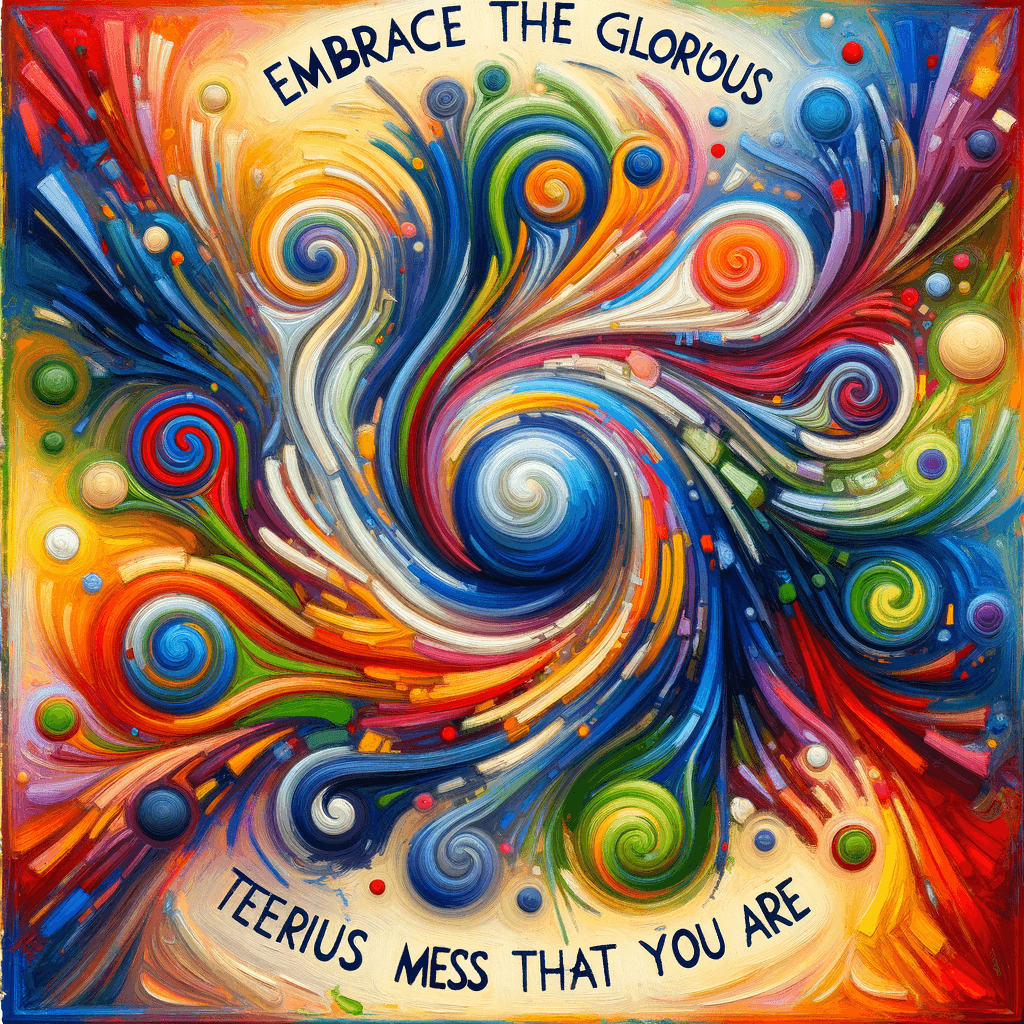
Embrace the glorious mess that you are. — Elizabeth Gilbert
—What lingers after this line?
Self-Acceptance
This quote encourages individuals to accept themselves with all their flaws, imperfections, and unique traits. Embracing one's true self is a step towards genuine self-love.
Celebrating Individuality
It highlights the beauty in diversity and individuality. Each person's 'mess' makes them unique, and this should be celebrated rather than hidden.
Overcoming Perfectionism
The quote addresses the unrealistic standard of perfection imposed by society. It suggests that one should let go of the need to appear perfect and instead appreciate their authentic selves.
Emotional Freedom
Accepting oneself as a 'glorious mess' leads to emotional freedom. It allows one to be more open, vulnerable, and honest about their true feelings and experiences.
Personal Growth
By embracing one's imperfections, individuals can better understand themselves and foster personal growth. Accepting the 'mess' is a crucial step in the journey of self-improvement and development.
Cultural Context
Elizabeth Gilbert is an American author known for her memoir 'Eat, Pray, Love.' Her works often explore themes of identity, self-discovery, and personal transformation, reflecting contemporary issues of self-acceptance and mental well-being.
One-minute reflection
Where does this idea show up in your life right now?
Related Quotes
6 selectedEmbrace the glorious mess that you are. — Elizabeth Gilbert
Elizabeth Gilbert
This quote encourages individuals to accept and love themselves with all their flaws and imperfections. Recognizing that everyone has a 'mess' within them, it promotes self-compassion and self-acceptance.
Read full interpretation →Embrace the glorious mess that you are; it is the beauty in our imperfections that transforms the ordinary into the extraordinary. — P!nk, USA.
P!nk, USA.
This quote highlights the importance of accepting oneself, flaws and all. Embracing one’s imperfections can lead to a greater sense of self-worth and identity.
Read full interpretation →Embrace the glorious mess that you are; it's in the chaos that you find your true beauty and strength. — Brene Brown, USA.
Brene Brown, USA.
This quote highlights the importance of accepting one's flaws and imperfections. By embracing our 'messiness,' we can appreciate our uniqueness and authenticity.
Read full interpretation →Imperfections are not inadequacies; they are reminders that we're all in this together. — Brené Brown, United States.
Brené Brown, United States.
Brené Brown emphasizes the idea that imperfections should not be viewed as shortcomings. Instead, they serve as reminders of our shared humanity and the collective experience of being imperfect.
Read full interpretation →Healing may not be so much about getting better, as about letting go of everything that isn't you. — Rachel Naomi Remen
Rachel Naomi Remen
Rachel Naomi Remen’s insight gently shifts healing away from the usual language of repair. Instead of imagining ourselves as broken machines that must be made efficient again, she suggests that healing may involve removi...
Read full interpretation →I wanted a perfect ending. Now I've learned, the hard way, that some poems don't rhyme, and some stories don't have a clear beginning, middle, and end. — Gilda Radner
Gilda Radner
Gilda Radner’s quote begins with a deeply human wish: the desire for a perfect ending. Most people instinctively want life to resemble a well-made story, with conflicts resolved, wounds explained, and every emotional thr...
Read full interpretation →More From Author
More from Elizabeth Gilbert →A good-enough novel violently written now is better than a perfect novel meticulously written never. — Elizabeth Gilbert
Elizabeth Gilbert’s line immediately shifts the argument from artistic purity to artistic existence. A “good-enough” novel, even one “violently written,” has entered the world and can move, provoke, or comfort someone; b...
Read full interpretation →A calm heart is a creative heart. When we release the frantic need to prove our worth, we finally make space for the life we were meant to live. — Elizabeth Gilbert
At its core, Elizabeth Gilbert’s quote proposes that creativity does not flourish in inner chaos but in emotional steadiness. A calm heart is not an empty or passive one; rather, it is a mind cleared of constant self-def...
Read full interpretation →You don't need a massive platform to change the world; you just need to be a decent human to the three people you see every day. — Elizabeth Gilbert
Elizabeth Gilbert reframes social change in strikingly modest terms: impact does not begin with fame, scale, or public recognition, but with ordinary decency practiced at close range. Rather than imagining the world as s...
Read full interpretation →Sometimes you have to stop and be bored, because boredom is the dream-killer's worst enemy. — Elizabeth Gilbert
At first glance, Elizabeth Gilbert’s remark sounds counterintuitive, because boredom is usually treated as something to escape. Yet her point turns that assumption upside down: when we stop filling every empty moment, we...
Read full interpretation →