
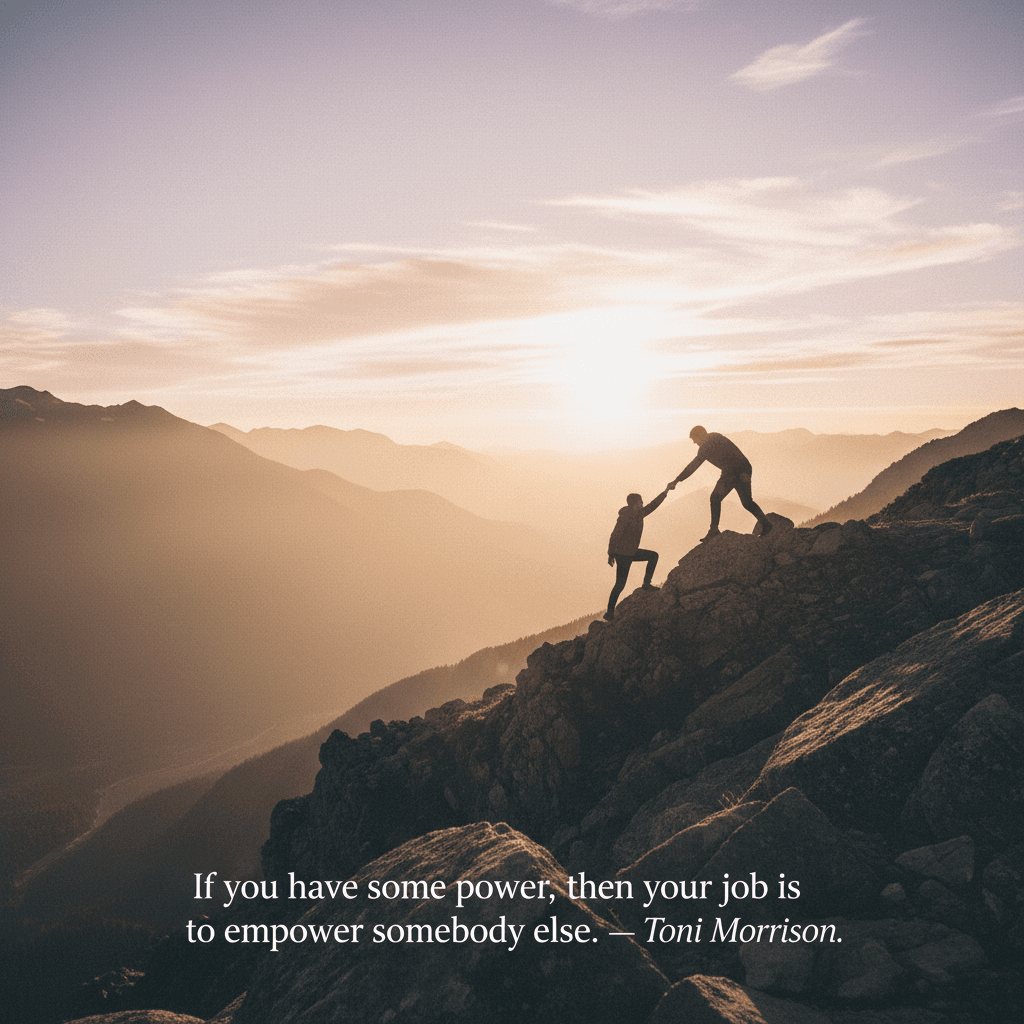
If you have some power, then your job is to empower somebody else. — Toni Morrison
—What lingers after this line?
From Possession to Responsibility
Toni Morrison’s line converts power from a private asset into a public trust. Rather than hoard influence, she argues, those who have it must turn it outward. Tellingly, Morrison modeled this ethic as an editor, using her role at Random House to lift voices the mainstream had sidelined. She shepherded The Black Book (1974), a collage of African American life that widened the historical canon, and supported landmark works like Angela Davis: An Autobiography (1974) and Gayl Jones’s Corregidora (1975). In doing so, she demonstrated that empowerment is not a slogan but a practice: redirecting attention, resources, and legitimacy to others.
Movement Builders’ Quiet Genius
Extending this idea beyond literature, movement architects made empowerment their method. Ella Baker, a strategist behind the Student Nonviolent Coordinating Committee, insisted that “strong people don’t need strong leaders” (c. 1960), emphasizing bottom-up organizing over charismatic control. Likewise, Fannie Lou Hamer’s Mississippi Freedom Democratic Party (1964) sought to transfer political voice to those excluded from it. These figures understood, as Morrison suggests, that the test of power is whether it creates more power in others—leaders who multiply leaders rather than followers who await direction.
Why Sharing Power Works
Psychology clarifies the mechanics. Self-Determination Theory shows that autonomy support—giving people meaningful choice and competence—fuels motivation and performance (Deci & Ryan, 2000). Organizations with psychological safety invite candor and error-correction, producing better learning and outcomes (Edmondson, 1999). Moreover, Dacher Keltner’s The Power Paradox (2016) argues influence is gained by advancing others but erodes when self-interest dominates. Thus Morrison’s imperative is not only moral; it is pragmatic. By designing roles and rituals that enable contribution, we create environments where initiative proliferates—and with it, durable power.
Civic Designs That Distribute Voice
Governance can encode empowerment structurally. Participatory budgeting, pioneered in Porto Alegre (1989), invites residents to direct portions of public spending. Research links this model to increased investment in poorer districts and improved health outcomes; in Brazilian cities, it correlates with reduced infant mortality as social spending rises (Touchton & Wampler, Comparative Political Studies, 2014). As versions spread to New York and Paris, the pattern holds: when people help decide, they help build. In this way, civic architectures convert Morrison’s ethos into routine practice, turning sporadic consultation into shared authority.
Workplaces: From Mentors to Sponsors
In professional settings, empowerment becomes concrete when influence is risked on someone else’s behalf. Sponsorship—using one’s capital to advocate, open doors, and attach one’s name to another’s stretch opportunity—outperforms advice-only mentorship (Hewlett, Forget a Mentor, Find a Sponsor, 2013). Recent analyses echo this: sponsored employees advance faster and are retained at higher rates (McKinsey & LeanIn.org, Women in the Workplace 2023). Practically, that means sharing credit, rotating visible assignments, making pay and criteria transparent, and keeping a public decision log so judgment becomes teachable. Through these habits, opportunity ceases to be a secret and becomes a system.
Education That Hands Over the Mic
Classrooms also reveal empowerment’s architecture. Paulo Freire’s Pedagogy of the Oppressed (1970) rejects the “banking model” of depositing facts, opting instead for dialogue that positions learners as co-creators. Building on this, bell hooks’s Teaching to Transgress (1994) frames engaged pedagogy as an ethic of shared risk and voice. When teachers surrender sole control—inviting students to frame problems, lead seminars, or co-design rubrics—agency takes root. The lesson travels: whether in schools or teams, those who own the questions soon own the future.
Making Empowerment a Daily Practice
Finally, empowerment scales through small, repeatable moves. Begin meetings by asking, “Who is not here but affected?” then reserve time to hear absent perspectives. Give away the mic—literally—by rotating facilitation and instituting a “last word” norm for junior voices. Publish playbooks, not just results, so others can reproduce success; seed microgrants so they can try. Over time, these choices compound into networks where power is less a peak to guard than a grid to light. In that glow, Morrison’s charge becomes ordinary: having some power means making more of it, in someone else’s hands.
One-minute reflection
What feeling does this quote bring up for you?
Related Quotes
6 selectedTrue leadership is recognizing the potential in others and helping them reach it. A light does not lose its brightness by lighting another flame.
lighting another flame.
True leadership involves recognizing the potential within individuals and providing them with the support and resources needed to help them achieve their full potential.
Read full interpretation →Make your story a ladder others can climb. — Toni Morrison
Toni Morrison
Toni Morrison’s charge reframes storytelling as infrastructure rather than ornament. A ladder is built to be used, held, and climbed by many hands; it implies direction, support, and shared elevation.
Read full interpretation →The delicate balance of mentoring someone is not creating them in your own image, but giving them the opportunity to create themselves. — Steven Spielberg
Steven Spielberg
At its heart, Spielberg’s remark reframes mentoring as an act of stewardship rather than control. A mentor may offer knowledge, discipline, and encouragement, yet the goal is not to reproduce a younger version of oneself...
Read full interpretation →A mentor is someone who allows you to see the hope inside yourself. — Oprah Winfrey
Oprah Winfrey
Oprah Winfrey’s line reframes hope as an internal resource rather than an external gift. A mentor, in this view, isn’t a savior who supplies confidence from the outside; instead, they help you recognize what has been the...
Read full interpretation →Your crown has been bought and paid for. All you must do is put it on. — Maya Angelou
Maya Angelou
Maya Angelou’s image of a “crown” compresses an entire philosophy of dignity into a single, vivid object. A crown typically signals status granted from outside—by lineage, institution, or public acclaim—yet Angelou refra...
Read full interpretation →Don't try to lessen yourself for the world; let the world catch up to you. — Beyoncé
Beyoncé
Beyoncé’s line starts with a clear boundary: don’t reduce your ambition, personality, or standards just to fit what others find comfortable. That “lessen yourself” can mean speaking more quietly, aiming lower, or pretend...
Read full interpretation →More From Author
More from Toni Morrison →The building of the architecture of a novel - the craft of it - is something I never tire of. — Toni Morrison
At its core, Toni Morrison’s remark celebrates not merely storytelling, but the deliberate construction behind it. By speaking of the “architecture of a novel,” she shifts attention from inspiration alone to design, sugg...
Read full interpretation →The role of art has never been to escape reality, but to help us understand it. — Toni Morrison
At first glance, art is often treated as a refuge from hardship, a private world where pain can be softened or forgotten. Toni Morrison overturns that expectation by arguing that art’s deeper purpose is not avoidance but...
Read full interpretation →The ability to endure is the discipline of the soul. — Toni Morrison
Toni Morrison’s line shifts endurance from a mere survival trait into a deliberate inner practice: a discipline cultivated in the soul. Rather than glorifying pain for its own sake, she suggests that the capacity to cont...
Read full interpretation →You are your best thing. — Toni Morrison
Toni Morrison’s line, “You are your best thing,” quietly overturns a common habit: looking outward for proof of worth. Instead of treating love, status, or achievement as the final measure, the quote plants value inside...
Read full interpretation →