
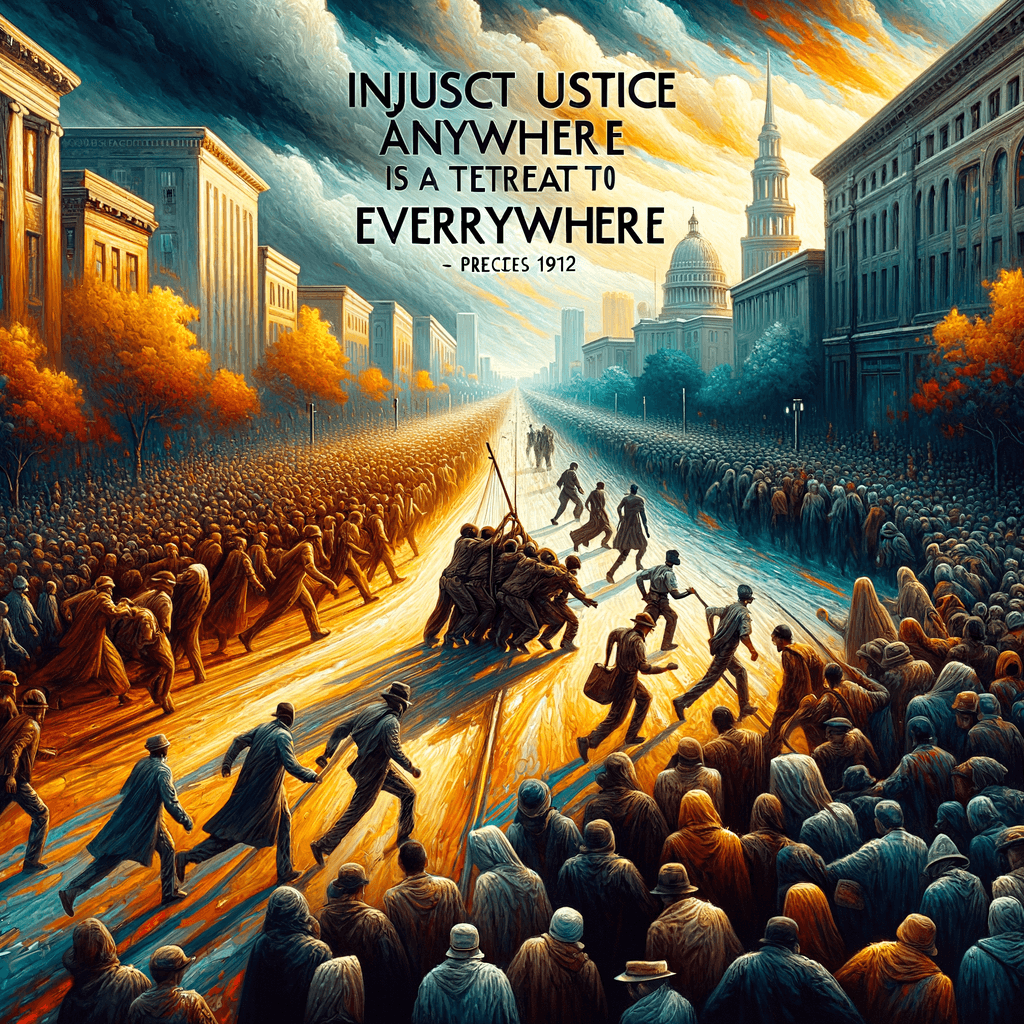
Injustice anywhere is a threat to justice everywhere. — Martin Luther King Jr., United States.
—What lingers after this line?
Interconnectedness of Justice
This quote highlights the idea that justice is not isolated to a specific location or situation; rather, it is a universal concept. Injustice in one place undermines the pursuit of justice globally.
Social Responsibility
The statement calls for collective responsibility in addressing injustice. It suggests that individuals and communities must remain vigilant and proactive in fighting against injustice to protect justice for all.
Advocacy for Human Rights
Martin Luther King Jr. was a prominent civil rights leader, and this quote emphasizes the importance of advocating for human rights. It reinforces the notion that advocating for justice is a moral obligation that transcends borders.
Prevention of a Wider Impact
The quote warns that tolerating injustice anywhere can lead to a broader acceptance of injustice. This acceptance can escalate and impact other communities, eventually affecting everyone’s rights and freedoms.
Historical Context
Martin Luther King Jr. delivered this message during the civil rights movement in the United States, a time when racial injustice was rampant. His message serves as a timeless reminder of the ongoing struggle for equality and justice worldwide.
One-minute reflection
What feeling does this quote bring up for you?
Related Quotes
6 selectedWhen you plant a question of justice, tend it with daily acts until it bears fruit — Desmond Tutu
Desmond Tutu
Desmond Tutu frames justice not as a one-time verdict but as a “question” that must be planted—something living that begins in the mind and conscience. A question implies uncertainty and moral inquiry: What is fair here?
Read full interpretation →Stand firm for justice; each steadfast heart pushes the arc toward fairness. — Emmeline Pankhurst
Emmeline Pankhurst
This quote evokes the familiar image of history as a great arc bending toward justice, yet it subtly revises the metaphor. Rather than suggesting that time naturally cures injustice, it insists that each steadfast heart...
Read full interpretation →I am no longer accepting the things I cannot change. I am changing the things I cannot accept. — Angela Y. Davis
Angela Y. Davis
Davis’s line pivots on a deliberate reversal. Where the Serenity Prayer asks for serenity to accept what cannot be changed (Niebuhr, c.
Read full interpretation →Never be afraid to raise your voice for honesty and truth and compassion against injustice and lying and greed. — William Faulkner
William Faulkner
This quote encourages individuals to stand up for what is right, even when it is difficult. It highlights the importance of having the courage to speak out in defense of honesty, truth, and compassion.
Read full interpretation →Believe in your dreams and they may come true; believe in yourself and they will come true. — Martin Luther King Jr., United States.
Martin Luther King Jr., United States.
This quote emphasizes the significance of dreaming big. Dreams serve as the foundation for aspirations, motivating individuals to strive for their goals.
Read full interpretation →Intelligence plus character—that is the goal of true education. — Martin Luther King Jr., United States.
Martin Luther King Jr., United States.
This quote emphasizes the importance of a well-rounded education that goes beyond intellectual achievement. True education should cultivate both knowledge and moral character.
Read full interpretation →More From Author
More from Martin Luther King Jr., United States. →Faith is taking the first step even when you don't see the whole staircase. — Martin Luther King Jr., United States.
This quote emphasizes that faith is about trust and belief in something greater than oneself. It suggests that faith is not always about having a clear vision of the outcome but about having the courage to begin.
Read full interpretation →Believe in your dreams and they may come true; believe in yourself and they will come true. — Martin Luther King Jr., United States.
This quote emphasizes the significance of dreaming big. Dreams serve as the foundation for aspirations, motivating individuals to strive for their goals.
Read full interpretation →Intelligence plus character—that is the goal of true education. — Martin Luther King Jr., United States.
This quote emphasizes the importance of a well-rounded education that goes beyond intellectual achievement. True education should cultivate both knowledge and moral character.
Read full interpretation →