
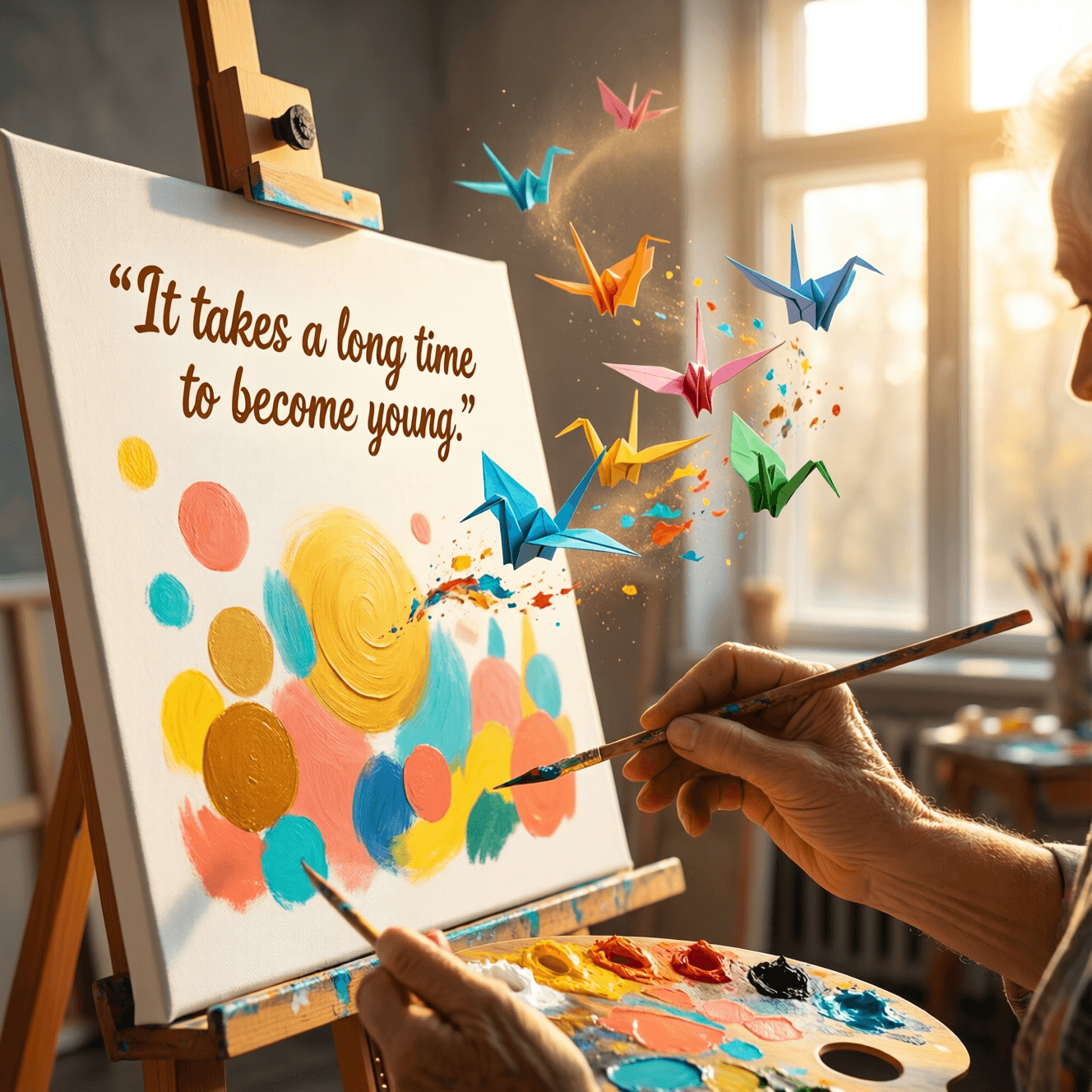
It takes a long time to become young. — Pablo Picasso
—What lingers after this line?
Youth as a Destination, Not a Starting Point
Picasso’s line flips the usual story of aging: instead of youth being something we naturally possess and then lose, he frames it as something we arrive at. In this view, “young” isn’t merely an age but a quality of attention—curiosity, openness, and responsiveness to the world. The paradox hints that what looks like effortless youthful vitality may actually be the product of years of living, failing, and recalibrating. From the outset, the quote invites a distinction between being young in years and being young in spirit. A child may have energy, but the kind of youth Picasso points to often includes a deliberate lightness that only emerges after one has carried, and then learned to set down, unnecessary weight.
Unlearning: The Slow Work Behind Fresh Eyes
If becoming young takes time, it is partly because adults accumulate habits of thought—cynicism, caution, and fixed identities—that make perception rigid. Becoming “young” again can mean unlearning those reflexes and recovering the ability to be surprised. That recovery rarely happens quickly; it comes through repeated encounters with change that force us to revise what we thought we knew. This connects to a wider idea in philosophy: many traditions treat wisdom not as adding more knowledge but as removing illusions. In that sense, youthfulness can be the clarity that appears after simplification—when you stop performing who you think you must be and return to what genuinely interests you.
Artistic Practice and the Return to Play
The quote gains extra resonance coming from Picasso, whose career shows a continual reinvention of style. Artists often spend years mastering technique, only to later pursue work that looks simpler, freer, even childlike. That “childlike” quality, however, is frequently the end point of long discipline—what many viewers mistake for spontaneity is supported by hard-won control. Seen this way, becoming young is the return to play after competence. You learn the rules, internalize them, and then—only then—can you bend them without collapsing into chaos. The apparent innocence is not naïveté; it is practiced freedom.
Aging, Identity, and the Courage to Change
As time passes, people often lock themselves into stories about who they are: the responsible one, the realist, the person who doesn’t take risks. Yet life repeatedly demonstrates that identities are provisional. Ironically, it can take decades to gain the courage to revise your self-concept—to try something new without needing permission or guarantees. Therefore, youth in Picasso’s sense may be less about reclaiming the past and more about reclaiming flexibility. It is the ability to pivot, to start again, and to admit you were wrong without feeling diminished—an emotional agility that many people only develop after enduring enough setbacks to realize that reinvention is survivable.
Joy After Grief: Lightness Earned, Not Given
Another reason becoming young takes a long time is that genuine lightness often follows hardship. Early in life, joy can be untested; later, it can become intentional. People who have faced loss sometimes describe a renewed appreciation for ordinary moments—a walk, a conversation, a meal—because they understand how quickly things change. In this progression, youthfulness looks like the ability to feel fully without being permanently hardened by pain. It is not denial but restoration: choosing tenderness, humor, and presence after experience has given you many reasons to withdraw.
Practical Ways to ‘Become Young’ Over Time
Ultimately, Picasso’s sentence reads like an invitation: treat youth as a practice. You cultivate it by staying curious—learning new skills, talking to people outside your circle, traveling if possible, or simply changing your routine enough to notice your environment again. Just as importantly, you protect it by reducing what dulls perception: constant distraction, chronic overwork, and relationships that punish honesty. Over time, these small choices accumulate into a recognizable stance toward life. The “long time” is not a lament; it’s the point. Youth, understood as aliveness and creative attention, may be one of the few gifts that deepens precisely because it is earned.
One-minute reflection
Why might this line matter today, not tomorrow?
Related Quotes
6 selectedSerious art is born from serious play. — Julia Cameron
Julia Cameron
At first glance, Julia Cameron’s line seems contradictory: how can play be serious, and how can seriousness produce art without becoming rigid? Yet that tension is precisely her point.
Read full interpretation →Adults can benefit from play as much as children. Go ahead and dance with your dog or build something just for fun. — Dr. Elinore McCance-Katz
Katz
At first glance, Dr. Elinore McCance-Katz’s quote sounds almost disarmingly simple, yet it challenges a common adult assumption: that play belongs mainly to childhood.
Read full interpretation →Adults can benefit from play as much as children—not just as a reward, but something that helps regulate. — Valentina Ogaryan
Valentina Ogaryan
Valentina Ogaryan’s quote opens by challenging the common assumption that play is primarily for children or reserved for leisure after “real work” is done. Instead, it proposes that adults benefit just as deeply—suggesti...
Read full interpretation →We are here on Earth to fart around, and don't let anybody tell you different. — Kurt Vonnegut
Kurt Vonnegut
Vonnegut’s line punctures the solemn insistence that life must be justified by lofty missions, heroic productivity, or cosmic significance. By saying we are here “to fart around,” he offers a deliberately vulgar, comic a...
Read full interpretation →I get up every morning determined to both change the world and have one hell of a good time. Sometimes this makes planning the day difficult. — E.B. White
E.B. White
E.B. White’s line captures a familiar tension that begins the moment we wake: the urge to do something meaningful with our lives while still relishing the pleasures of the day.
Read full interpretation →From time to time it is good to be a little crazy; it makes life interesting. - Miguel de Cervantes
Miguel de Cervantes
This quote highlights the importance of spontaneity in life. Embracing moments of craziness can bring excitement and prevent life from becoming monotonous.
Read full interpretation →More From Author
More from Pablo Picasso →It is not the language of painters but the language of nature which one should listen to. — Pablo Picasso
At first glance, Picasso’s remark challenges the authority of artistic convention. By contrasting ‘the language of painters’ with ‘the language of nature,’ he suggests that art should not merely imitate established techn...
Read full interpretation →The chief enemy of creativity is good sense. — Pablo Picasso
At first glance, Picasso’s claim sounds like a provocation against reason itself. Yet his point is subtler: ‘good sense’ often means the habits, rules, and social expectations that keep people from taking imaginative ris...
Read full interpretation →The artist is a receptacle for emotions that come from all over the place: from the sky, from the earth, from a scrap of paper, from a passing shape, from a spider's web. — Pablo Picasso
At the heart of Picasso’s remark is a striking redefinition of creativity: the artist is not merely a maker, but a receiver. Rather than inventing emotion from nothing, the artist absorbs impressions that drift in from t...
Read full interpretation →Computers are useless. They can only give you answers. — Pablo Picasso
Pablo Picasso’s jab—“Computers are useless. They can only give you answers.”—is less a literal dismissal than a provocation about what humans value.
Read full interpretation →