
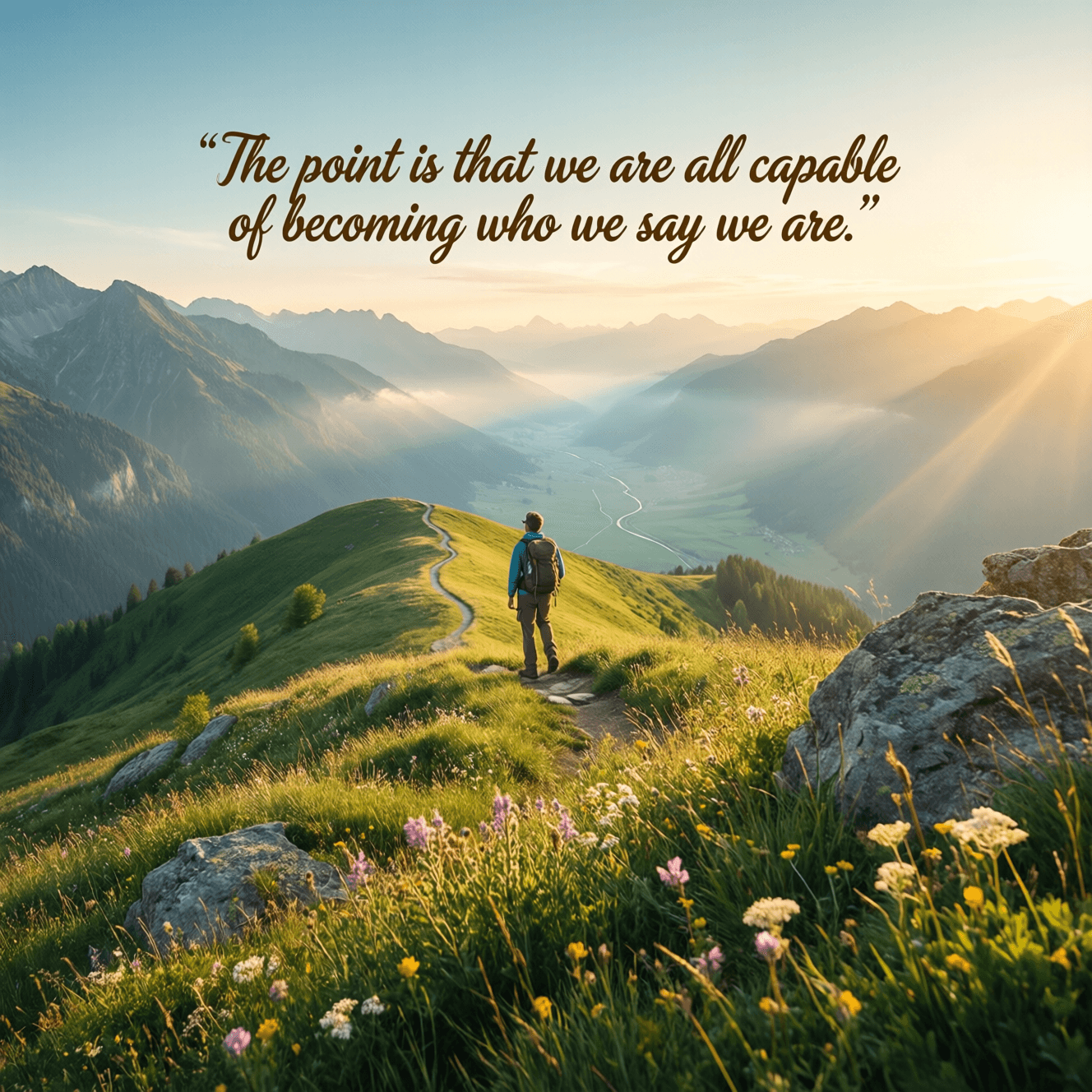
The point is that we are all capable of becoming who we say we are. — Cheryl Strayed
—What lingers after this line?
A Claim About Human Potential
Cheryl Strayed’s line hinges on a simple but demanding premise: identity is not only discovered, it is enacted. When she says we are capable of becoming who we say we are, she treats our self-descriptions as more than hopeful slogans—they are early drafts of a future self. From there, the quote shifts responsibility back to the speaker. If a person declares, “I’m someone who tells the truth,” or “I’m a steady parent,” the statement is not a report card on the past but a direction for the next set of choices, implying that capability is widespread even when circumstances differ.
Words as Commitments, Not Decorations
If identity can be enacted, then language matters because it frames the commitments we are willing to make. Strayed’s emphasis on “who we say we are” suggests that naming our values publicly or privately can become a kind of contract, raising the cost of inconsistency. This is why everyday moments feel so decisive: promising yourself you are “a writer” quietly asks you to write when no one applauds; claiming you are “sober” asks you to endure an evening of discomfort without bargaining. In that sense, the quote highlights how self-definition can become a lever that moves behavior.
The Gap Between Intention and Habit
Of course, the hard part is that intention doesn’t automatically rewrite habit. Strayed’s point can sound optimistic, but it also acknowledges the distance between aspiration and daily practice—the space where most people get discouraged. Yet capability often shows up precisely as repetition. A person who says they are “calm under pressure” doesn’t become that by one heroic performance; they become it by small rehearsals: pausing before replying, breathing through uncertainty, returning to the task. Gradually, what began as a claimed identity starts to feel like a lived one.
Freedom Within Constraints
Still, not everyone has the same resources, safety, or time, so becoming who we say we are cannot mean that all outcomes are equally available. Instead, the quote reads more convincingly as an argument for agency within constraints: even when the world limits our options, we retain some power to choose the next honest step. That might look like the caretaker who can’t change jobs yet but can study at night, or the anxious student who can’t erase fear but can show up anyway. The capability Strayed points to is less about perfect control and more about persistent, directional movement.
Narrative Identity and Self-Authorship
Because humans think in stories, identity often becomes a narrative we revise. Strayed’s sentence implies that self-authorship is real: we can edit the plot not by rewriting what happened, but by changing what happens next. This echoes the idea that meaning is not fixed to events alone but to the role we choose to play after them. Someone who has failed can still say, “I’m resilient,” and then prove it through the next attempt; someone who has been hurt can still say, “I’m someone who protects my boundaries,” and then practice that protection. The story becomes credible through action.
Turning the Quote Into Practice
The most practical reading of Strayed’s claim is to treat identity statements as behavioral prompts. Instead of asking, “Am I already this person?” the better question becomes, “What would this person do today?” From there, the transformation stays manageable: choose one repeated act that matches the identity you’ve named, and make it small enough to sustain. Over time, the words stop being a wish and become evidence. In that closing loop—saying, doing, and then believing because you’ve done—you can see what Strayed is ultimately defending: the ordinary, human capacity to become coherent with our own claims.
One-minute reflection
What feeling does this quote bring up for you?
Related Quotes
6 selectedTrue belonging only happens when we present our authentic, imperfect selves to the world. — Brené Brown
Brené Brown
Brené Brown’s line draws an immediate boundary between belonging and fitting in. Fitting in is a strategy—adjusting yourself to match what you think a group wants—while belonging is an experience of being received as you...
Read full interpretation →True belonging only happens when we present our authentic, imperfect selves to the world. — Brené Brown
Brené Brown
Brené Brown’s claim begins by separating two experiences that often masquerade as the same thing: fitting in and belonging. Fitting in is conditional—an ongoing performance calibrated to earn acceptance—whereas belonging...
Read full interpretation →Authenticity is the daily practice of letting go of who we think we're supposed to be. — Brené Brown
Brené Brown
Brené Brown frames authenticity not as something we either “have” or “lack,” but as a repeated, lived discipline. By calling it a “daily practice,” she implies that realness isn’t a single declaration—it's a set of choic...
Read full interpretation →There is a quiet power in the ability to simply be, to exist without the need for constant performance. — Eileen Caddy
Eileen Caddy
Eileen Caddy’s words begin with a gentle challenge to modern restlessness: we often feel compelled to prove our worth through productivity, charm, achievement, or constant visibility. Yet her phrase “quiet power” suggest...
Read full interpretation →Be who you are and say what you feel, because those who mind don't matter, and those who matter don't mind. — Bernard M. Baruch
Bernard M. Baruch
Baruch’s quote begins with a simple but demanding instruction: be yourself and speak honestly. At its core, the line argues that authenticity is not merely a personality trait but an act of courage, especially in a world...
Read full interpretation →You're born an original—don't die a copy. — John Mason
John Mason
At its core, John Mason’s line is a sharp reminder that every person begins life with a distinct combination of temperament, talent, and perspective. To be “born an original” suggests that individuality is not something...
Read full interpretation →More From Author
More from Cheryl Strayed →Let yourself be gutted. Let it open you. Start there. — Cheryl Strayed
At first glance, Cheryl Strayed’s words sound brutal, yet their force lies in invitation rather than destruction. To be “gutted” is to be stripped of pretense, certainty, and emotional armor; however, Strayed immediately...
Read full interpretation →When you feel overwhelmed, stop looking at the mountain and start looking at your feet. The next right action is the only one that exists. — Cheryl Strayed
Cheryl Strayed’s line begins by naming a familiar problem: when a challenge becomes a “mountain,” the mind instinctively tries to comprehend the entire climb at once. That leap in scale turns uncertainty into panic, beca...
Read full interpretation →The truth is that you can't change your life until you change your life. — Cheryl Strayed
Cheryl Strayed’s line sounds like a tautology on purpose: it traps us inside the circular logic we often use to delay action. We say we want a new life, but we keep waiting for the feeling of being “ready,” for clarity,...
Read full interpretation →Healing is a small and ordinary and very burnt thing. And it's one thing and one thing only: it's doing what you have to do. — Cheryl Strayed
Cheryl Strayed strips healing of its usual glow and spectacle, describing it instead as “small and ordinary and very burnt.” In that framing, recovery isn’t a cinematic turning point or a single enlightened insight; it’s...
Read full interpretation →