
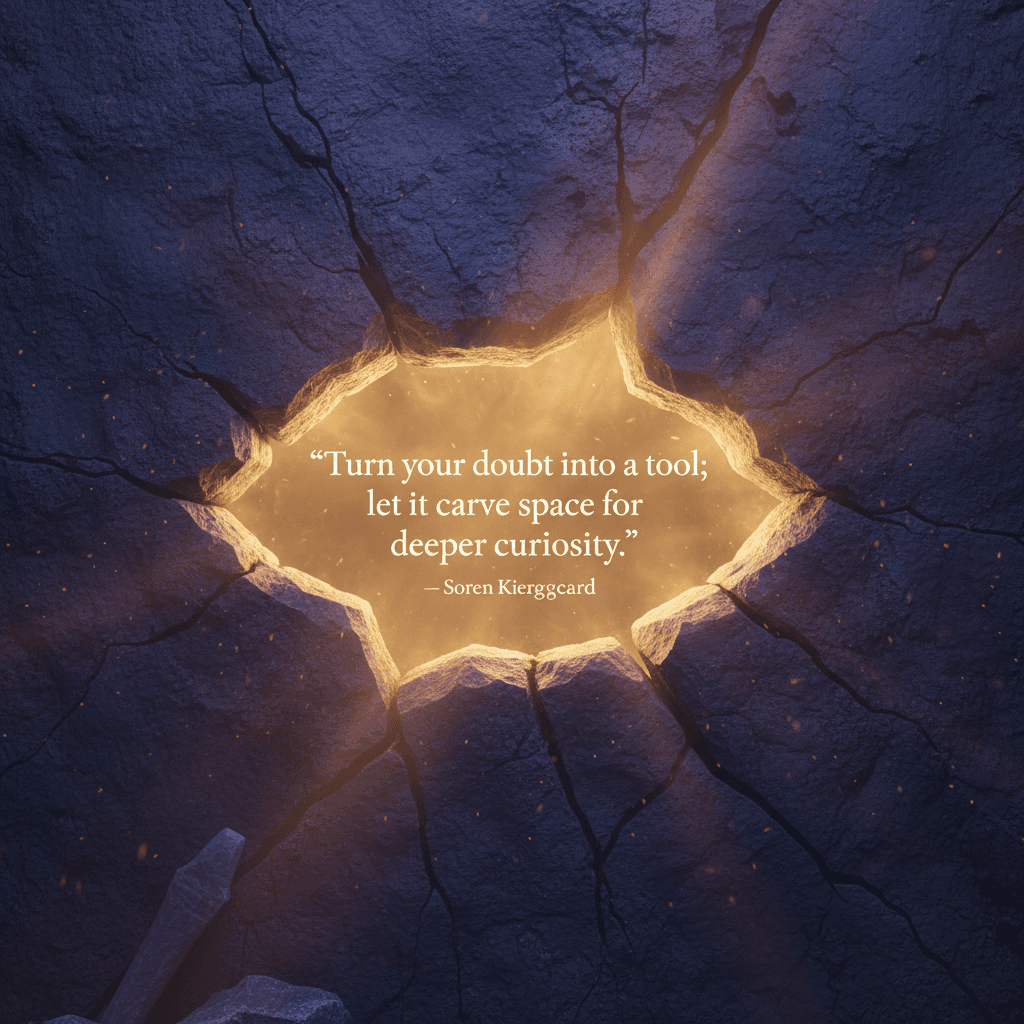
Turn your doubt into a tool; let it carve space for deeper curiosity. — Søren Kierkegaard
—What lingers after this line?
From Anxiety to Direction
Kierkegaard treats uncertainty not as a defect but as a doorway. In “The Concept of Anxiety” (1844), he describes anxiety as the dizziness of freedom—an unsettling but fertile state that precedes choice. Likewise, “Fear and Trembling” (1843) dramatizes how inward struggle can refine commitment rather than destroy it. In this light, to turn doubt into a tool is to let it hollow out space within us—a chamber where better questions can echo and mature. The hollow is not emptiness; it is room to breathe, notice, and choose with awareness. Consequently, doubt becomes less a threat and more an instrument of attunement. Instead of rushing to premature certainty, we permit uncertainty to slow us, sharpening attention. This reframing prepares us for older traditions that also used doubt as craft rather than crisis.
From Socratic Aporia to Existential Inwardness
Socrates honed doubt through elenchus, leading interlocutors to aporia—a productive impasse. Plato’s dialogues like “Meno” and “Apology” show how recognizing ignorance catalyzes genuine learning. Kierkegaard modernizes this posture: under the pseudonym Johannes Climacus, he argues in “Concluding Unscientific Postscript” (1846) that truth must be inwardly appropriated. System-building that abolishes uncertainty misses existence’s living tension. Thus, the move from Socratic not-knowing to Kierkegaardian inwardness is a deepening: doubt is no longer simply logical hygiene; it is an existential practice. And this practice, far from paralyzing, clears the ground for disciplined inquiry elsewhere—most visibly in science.
Uncertainty as Science’s Engine
Descartes’s “Meditations” (1641) advances methodic doubt to rebuild knowledge, yet Charles S. Peirce’s “The Fixation of Belief” (1877) insists that only genuine, felt doubt motivates investigation. Karl Popper’s “Conjectures and Refutations” (1963) turns this into a program: knowledge grows by proposing bold claims and inviting their refutation. Richard Feynman’s plainspoken credo—“I can live with doubt and uncertainty and not knowing” (The Pleasure of Finding Things Out, 1999)—echoes this ethos. Collectively, these voices show how uncertainty, handled correctly, increases contact with reality. Rather than craving closure, we test, revise, and iterate. From here, the question becomes practical: how do we carve such space in day-to-day thinking?
Techniques that Carve Cognitive Space
Language can turn doubt into a tool. Reframe judgments as questions: “How might this be wrong?” or “What would change my mind?” The design prompt “How might we…?” keeps options open while directing effort. Taiichi Ohno’s Toyota Production System describes the “5 Whys,” a simple way to dig beneath surface explanations (c. 1970s). Similarly, an “assumption parking lot” externalizes untested beliefs so they can be examined later. To sustain the space you’ve opened, schedule it: timebox exploration before deciding. Create an “unknowns map” listing knowns, known unknowns, and risky unknowns. Each technique widens the aperture of attention, converting vague unease into tractable lines of inquiry—an operational form of Kierkegaard’s counsel.
Habits That Turn Doubt into Momentum
Rituals help doubt compound into insight. Keep a prediction log with explicit probabilities; then track outcomes to calibrate confidence. Philip Tetlock and Dan Gardner’s “Superforecasting” (2015) shows how continual feedback refines judgment. Likewise, a short daily entry—What did I learn? What surprised me? What evidence shifted my view?—turns reflection into a repeatable loop. Over time, these habits convert sporadic skepticism into steady curiosity. Doubt ceases to be a stop sign and becomes a steering wheel, guiding attention to where learning is richest.
Humility, Dialogue, and Ethical Space
Curiosity deepens when doubt is shared. Martin Buber’s “I and Thou” (1923) portrays dialogue as meeting, not conquest. Entering conversation with provisional beliefs invites the other’s perspective to widen our horizon. William James’s “The Will to Believe” (1896) adds a caution and a permission: where evidence underdetermines action, commitment may be ethical—provided we remain corrigible. Thus, intellectual humility is not self-effacement but respect for reality and for others. Doubt, held ethically, creates space not only in the mind but between people, where questions can breathe.
Closing the Loop Without Closing the Mind
Doubt must eventually yield to decision. Herbert Simon’s notion of satisficing (1956) offers a humane standard: choose the option that clears a threshold of adequacy under constraints, then keep learning. A pre-mortem (Gary Klein, 2007) anticipates failure modes before committing, preserving doubt’s benefits without stalling action. Finally, return to Kierkegaard: uncertainty is not erased but inhabited. When doubt is used as a tool—precisely and patiently—it carves space where deeper curiosity can take root, and from that rootedness, better choices grow.
One-minute reflection
What feeling does this quote bring up for you?
Related Quotes
6 selectedStep forward with curiosity; the path will reveal itself beneath your feet. — Søren Kierkegaard
Søren Kierkegaard
Kierkegaard’s line invites us to act before we possess total clarity. Instead of waiting for a fully mapped-out route, he suggests that the path appears as we advance.
Read full interpretation →Leap toward the question that scares you; the answer often waits beyond comfort. — Søren Kierkegaard
Søren Kierkegaard
Kierkegaard’s provocation suggests that fear is not merely an alarm but an arrow—pointing toward the inquiries that matter most. When a question unsettles us, it often touches our identity, our loyalties, or the stories...
Read full interpretation →Begin where the doubt is loudest; your motion will quiet it — Søren Kierkegaard
Søren Kierkegaard
To begin where doubt is loudest is to confront the precise point of paralysis, and Kierkegaard suggests that motion—not mere rumination—turns noise into signal. Action creates contact with reality; it tests possibilities...
Read full interpretation →Don't be intimidated by what you don't know. That can be your greatest strength. — Sara Blakely
Sara Blakely
At first glance, Sara Blakely’s quote sounds like a simple encouragement, yet it points to a deeper truth: ignorance is not always a weakness. When people are not trapped by assumptions about how things are “supposed” to...
Read full interpretation →Be a loner. That gives you time to wonder, to search for the truth. Have holy curiosity. Make your life worth living. — Albert Einstein
Albert Einstein
At first glance, Einstein’s advice to “be a loner” may sound like a rejection of society, yet his deeper point is about protecting the inner space where thought can mature. Solitude gives a person room to hear their own...
Read full interpretation →Sometimes, you have to find new angles on life to keep you interested. — John Travolta
John Travolta
John Travolta’s remark begins with a simple but revealing truth: interest in life is not always automatic; sometimes it must be actively rekindled. By suggesting that we ‘find new angles,’ he implies that boredom often c...
Read full interpretation →More From Author
More from Søren Kierkegaard →Where you stand determines what you see and what you do not see; a change in where you stand changes everything. — Søren Kierkegaard
Kierkegaard’s insight begins with a simple but unsettling claim: vision is never neutral. Where we stand—socially, emotionally, spiritually, or intellectually—determines not only what comes into view but also what remain...
Read full interpretation →Hope is passion for the possible. — Søren Kierkegaard
At first glance, Kierkegaard’s line transforms hope from a passive feeling into an active force. To call hope “passion for the possible” means that hope is not mere daydreaming; rather, it is an inward energy that leans...
Read full interpretation →To know what you want to do and to do it is the same courage. — Søren Kierkegaard
At first glance, Kierkegaard’s line seems to separate thought from action, yet it quickly reunites them under a single demand: courage. To know what one truly wants is not a passive discovery, because genuine self-knowle...
Read full interpretation →The most common form of despair is not being who you are. — Søren Kierkegaard
Kierkegaard’s line reframes despair as something subtler than grief or temporary unhappiness. Rather than treating it as a passing mood, he points to a spiritual and existential condition: the suffering that arises when...
Read full interpretation →