
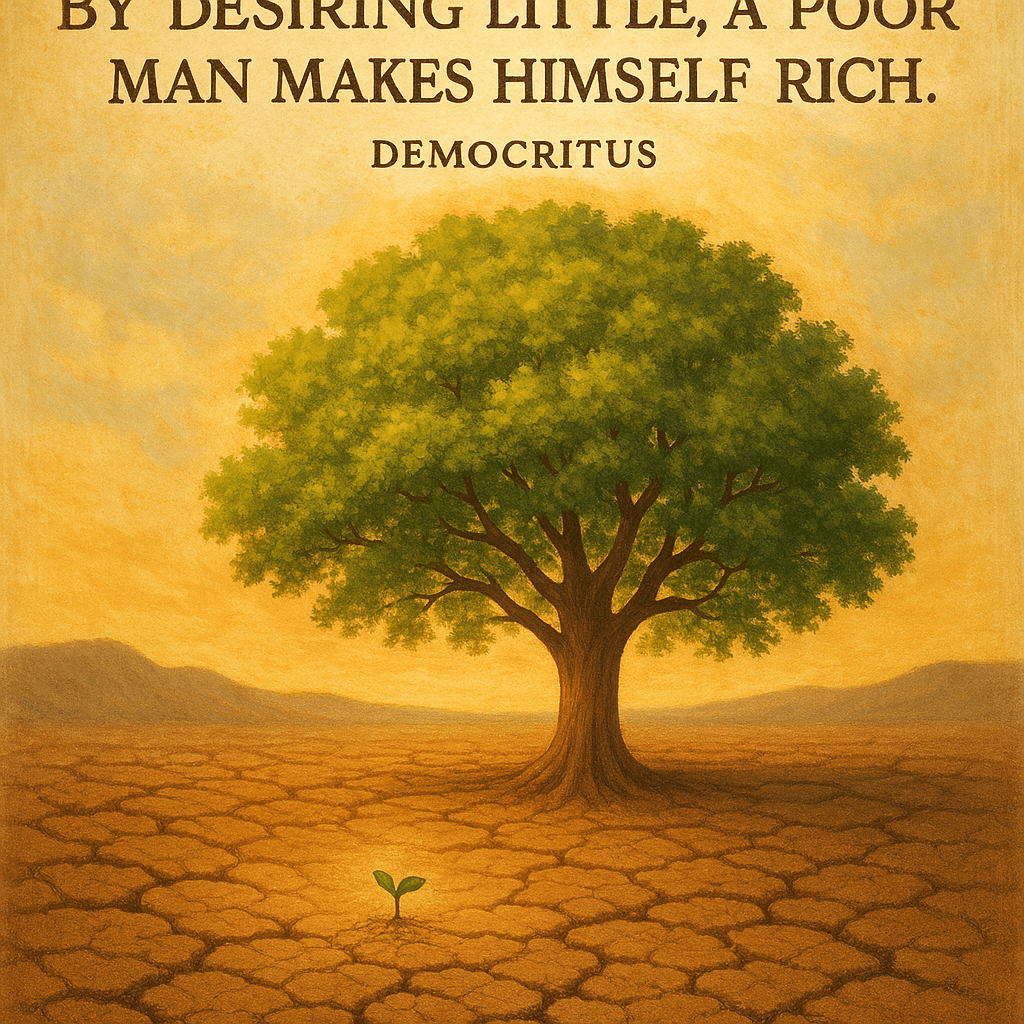
By desiring little, a poor man makes himself rich. — Democritus
—What lingers after this line?
Democritus and the Value of Modest Desires
Democritus, an ancient Greek philosopher, is renowned for his emphasis on inner riches over material wealth. By proposing that 'desiring little' enables a poor person to feel rich, he subverts conventional definitions of wealth. Rather than equating abundance with external possessions, Democritus points to the mind’s power to redefine satisfaction—a theme that would influence numerous philosophical traditions.
Echoes in Stoic Philosophy
Transitioning from Democritus's insight, the Stoic philosophers of ancient Rome adopted a similar stance. Figures such as Seneca and Epictetus frequently argued that peace of mind originates from curbing desires, not from accumulating goods. Seneca’s Letters on Ethics describe how one who requires little is not truly poor, for even meager resources can suffice for happiness. This connection bridges Democritus’s thought to broader ethical frameworks.
Cultural Narratives on Simplicity
Stories of contentment with little are woven throughout world cultures. For instance, in Buddhist teachings, monks are encouraged to own only basic necessities, emphasizing spiritual wealth over physical comfort. Leo Tolstoy’s tale, 'How Much Land Does a Man Need?’ graphically illustrates how endless wanting leads to ruin, whereas restraint preserves both life and happiness. Thus, literature and religion reaffirm the wisdom of modest longing.
Psychological Insights Into Happiness
Modern psychology supports these ancient perspectives. Studies on subjective well-being, such as those by Daniel Kahneman and Angus Deaton (2010), suggest that beyond a basic threshold, increased wealth has diminishing returns on happiness. Cultivating gratitude and managing expectations—key facets of 'desiring little'—consistently correlate with higher life satisfaction. This scientific evidence merges seamlessly with Democritus’s ancient intuition.
Practical Applications in Contemporary Life
Finally, in today’s consumer-driven world, Democritus’s message is more pertinent than ever. Practices like minimalism and voluntary simplicity offer frameworks for reducing desires and finding fulfillment without excess. By embracing these principles, individuals can experience the psychological freedom and richness Democritus described, turning perceived poverty into genuine abundance through an intentional mindset.
One-minute reflection
Where does this idea show up in your life right now?
Related Quotes
6 selectedThe greatest wealth is to live content with little. — Plato
Plato
This quote highlights the importance of finding contentment and happiness in simplicity rather than material possessions. It suggests that true wealth comes from a satisfied mind and spirit.
Read full interpretation →If you desire to be rich, do not add to your money, but subtract from your desire. — Plutarch
Plutarch
This quote highlights that true happiness comes not from accumulating wealth but from being content with what one has. Reducing excessive desires leads to a more fulfilled and peaceful life.
Read full interpretation →Wealth consists not in having great possessions, but in having few wants. — Epictetus
Epictetus
Epictetus reframes the concept of wealth from accumulation to contentment. Rather than measuring riches by outward abundance, he suggests true wealth lies in one's ability to limit desires.
Read full interpretation →Wealth consists not in having great possessions, but in having few wants. — Epictetus
Epictetus
Epictetus, a prominent Stoic philosopher, reframes the idea of wealth from material accumulation to internal contentment. In his *Discourses* (c.
Read full interpretation →To live content with small means; to seek elegance rather than luxury. — Henry David Thoreau
Henry David Thoreau
Henry David Thoreau’s statement encourages the virtue of contentment through minimalism. Rather than aspiring to endless abundance, he proposes that genuine satisfaction springs from making peace with ‘small means.’ This...
Read full interpretation →I have learned that to be with those I like is enough. — Walt Whitman
Walt Whitman
Whitman’s line reduces happiness to something disarmingly plain: the presence of beloved company. Rather than chasing wealth, status, or elaborate pleasures, he suggests that being with people one genuinely likes can alr...
Read full interpretation →More From Author
More from Democritus →Happiness resides not in possessions, and not in gold, happiness dwells in the soul. — Democritus
Democritus suggests that true happiness comes from within oneself and the state of one's soul rather than external possessions or wealth. Material goods alone cannot provide lasting satisfaction.
Read full interpretation →Words are but the shadows of actions. — Democritus
Democritus, an ancient Greek philosopher, profoundly suggests that words alone are mere reflections or shadows of genuine deeds. His statement invites us to look past language and to recognize that true value and intent...
Read full interpretation →