
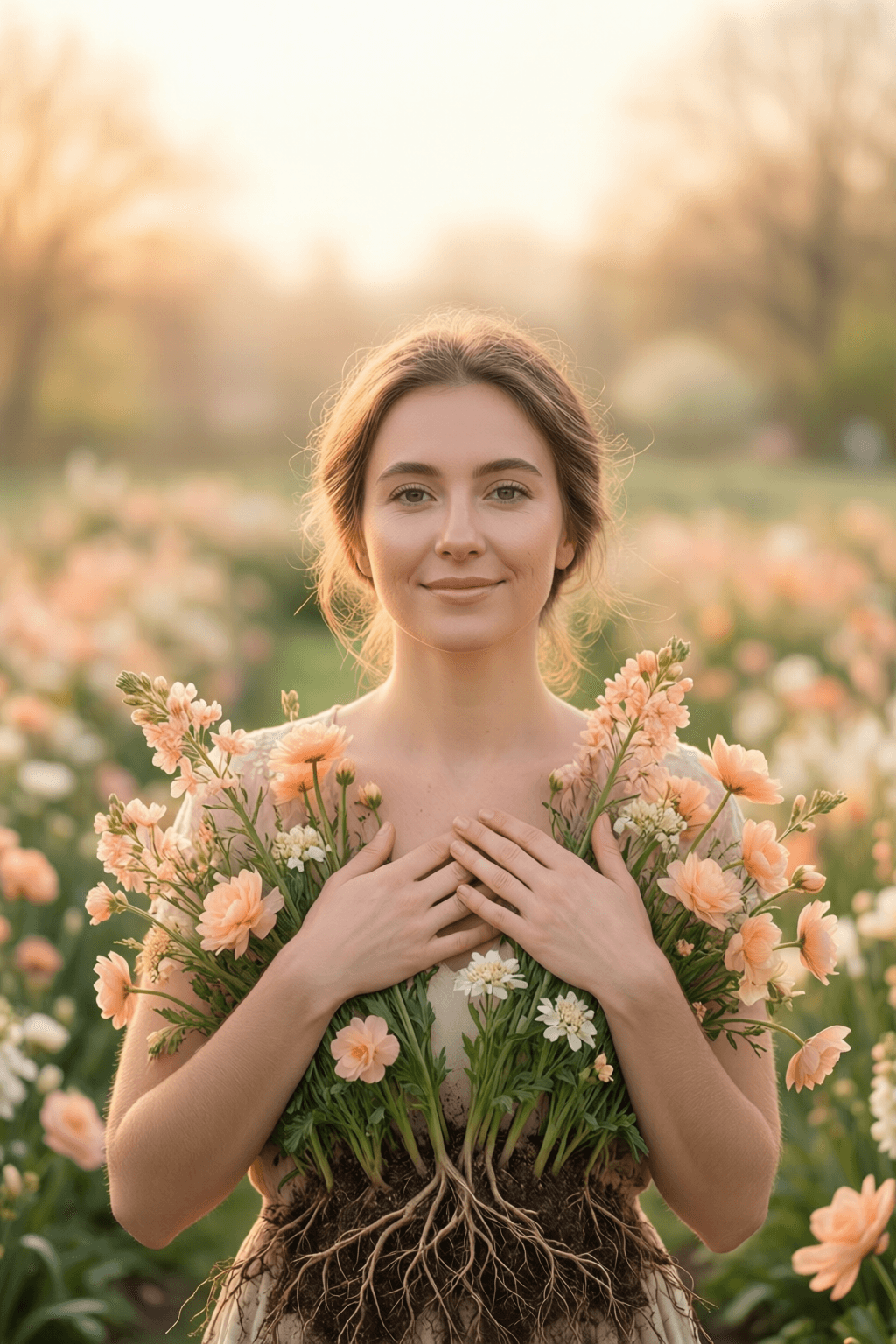
My body is a garden rooted in gratitude. Thank you is the biggest poem i've got inside of me. — Sabrina Benaim
—What lingers after this line?
The Body as Living Landscape
At first, Sabrina Benaim’s line transforms the body into a garden, a place of growth, care, and seasonal change. By saying the body is “rooted in gratitude,” she suggests that thankfulness is not a passing mood but a sustaining force buried deep beneath the surface. The image makes the self feel organic rather than mechanical, alive because it is nourished from within. In this way, the quote gently shifts attention from appearance to cultivation. A garden is not valued for perfection but for tending, resilience, and renewal, and that comparison gives the body a tenderness often missing from modern language about the self.
Gratitude as a Form of Grounding
From that bodily image, the quote moves naturally into the emotional life that supports it. Gratitude here acts like soil: quiet, unseen, yet essential. Rather than presenting thankfulness as simple politeness, Benaim frames it as a grounding practice that stabilizes identity and helps a person remain connected to life even in difficulty. This idea echoes broader literary and spiritual traditions in which gratitude becomes a mode of survival. For instance, Mary Oliver’s poetry, especially in *Thirst* (2006), often treats attention and thankfulness as ways of staying spiritually awake. Benaim’s phrasing carries a similar energy, where gratitude is less an obligation than a life-source.
Why “Thank You” Becomes a Poem
As the quote unfolds, “Thank you” grows larger than ordinary speech and becomes “the biggest poem” inside the speaker. This is a striking reversal: instead of poetry being ornate or distant, it emerges from the simplest possible phrase. Benaim suggests that true poetic force may come not from complexity, but from sincerity so full it overflows language’s usual boundaries. Consequently, gratitude becomes creative expression. The speaker does not merely feel thankful; she carries that feeling as an inner composition, something rhythmic, expansive, and alive. In that sense, the poem is not written on paper first—it is written in the body, then spoken outward.
Inner Abundance and Emotional Healing
Seen more deeply, the quote also hints at healing. To say that the largest poem inside oneself is “thank you” implies an inner life shaped not only by pain or memory, but by abundance. This does not erase suffering; rather, it suggests that gratitude can coexist with it and gradually reorganize the way one inhabits the self. That perspective aligns with contemporary spoken-word traditions, where personal testimony often transforms vulnerability into renewal. Benaim, known for emotionally candid performance poetry, frequently writes from the tension between hurt and recovery. Here, gratitude sounds hard-won, which makes it feel less sentimental and more enduring.
A Feminine Voice Reclaiming the Self
At the same time, the quote can be read as a reclaiming of the body through language. Bodies, especially women’s bodies, are often described from the outside—judged, measured, or objectified. Benaim instead describes the body from within, not as an object to be viewed but as a sacred, growing space shaped by feeling and self-knowledge. Therefore, the metaphor of the garden carries quiet resistance. It restores intimacy and agency, allowing the speaker to define her body through nourishment, rootedness, and expression. The result is a vision of embodiment that feels generous rather than defensive.
The Universal Invitation of the Quote
Finally, the power of the line lies in how personally it speaks while still inviting others in. Most people know what it means to carry unspoken feelings, yet Benaim imagines the deepest one as gratitude rather than fear. That choice offers a subtle challenge: what might change if we treated thankfulness as something central to our identity instead of peripheral to it? By ending on “the biggest poem,” the quote leaves readers with a sense of inward vastness. Gratitude is not reduced to a social reflex; it becomes a creative, bodily, and even spiritual force. In turn, the self appears not empty or fractured, but fertile enough to bloom.
Recommended Reading
As an Amazon Associate, we earn from qualifying purchases.
One-minute reflection
What feeling does this quote bring up for you?
Related Quotes
6 selectedGratitude is the fairest blossom which springs from the soul. — Henry Ward Beecher
Henry Ward Beecher
At first glance, Henry Ward Beecher’s metaphor turns gratitude into something living and visible: a blossom emerging from the hidden depths of the soul. By choosing the image of a flower, he suggests that thankfulness is...
Read full interpretation →Be like a lotus. Let the beauty of your heart speak. Be grateful to the mud, water, air, and the light. — Amit Ray
Amit Ray
The lotus thrives in muddy waters, symbolizing the ability to grow and flourish despite challenging and adverse circumstances. It encourages embracing difficulties as they contribute to personal growth.
Read full interpretation →Awaken each day with a heart full of gratitude; let your actions be the petals of kindness that blossom into a garden of joy and inspiration for all. — Unknown, Global.
Unknown, Global.
This quote emphasizes the importance of starting each day with a thankful mindset. Practicing gratitude can set a positive tone and enhance overall well-being.
Read full interpretation →The broken will always be able to love harder than most. Once you've been in the dark, you learn to appreciate everything that shines. — Ann Voskamp
Ann Voskamp
Ann Voskamp’s reflection begins with a striking claim: those who have been broken often love with unusual intensity. The idea is not that pain is noble in itself, but that suffering can strip away superficial assumptions...
Read full interpretation →Gratitude is the closest thing to beauty manifested in an emotion. — Mindy Kaling
Mindy Kaling
At first glance, Mindy Kaling’s line suggests that beauty is not only something we see but something we feel. Gratitude becomes a kind of inward radiance, transforming an ordinary emotional response into something almost...
Read full interpretation →To care for those who once cared for us is one of the highest honors. — Tia Walker
Tia Walker
At its heart, Tia Walker’s quote frames caregiving as more than duty; it becomes a moral act of gratitude. When those who once protected, fed, taught, or comforted us begin to need help themselves, stepping forward feels...
Read full interpretation →More From Author
More from Sabrina Benaim →