
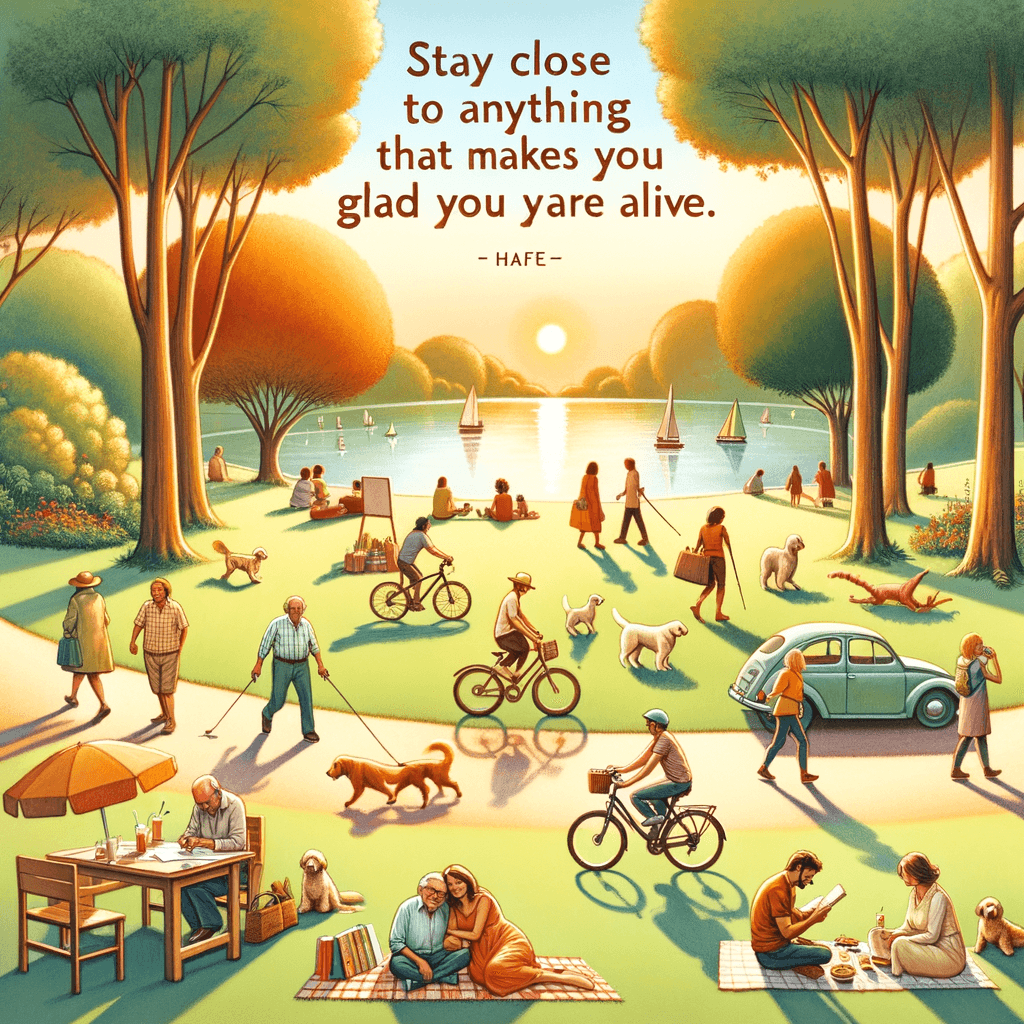
Stay close to anything that makes you glad you are alive. — Hafez
—What lingers after this line?
Pursuit of Happiness
This quote encourages individuals to seek out and remain close to the people, activities, and places that bring them joy and fulfillment. It's a reminder to prioritize our well-being by surrounding ourselves with positive influences.
Mindfulness and Presence
It suggests practicing mindfulness and being present in moments that uplift our spirit. By recognizing and cherishing these moments, one can live a more enriched and contented life.
Mental Health
Hafez's quote highlights the importance of mental health. Staying close to things that bring joy can reduce stress and anxiety, leading to a healthier mental and emotional state.
Purpose and Fulfillment
Being close to what makes one glad to be alive can also provide a sense of purpose and fulfillment. By identifying and embracing what we love, we can lead more meaningful lives.
Personal Growth
This advice promotes personal growth, as surrounding oneself with positive influences and experiences encourages growth, learning, and development.
Historical Context
Hafez, a 14th-century Persian poet, often wrote about love, spirituality, and the joys and sorrows of life. His work continues to inspire with its deep understanding of human nature and the pursuit of happiness.
One-minute reflection
What's one small action this suggests?
Related Quotes
6 selectedLearn to be thankful for what you already have, while you pursue all that you want. — Jim Rohn
Jim Rohn
Jim Rohn’s advice begins with a delicate balance: appreciation for the present should not cancel ambition for the future. Instead, gratitude and aspiration can move together, like two steps in the same journey.
Read full interpretation →You are not Atlas carrying the world on your shoulder. It is good to remember that the planet is carrying you. — Vandana Shiva
Vandana Shiva
Vandana Shiva’s words begin by overturning a familiar heroic image: the individual as Atlas, straining beneath the weight of the world. Instead, she gently corrects that illusion, reminding us that we are not supporting...
Read full interpretation →The broken will always be able to love harder than most. Once you've been in the dark, you learn to appreciate everything that shines. — Ann Voskamp
Ann Voskamp
Ann Voskamp’s reflection begins with a striking claim: those who have been broken often love with unusual intensity. The idea is not that pain is noble in itself, but that suffering can strip away superficial assumptions...
Read full interpretation →My body is a garden rooted in gratitude. Thank you is the biggest poem i've got inside of me. — Sabrina Benaim
Sabrina Benaim
At first, Sabrina Benaim’s line transforms the body into a garden, a place of growth, care, and seasonal change. By saying the body is “rooted in gratitude,” she suggests that thankfulness is not a passing mood but a sus...
Read full interpretation →It is when we are in transition that we are most completely alive. — William Bridges
William Bridges
William Bridges’ insight begins with a striking reversal: the moments we usually experience as unstable or uncertain may actually be the moments when life feels most vivid. Transition interrupts routine, and in doing so...
Read full interpretation →Gratitude is the closest thing to beauty manifested in an emotion. — Mindy Kaling
Mindy Kaling
At first glance, Mindy Kaling’s line suggests that beauty is not only something we see but something we feel. Gratitude becomes a kind of inward radiance, transforming an ordinary emotional response into something almost...
Read full interpretation →More From Author
More from Hafez →Turn sorrow into song, and use the rhythm to carry you forward. — Hafez
Hafez’s line begins with an act of transformation: sorrow is not denied or discarded, but changed in form. By urging us to “turn sorrow into song,” he frames pain as raw material for meaning, suggesting that what hurts c...
Read full interpretation →Follow the pulse of longing; it beats the direction of your craft — Hafez
Hafez frames longing not as a weakness to overcome but as a trustworthy signal—something with rhythm, insistence, and direction. By calling it a “pulse,” he suggests desire is embodied and recurring, the kind of message...
Read full interpretation →Write tenderness into the ledger of your days; small kindnesses compound into revolutions. — Hafez
Hafez’s image of a ledger transforms tenderness into something both poetic and practical. A ledger is where we record what truly counts—profits, losses, and the running story of value over time.
Read full interpretation →Let longing be a compass, not a chain. — Hafez
Hafez’s line invites a subtle but radical shift: instead of treating longing as a weight that drags us backward, we can treat it as an instrument that points us forward. Longing as a chain suggests paralysis, rumination,...
Read full interpretation →