
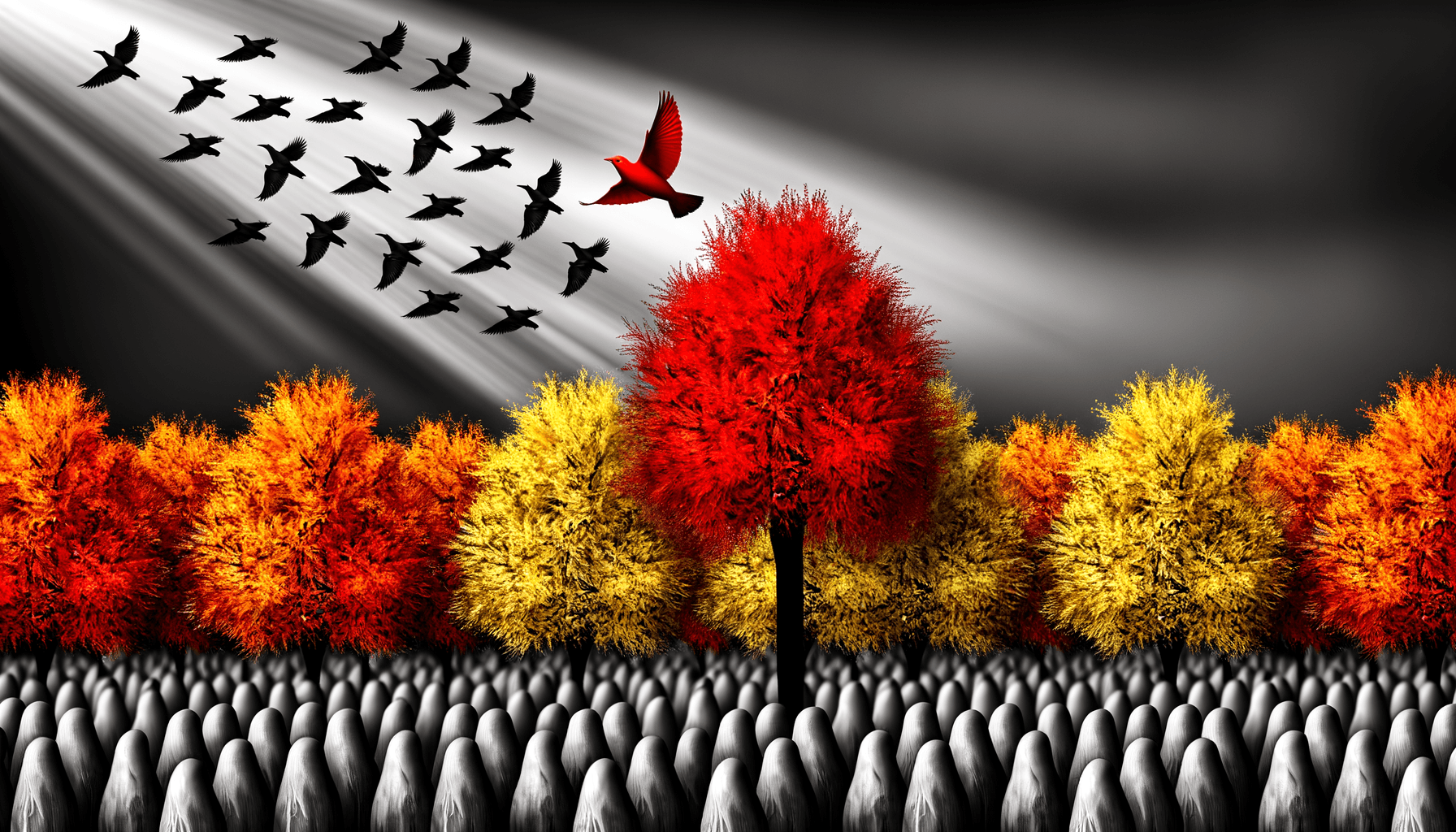
Conformity is the jailer of freedom and the enemy of growth. — John F. Kennedy
—What lingers after this line?
The Restriction of Individual Freedom
This quote suggests that conformity limits personal freedom. When individuals try too hard to fit societal expectations, they suppress their own unique thoughts and desires.
Growth Requires Independence
Kennedy implies that growth, whether personal or societal, requires independent thinking. Progress happens when people challenge norms rather than blindly following them.
Innovation and Creativity
Conformity can stifle creativity and innovation. Many groundbreaking ideas arise when individuals dare to think differently rather than following predetermined paths.
Social and Political Relevance
In politics and society, conformity can prevent meaningful change. Progress often comes from questioning existing structures and advocating for new solutions.
Kennedy's Leadership and Vision
As a leader who inspired progress and change in America, John F. Kennedy encouraged people to think critically, embrace new possibilities, and strive for a better future without fear of breaking from tradition.
One-minute reflection
Why might this line matter today, not tomorrow?
Related Quotes
6 selectedJust as we develop our physical bodies through exercise, we develop our minds through the act of thinking. — John F. Kennedy
John F. Kennedy
This quote highlights that just as physical fitness requires regular exercise, mental fitness requires consistent thinking and reflection. It suggests that engaging our minds actively promotes cognitive development.
Read full interpretation →Learning to love yourself is like learning to walk – essential, life-changing, and the only way to stand tall. — Vironika Tugaleva
Vironika Tugaleva
Vironika Tugaleva’s comparison begins with a simple but powerful truth: self-love is not a luxury, but a basic human necessity. Just as walking allows a child to move through the world with growing independence, learning...
Read full interpretation →To be part of society is to lose a part of yourself; do what you would do if you were the only person on Earth. — Derek Sivers
Derek Sivers
Derek Sivers’ line begins with a sober observation: joining society often means trimming away parts of the self to fit shared expectations. Manners, careers, tastes, and even ambitions can become performances shaped by a...
Read full interpretation →The most gifted members of the human species are at their creative best when they cannot have their way, and must compensate for what they miss by realizing and cultivating their capacities. — Bryant H. McGill
Bryant H. McGill
Bryant H. McGill’s observation begins with a striking reversal: gifted people may not reach their highest potential when everything comes easily, but when something blocks their path.
Read full interpretation →A mind grows by staying with difficulty long enough for the experience to change it. — Mary Catherine Bateson
Mary Catherine Bateson
Mary Catherine Bateson’s observation begins with a quiet but demanding truth: the mind does not grow merely by encountering difficulty, but by remaining with it. Challenge becomes transformative only when we resist the u...
Read full interpretation →Consistency is a superpower. — Ryan Holiday
Ryan Holiday
Ryan Holiday’s line begins with a deceptively simple idea: greatness is rarely built through dramatic gestures. More often, it emerges from repeated actions that seem ordinary in isolation but become extraordinary over t...
Read full interpretation →More From Author
More from John F. Kennedy →Let us not seek the Republican answer or the Democratic answer, but the right answer. Let us not seek to fix blame for the past. Let us accept our own responsibility for the future. — John F. Kennedy
At its core, John F. Kennedy’s statement urges citizens to rise above partisan identity and focus on what is genuinely right.
Read full interpretation →We are tied to the ocean. And when we go back to the sea... we are going back from whence we came. — John F. Kennedy
Kennedy’s words begin with a biological and poetic truth at once: humanity is not separate from the ocean, but born from a world shaped by it. Modern evolutionary science traces life’s earliest beginnings to the sea, so...
Read full interpretation →We must find time to stop and thank the people who make a difference in our lives. — John F. Kennedy
John F. Kennedy’s remark begins with a simple but demanding idea: gratitude requires intention.
Read full interpretation →The world is filled with chaos, so you must build your own windmills. — John F. Kennedy
At first glance, Kennedy’s remark accepts a hard truth: the world rarely offers perfect order, fairness, or clarity. Instead of promising stability, it acknowledges confusion as a permanent feature of human life.
Read full interpretation →