
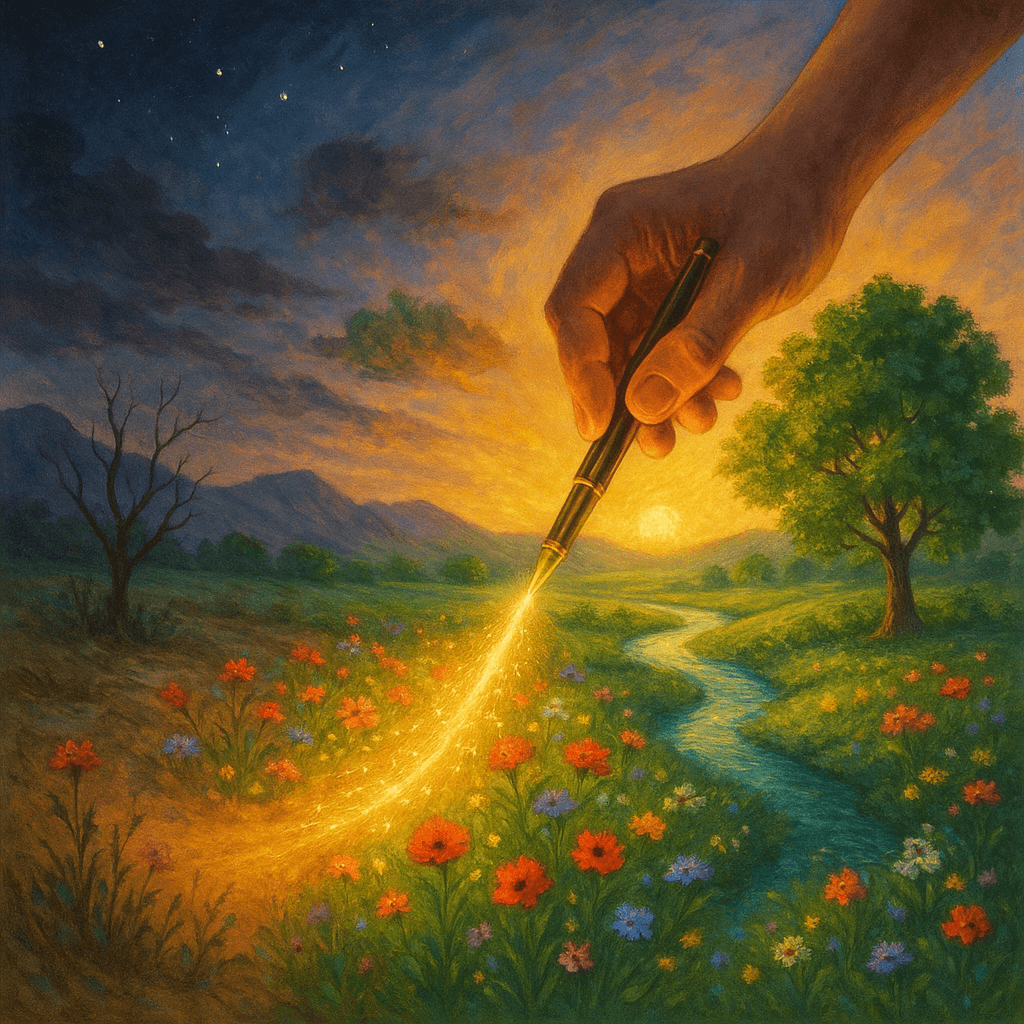
From the moment I picked up the pen, I knew the world was about to change. — Chimamanda Ngozi Adichie
—What lingers after this line?
The Power of Intention in Creation
Chimamanda Ngozi Adichie's declaration encapsulates the profound sense of purpose that can drive creative acts. By recognizing from the very outset that her words have the potential to influence, she illustrates how conscious intention elevates even the simplest act—picking up a pen—into a moment ripe with possibilities. This mindset echoes throughout history, as countless writers have considered the pen mightier than the sword, recognizing its latent power to alter perspectives and chart new courses for society.
Literature as an Agent of Change
Transitioning from intention to action, literature has long served as a vehicle for social evolution and personal awakening. From Harriet Beecher Stowe’s *Uncle Tom’s Cabin* (1852), which stoked the fires of abolition, to Chinua Achebe’s *Things Fall Apart* (1958) reshaping perceptions about Africa, the written word regularly destabilizes entrenched narratives and opens new avenues for thought. Adichie, in the tradition of such authors, wields her pen not only to tell stories, but to generate lasting impact.
The Writer’s Empowerment and Responsibility
This sense of transformative power imparts profound responsibility upon the writer. When Adichie acknowledges that 'the world was about to change,' she alludes to the ripple effect stories can produce—challenging injustices, resurrecting forgotten histories, and amplifying marginalized voices. With this empowerment comes the obligation to wield words thoughtfully, recognizing that every narrative shapes, reinforces, or disrupts collective consciousness.
Personal Transformation Through Storytelling
Moreover, the act of writing initiates change within the writer as much as the world. As Adichie’s journey reveals, picking up the pen is not merely a call to external change but an invitation to self-exploration and growth. Authors like Virginia Woolf, in her diaries, recount how writing unlocks new layers of understanding and empathy. Thus, the transformation is reciprocal: as the world shifts, so does the author.
Sustaining Change in the Modern World
Finally, in our rapidly evolving society, the pen retains its power as a tool for enduring progression. Whether through novels, essays, or digital media, Adichie’s insight reminds us that deliberate storytelling can still unsettle norms and inspire collective movement. Each time a writer picks up a pen, they participate in this ongoing tradition—perpetuating a cycle of change that stretches from personal desks to global audiences.
One-minute reflection
What does this quote ask you to notice today?
Related Quotes
6 selectedWords want to be free, and stories want to be told. — Chimamanda Ngozi Adichie
Chimamanda Ngozi Adichie
Chimamanda Ngozi Adichie’s statement begins with the assertion that ‘words want to be free.’ This personification suggests that language itself inherently resists confinement. Throughout history, from the censored verses...
Read full interpretation →Start by telling one true story — it may light a path for many. — Chimamanda Ngozi Adichie
Chimamanda Ngozi Adichie
It begins with Chimamanda Ngozi Adichie’s own account: as a student in the United States, she met a roommate who assumed Africa was a land of tribal music and catastrophe. In her TEDGlobal talk “The Danger of a Single St...
Read full interpretation →Tell your story boldly; in the echo of your voice villages find their courage. — Chinua Achebe
Chinua Achebe
Achebe’s imperative begins with an individual—a lone voice willing to speak without flinching—and ends with a community that discovers its bravery. The metaphor of the echo matters: it suggests repetition, resonance, and...
Read full interpretation →It is not the voice that commands the story: it is the ear. — Italo Calvino
Italo Calvino
At first glance, Calvino’s line overturns a common assumption about storytelling. We often praise the speaker, the narrator, or the authorial voice as the force that leads a tale forward.
Read full interpretation →Every story I create, creates me. I write to create myself. — Octavia E. Butler
Octavia E. Butler
At first glance, Octavia E. Butler’s remark turns writing into more than expression; it becomes a process of becoming.
Read full interpretation →Plant ideas like seeds and tend them with action until forests of change grow — Marie Curie
Marie Curie
Marie Curie’s metaphor treats ideas not as static thoughts but as living seeds—small, vulnerable, and full of latent potential. A seed contains an entire future, yet it remains invisible until it meets the right conditio...
Read full interpretation →More From Author
More from Chimamanda Ngozi Adichie →To love is to recognize that another person is a separate universe, and yet to choose, daily, to walk through it beside them. — Chimamanda Ngozi Adichie
At its heart, Adichie’s line defines love not as possession but as perception. To love someone is first to grasp that they are irreducibly distinct: a ‘separate universe’ with their own memories, fears, loyalties, and in...
Read full interpretation →True milestones are not found in our public achievements, but in the quiet, transformative moments of connection we share with those we hold dear. — Chimamanda Ngozi Adichie
At first glance, Adichie’s quote gently overturns a common modern assumption: that the most important markers of a life are public victories, titles, or visible accomplishments. Instead, she redirects our attention towar...
Read full interpretation →Your job is not to be likable. Your job is to be yourself. — Chimamanda Ngozi Adichie
Adichie’s line begins by stripping away a common social bargain: if you act agreeable enough, you’ll be accepted. By saying your job is not to be “likable,” she points to how easily a person can become an employee of oth...
Read full interpretation →Make today the workshop where your best self is assembled piece by piece. — Chimamanda Ngozi Adichie
Chimamanda Ngozi Adichie’s line turns “today” from a deadline into a worksite: a place where something is being made. Instead of waiting for a future version of life to begin, she suggests the present is where constructi...
Read full interpretation →