
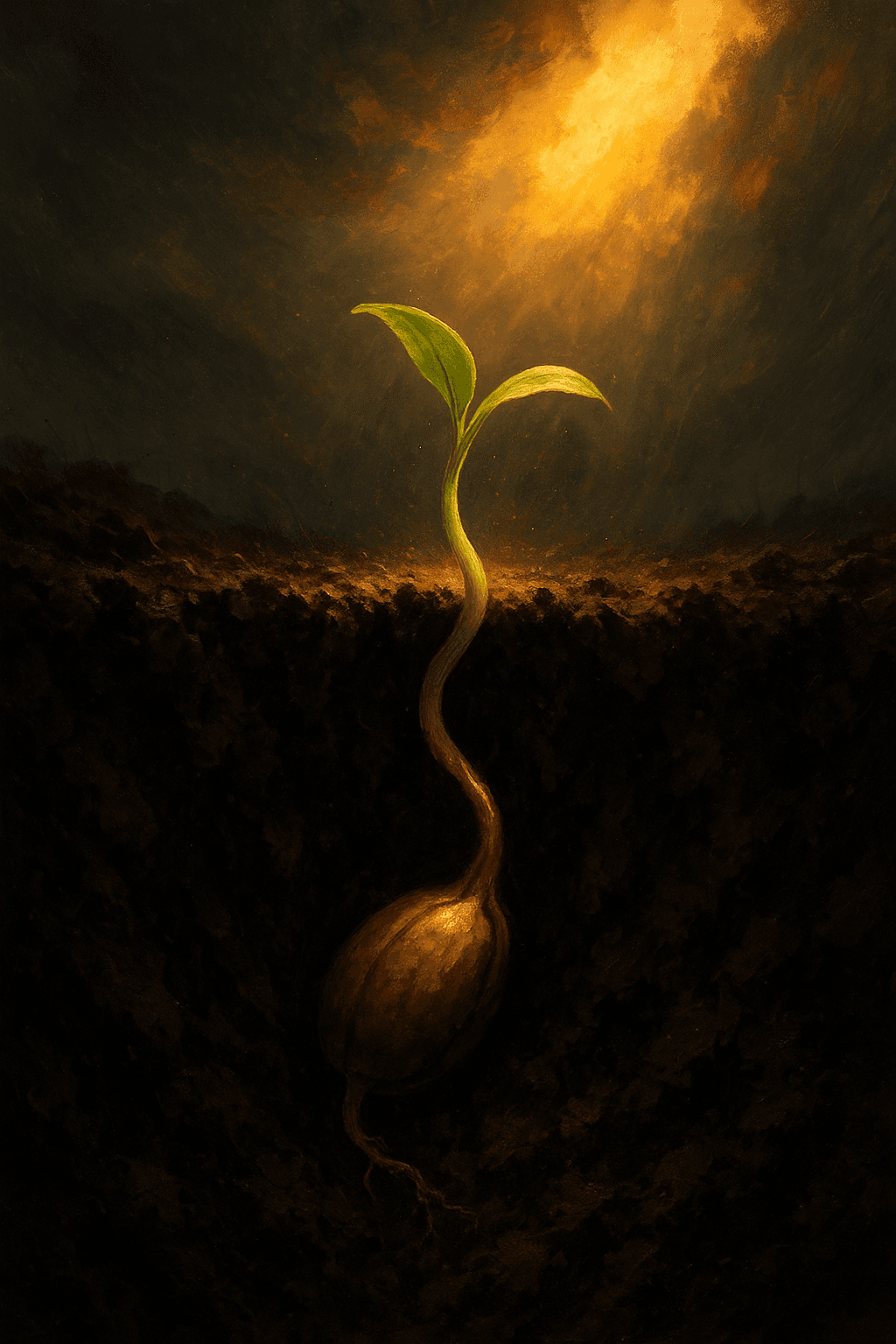
Growth demands a temporary surrender of security. — Eckhart Tolle
—What lingers after this line?
The Nature of Personal Growth
Eckhart Tolle’s observation underscores a universal truth: significant growth rarely occurs within one’s comfort zone. When we cling to familiar patterns and routines, we preserve a sense of security but forfeit opportunities for development. This sentiment echoes Carl Jung’s insight, ‘There is no coming to consciousness without pain,’ suggesting that the journey towards self-actualization inherently involves discomfort and risk.
The Illusion of Security
Transitioning from the safety of the known to the uncertainty of change confronts us with the illusion of lasting security. While stability offers short-term reassurance, it may create barriers to progress. In his book *The Power of Now*, Tolle elaborates that the mind’s attachment to security often stems from fear and a resistance to uncertainty, which can stifle creativity and self-discovery.
Historical Perspectives on Risk and Growth
Throughout history, transformative achievements have required individuals and societies to relinquish comfort. The Age of Exploration, for example, saw pioneers leaving behind safe harbors to discover new worlds—risking life and livelihood for the chance of expansion. Similarly, in *Man’s Search for Meaning*, Viktor Frankl describes how those who embrace uncertainty can find purpose even in adversity.
Modern Psychological Approaches
Modern psychology reinforces Tolle’s philosophy by identifying ‘growth mindset’ as essential for learning. Carol Dweck’s research emphasizes that those willing to face challenges and accept temporary instability are more likely to develop resilience and competence. By viewing setbacks as necessary steps, individuals transform fear of insecurity into motivation for progress.
Practical Implications for Everyday Life
Finally, applying Tolle’s wisdom means intentionally stepping beyond routine into realms of vulnerability—whether changing careers, pursuing new relationships, or learning unfamiliar skills. While the initial loss of certainty can be unsettling, it paves the way for profound personal and professional evolution. In the end, surrendering security is not a loss but a gateway to greater fulfillment and meaning.
One-minute reflection
What does this quote ask you to notice today?
Related Quotes
6 selectedIf you get the inside right, the outside will fall into place. — Eckhart Tolle
Eckhart Tolle
At its heart, Eckhart Tolle’s statement suggests that external life often reflects internal condition. If the mind is conflicted, reactive, or fearful, the world can appear equally chaotic; conversely, when one cultivate...
Read full interpretation →Growth feels scary because comfort feels warm, but you can take one small step. Change doesn't crush you; staying still slowly does. — Justin Welsh
Justin Welsh
At first glance, Justin Welsh captures a tension nearly everyone recognizes: comfort feels safe precisely because it is familiar. Routine wraps itself around us like warmth, making even imperfect situations feel preferab...
Read full interpretation →Confidence is silent. Insecurities are loud. — Unknown (Wait—skip/replace with: True nobility is being superior to your former self. — Ernest Hemingway)
Ernest Hemingway
At its core, Hemingway’s line redefines nobility as an inward achievement rather than a social rank. Instead of measuring worth by wealth, pedigree, or dominance over others, it points to a quieter standard: becoming bet...
Read full interpretation →You are under no obligation to be consistent with the person you were yesterday. — James McCrae
James McCrae
At its core, James McCrae’s line challenges the quiet pressure to remain legible to others. Many people feel bound to opinions, habits, or identities simply because they once claimed them, as though consistency were a mo...
Read full interpretation →Growth often looks like slowing down, reassessing, and rebuilding with intention. — Erin Gregory
Erin Gregory
At first glance, growth is often imagined as constant acceleration—more output, faster decisions, visible momentum. Erin Gregory’s quote gently overturns that assumption by suggesting that real development may appear qui...
Read full interpretation →The most important, difficult, and rewarding thing to work on is yourself. — Sven Schnieders
Sven Schnieders
At its heart, Sven Schnieders’ statement argues that self-development is the most valuable project a person can undertake. Unlike external goals—career success, status, or possessions—the work done on one’s character, ha...
Read full interpretation →More From Author
More from Eckhart Tolle →If you get the inside right, the outside will fall into place. — Eckhart Tolle
At its heart, Eckhart Tolle’s statement suggests that external life often reflects internal condition. If the mind is conflicted, reactive, or fearful, the world can appear equally chaotic; conversely, when one cultivate...
Read full interpretation →Acknowledging the good that you already have in your life is the foundation for all abundance. — Eckhart Tolle
At its heart, Eckhart Tolle’s statement argues that abundance does not begin with acquisition but with recognition. Before people can feel that life is full, they must first notice the value already present in ordinary m...
Read full interpretation →The moment you start watching the thinker, a higher level of consciousness becomes activated. You then begin to realize that there is a vast realm of intelligence beyond thought. — Eckhart Tolle
At the heart of Tolle’s statement is a simple but radical shift: instead of being absorbed by thought, we begin to observe it. The ‘thinker’ is the stream of commentary, memory, judgment, and planning that usually feels...
Read full interpretation →Give up defining yourself—to yourself or to others. You won't die. You will come to life. — Eckhart Tolle
At its core, Eckhart Tolle’s statement urges us to loosen our grip on the identities we constantly construct. We define ourselves through profession, status, history, beliefs, and even wounds, imagining that these descri...
Read full interpretation →