
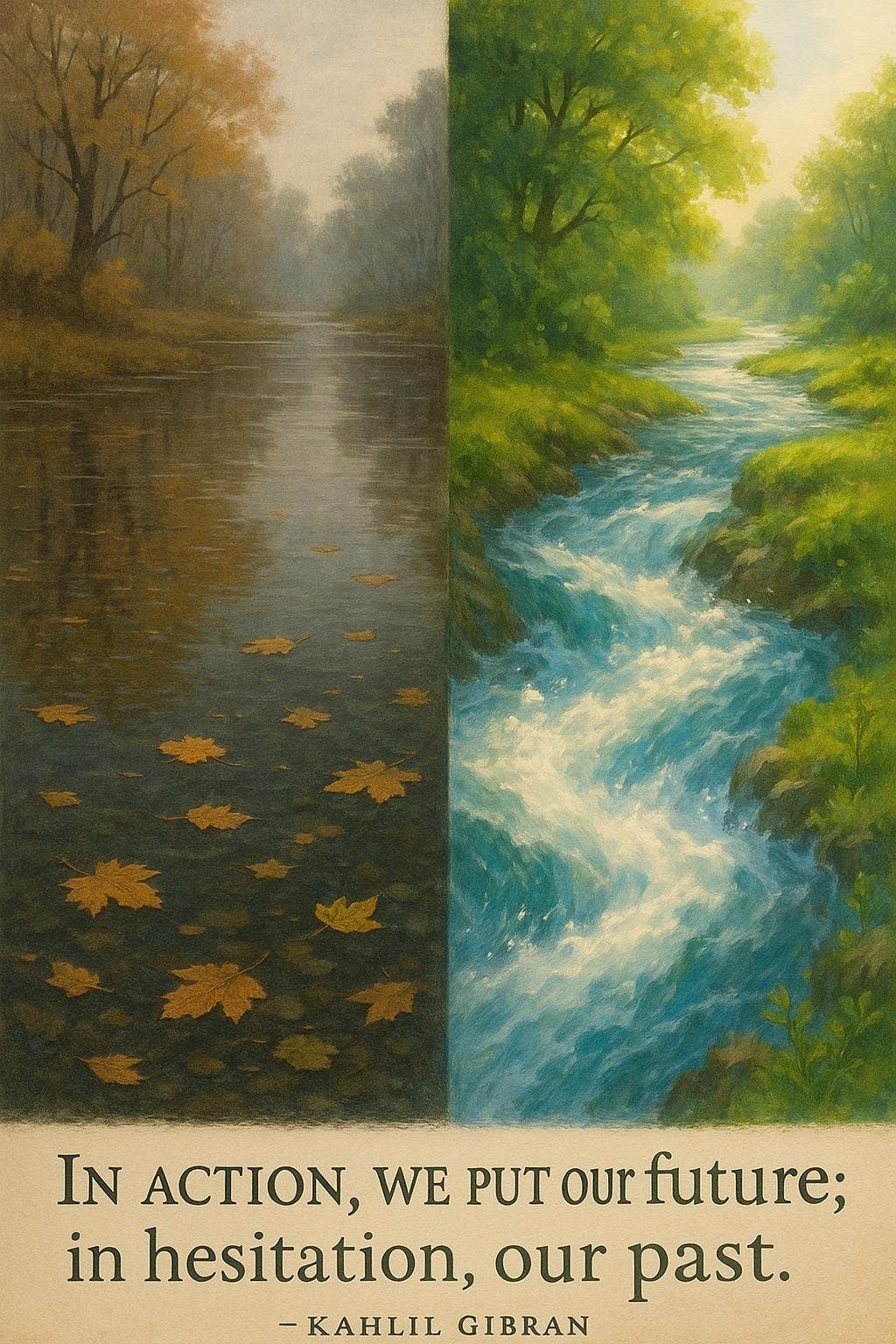
In action, we put our future; in hesitation, our past. — Kahlil Gibran
—What lingers after this line?
The Power of Action in Shaping Destiny
Kahlil Gibran’s quote foregrounds action as the active force crafting our future. By making decisions and taking steps, however uncertain, we carve out new possibilities. Consider Thomas Edison’s tireless attempts to invent the lightbulb—each act of perseverance propelled him closer to success and, ultimately, changed the course of history. Through action, the canvas of the future remains pliable, shaped by every bold stroke.
Hesitation as the Shadow of the Past
Conversely, hesitation often roots us in what has already occurred. Our doubts and fears emerge from experiences, ingrained habits, and memories that whisper caution. In Marcel Proust’s *In Search of Lost Time* (1913–1927), characters repeatedly falter, their indecision stemming from past traumas. Rather than opening new chapters, hesitation anchors us to old narratives, limiting growth.
The Interplay Between Memory and Decision
Transitioning from these extremes, it's crucial to recognize how memory shapes our hesitations. The lessons of the past must inform, but not paralyze, our present. When we dwell excessively on previous failures, like the mythic figure of Sisyphus doomed to repeat his task, indecision becomes a mechanism that preserves the status quo. Yet, when balanced wisely, memory can aid decision-making without dictating it.
Psychological Insights on Procrastination
Modern psychology delves deeper into this dynamic, noting that hesitation frequently stems from fear of repeating mistakes—a phenomenon tied to the ‘status quo bias’ (Samuelson & Zeckhauser, 1988). This bias compels individuals to stick with familiar patterns, inadvertently allowing the past to steer present choices. Thus, Gibran’s observation resonates as a call to transcend psychological inertia by embracing thoughtful action.
Embracing Agency for a Meaningful Future
In conclusion, Gibran urges us to recognize that our future is crafted, not inherited. Whether seizing opportunities or sidestepping into procrastination, our choices define the shape of what lies ahead. By consciously choosing action over hesitation, we honor our agency and invest in a narrative of possibility, ensuring that our past informs rather than confines our journey.
One-minute reflection
What feeling does this quote bring up for you?
Related Quotes
6 selectedInaction breeds doubt and fear. Action breeds confidence and courage. If you want to conquer fear, do not sit home and think about it. Go out and get busy. — Dale Carnegie
Dale Carnegie
This quote emphasizes the importance of taking action rather than being passive. It suggests that engaging in activities and tasks can help overcome feelings of doubt and fear.
Read full interpretation →The barrier between success and failure is thin and made of hesitation. — Khalil Gibran
Kahlil Gibran
Khalil Gibran’s poignant observation highlights how the divide between achieving one’s goals and falling short is not insurmountable, but rather fragile and elusive. At its core, hesitation manifests as a pause—a fleetin...
Read full interpretation →No matter how full a reservoir of maxims one may possess, if one has not taken advantage of every concrete opportunity to act, one's character may remain entirely unaffected. — William James
William James
At first glance, William James draws a sharp line between knowing and becoming. A person may store up countless moral sayings, noble principles, and wise resolutions, yet these remain largely ornamental if they never pas...
Read full interpretation →A garden is not made by singing 'Oh, how beautiful,' and sitting in the shade. — Rudyard Kipling
Rudyard Kipling
Kipling’s line immediately cuts through passive appreciation. Simply admiring a garden, however sincerely, does nothing to plant seeds, pull weeds, or carry water.
Read full interpretation →You cannot afford to live in potential for the rest of your life; at some point, you have to unleash it. — Eric Thomas
Eric Thomas
Eric Thomas’s quote begins with a stark warning: potential is not a place to live, only a promise of what might be. In other words, talent, intelligence, or ambition mean very little if they remain dormant.
Read full interpretation →The way to do is to be. — B.K.S. Iyengar
B.K.S. Iyengar
At first glance, B.K.S. Iyengar’s line seems to invert common advice.
Read full interpretation →More From Author
More from Kahlil Gibran →Your home is your larger body. It grows in the sun and sleeps in the stillness of the night. — Kahlil Gibran
At first glance, Gibran transforms the idea of home from a mere structure into something intimate and organic: “your larger body.” In this image, a dwelling is not separate from the person who inhabits it, but an outward...
Read full interpretation →March on. Do not tarry. To go forward is to move toward perfection. — Kahlil Gibran
Gibran’s opening imperative—“March on. Do not tarry.”—sets a tone of disciplined urgency.
Read full interpretation →There must be spaces in your togetherness, and let the winds of the heavens dance between you. — Kahlil Gibran
Gibran’s line opens with a gentle paradox: he speaks to people who are already “together,” yet insists that togetherness is healthiest when it includes room. Rather than portraying love as fusion, he frames it as a relat...
Read full interpretation →Our anxiety does not come from thinking about the future, but from wanting to control it. — Kahlil Gibran
Kahlil Gibran reframes anxiety as something more specific than mere anticipation. The future itself—uncertain, unfolding, and not yet real—doesn’t automatically distress us; rather, distress appears when we demand certai...
Read full interpretation →