
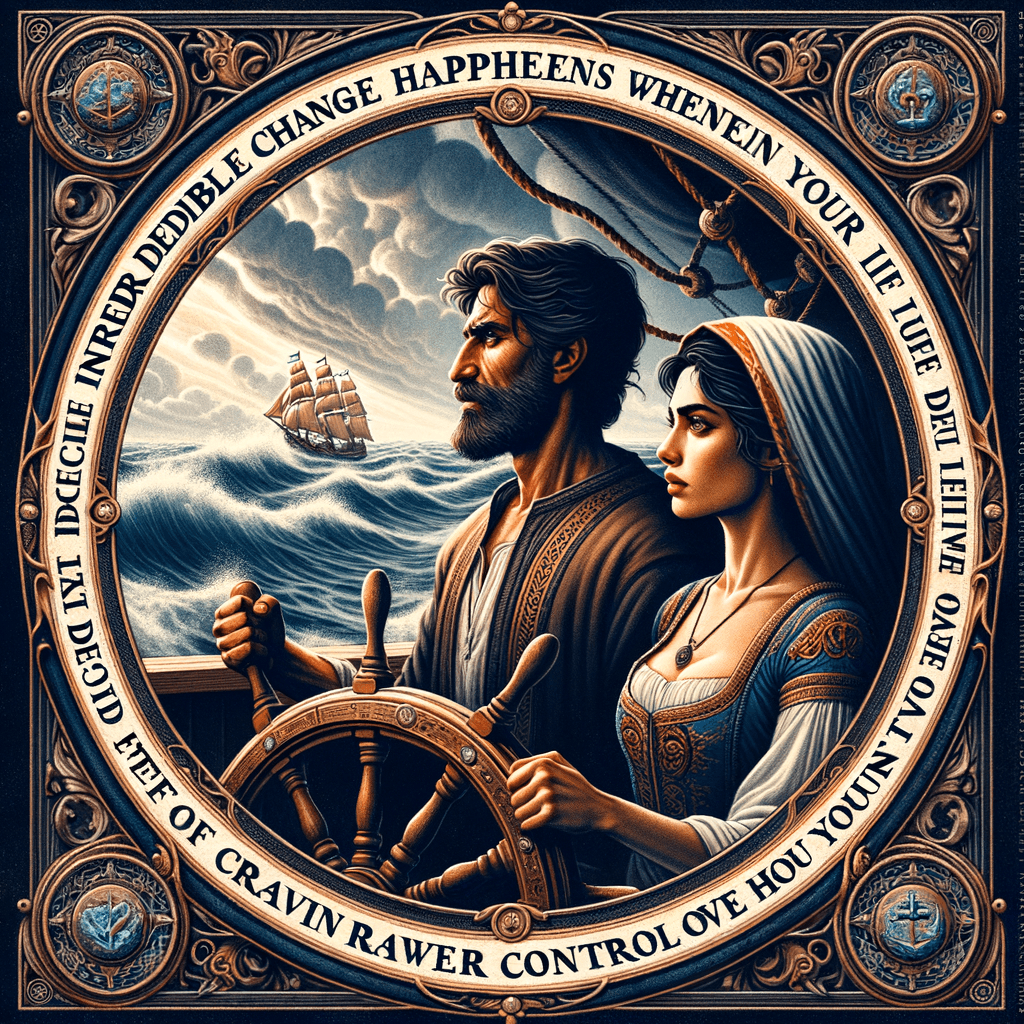
Incredible change happens in your life when you decide to take control of what you do have power over instead of craving control over what you don't. — Steve Maraboli
—What lingers after this line?
Personal Empowerment
This quote encourages individuals to focus on what they can control in their lives rather than wasting energy on things beyond their influence. By doing so, they can bring about meaningful and positive changes.
Decision-Making
It highlights the importance of making conscious decisions to manage aspects of your life over which you have direct power, such as your actions, responses, and attitudes.
Stress Reduction
Focusing on what you can control reduces stress and anxiety, as it shifts attention away from the uncertainties and uncontrollable aspects of life.
Self-Improvement
By taking charge of the controllable factors, you pave the way for personal growth and improvement, making progress more tangible and achievable.
Philosophical Perspective
This idea aligns with various philosophical teachings that stress the importance of inner control and acceptance of external realities. It suggests a mindset of proactive and strategic living.
Impactful Actions
Practical actions taken within one's sphere of influence often have a more significant and lasting impact compared to efforts spent on uncontrollable external factors.
Steve Maraboli
Steve Maraboli is a renowned author, speaker, and behavioral scientist known for his motivational insights. His work centers on empowering people to improve their lives through positive action and mental shifts.
One-minute reflection
What's one small action this suggests?
Related Quotes
6 selectedYour fear is 100% dependent on you for its survival. — Steve Maraboli
Steve Maraboli
This quote emphasizes that fear is a construct of the mind, reliant on one's perception. By changing the way we perceive situations, we have the power to diminish or eradicate our fears.
Read full interpretation →I wanted a perfect ending. Now I've learned, the hard way, that some poems don't rhyme, and some stories don't have a clear beginning, middle, and end. — Gilda Radner
Gilda Radner
Gilda Radner’s quote begins with a deeply human wish: the desire for a perfect ending. Most people instinctively want life to resemble a well-made story, with conflicts resolved, wounds explained, and every emotional thr...
Read full interpretation →The human soul doesn't want to be advised or fixed or saved. It simply wants to be witnessed. Exactly as it is. — Parker J. Palmer
Parker J. Palmer
At its core, Parker J. Palmer’s line shifts attention away from problem-solving and toward presence.
Read full interpretation →A rational person can find peace by cultivating indifference to things outside of their control. — Naval Ravikant
Naval Ravikant
At its heart, Naval Ravikant’s statement echoes a classic Stoic principle: inner peace grows when we stop attaching our well-being to events we cannot govern. Rather than encouraging apathy toward life itself, this kind...
Read full interpretation →Whatever is going to happen will happen, whether we worry or not. — J.K. Rowling
J.K. Rowling
At its core, Rowling’s line reminds us that worry often mistakes itself for control. We rehearse disasters in our minds as if anticipation could alter reality, yet events unfold according to forces far larger than our pr...
Read full interpretation →Nothing is wrong—whatever is happening is just real life. — Tara Brach
Tara Brach
At first glance, Tara Brach’s line gently interrupts a habit many people carry: the reflex to label discomfort as evidence that something has gone wrong. Instead, she proposes a quieter interpretation—what is happening i...
Read full interpretation →More From Author
More from Steve Maraboli →When we learn how to become resilient, we learn how to embrace the beautifully broad spectrum of the human experience. — Steve Maraboli
At first glance, Steve Maraboli’s statement frames resilience not merely as endurance, but as a deeper way of perceiving life. To become resilient is not simply to survive hardship; it is to widen our capacity for joy, g...
Read full interpretation →If you want to find happiness, find gratitude. — Steve Maraboli
Steve Maraboli’s line frames happiness not as something to chase directly, but as something that grows from a prior attitude: gratitude. In other words, the quote suggests that joy is often a consequence rather than a po...
Read full interpretation →The right thing to do and the hard thing to do are usually the same. — Steve Maraboli
At first glance, Steve Maraboli’s line suggests a sobering truth: ethical choices rarely arrive wrapped in comfort. The “right thing” often demands sacrifice, restraint, or courage, while the easier path offers immediate...
Read full interpretation →The most important person to seek approval from is yourself. — Steve Maraboli
At its heart, Steve Maraboli’s quote argues that self-worth should not be outsourced. When he says the most important person to seek approval from is yourself, he shifts attention away from the unstable judgments of othe...
Read full interpretation →