
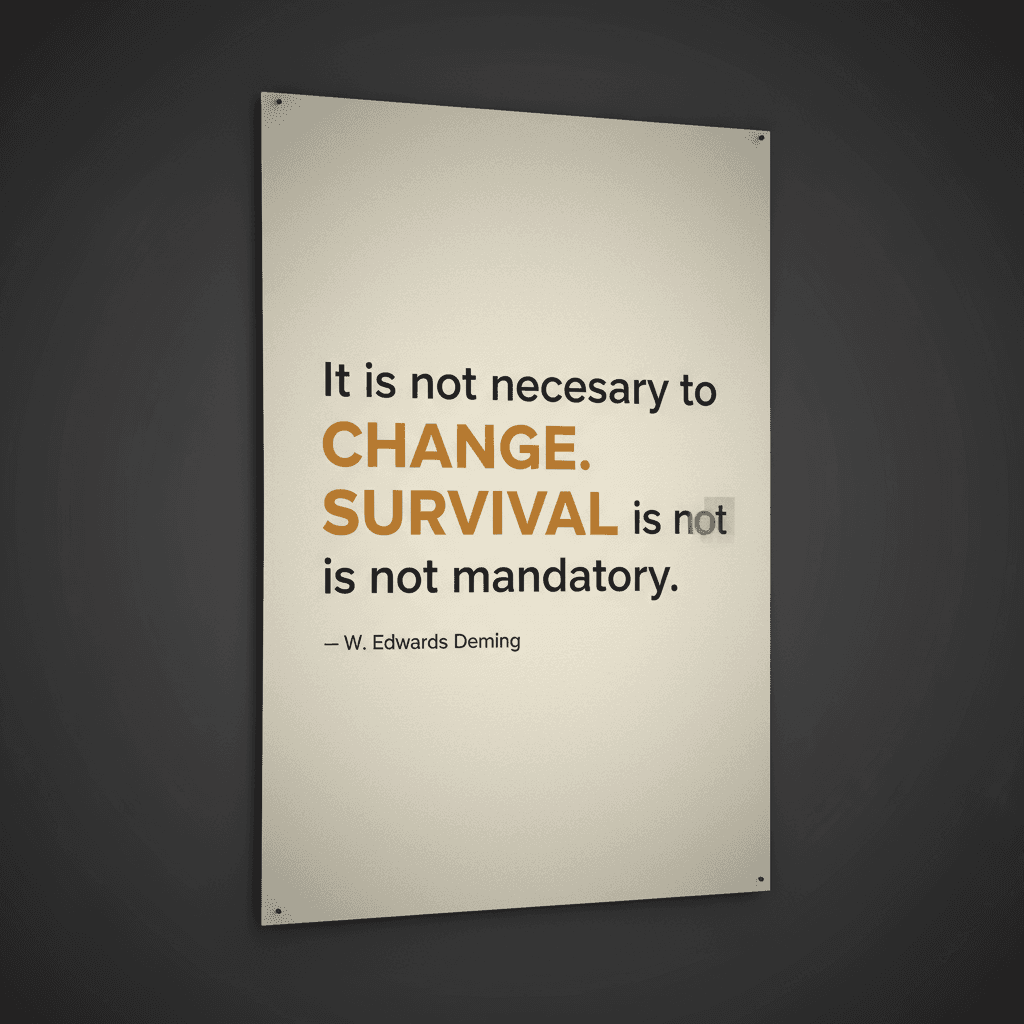
It is not necessary to change. Survival is not mandatory. — W. Edwards Deming
—What lingers after this line?
Change as a Deliberate Decision
Deming’s aphorism strips away comforting illusions: organizations are free to ignore change, but not its consequences. Emerging from his postwar work on quality and systems, Deming argued that performance is largely a product of the system, not individual heroics (Out of the Crisis, 1982). Thus, choosing not to improve is effectively choosing the trajectory of decline. By reframing change as optional, he removes excuses while placing responsibility squarely on leaders to create conditions where adaptation is possible and expected.
Adaptation, Not Strength, Ensures Survival
From this premise, the logic widens to markets and ecology. While often paraphrased as Darwin, the core idea is sound: survival favors responsiveness to shifting environments. Joseph Schumpeter’s creative destruction (Capitalism, Socialism and Democracy, 1942) explains how new combinations displace the old, regardless of past dominance. In this frame, stability is not safety; it is exposure. When environments destabilize—through technology, regulation, or consumer taste—the capacity to learn faster than conditions change becomes the decisive advantage.
Lessons from Corporate Evolution
History illustrates the cost of ignoring inflection points. Kodak pioneered digital photography in 1975 but clung to film economics, filing for bankruptcy in 2012 despite early invention. Blockbuster’s late pivot ceded ground to Netflix, which itself transitioned from DVDs to streaming before growth stalled. In contrast, IBM reoriented from hardware to services and software under Lou Gerstner, as recounted in Who Says Elephants Can’t Dance? (2002). These cases show Deming’s choice in action: institutions either revise their identity to fit the future or become artifacts of the past.
Turning Change into a System
To make adaptation repeatable, Deming promoted methods that convert learning into routine: statistical process control, the Plan–Do–Check–Act (PDCA) cycle, and his 14 Points. Toyota’s kaizen and the Toyota Production System (Taiichi Ohno, 1978) operationalized these ideas by empowering frontline workers to surface defects and improve flow. In this design, feedback is not a postmortem; it is a continual pulse. Consequently, change shifts from episodic disruption to everyday refinement, lowering risk while raising resilience.
Why We Resist: The Human Factor
Yet change is hard because people are wired for the status quo. Loss aversion magnifies perceived costs (Kahneman and Tversky, 1979), while status quo bias sustains existing choices (Samuelson and Zeckhauser, 1988). Kurt Lewin’s unfreeze–change–refreeze model (1947) and John Kotter’s eight steps (1996) address these frictions by creating urgency, building coalitions, and anchoring new behaviors in culture. When leaders reduce fear, clarify purpose, and make progress visible, resistance softens into participation.
Making Adaptation Actionable
Thus leaders can institutionalize agility with disciplined practices: run small bets, define kill criteria, and privilege leading indicators over lagging comfort. John Boyd’s OODA loop (observe–orient–decide–act) emphasizes faster learning cycles, while discovery-driven planning (Rita Gunther McGrath and Ian MacMillan, 1995) budgets for assumptions and pivots early. By treating strategy as a testable hypothesis rather than a fixed decree, organizations turn uncertainty from a threat into fuel for iteration.
The Ethical Stakes of Staying Still
Ultimately, Deming’s axiom carries moral weight. Choosing not to change risks customers’ trust, employees’ livelihoods, and communities’ welfare—particularly as safety, climate, and cybersecurity stakes rise. Continuous improvement safeguards more than margins; it protects people. Therefore, survival as a value implies an obligation: to learn, to adapt, and to build systems that make tomorrow safer and more useful than today. In that light, change is optional only if responsibility is, too.
One-minute reflection
Where does this idea show up in your life right now?
Related Quotes
6 selectedEmotional resilience refers to your ability to roll with the punches, adapt to adversity, and bounce back after setbacks. — Bettendorf Counseling Center
Bettendorf Counseling Center
At its core, the Bettendorf Counseling Center’s definition frames emotional resilience as a flexible strength rather than a hard shell. To “roll with the punches” is not to avoid pain or pretend setbacks do not matter; i...
Read full interpretation →The artist is not a solid, static being. The artist is fluid, like water, moving with the tides and changing form. — James McCrae
James McCrae
James McCrae’s image of the artist as fluid immediately challenges the common idea that creative people possess a single, fixed essence. Instead, he suggests that artistry is a process of becoming, not a stable condition...
Read full interpretation →The mind adapts and converts to its own purposes the obstacle to our acting. — Marcus Aurelius
Marcus Aurelius
At its heart, Marcus Aurelius’s line expresses a central Stoic conviction: external events do not fully determine our lives; rather, our judgments about them shape what they become. In his Meditations (c.
Read full interpretation →Adaptability is not imitation. It means power of resistance and assimilation. — Rabindranath Tagore
Rabindranath Tagore
At the heart of Tagore’s statement lies a careful distinction between changing and merely copying. Adaptability, he argues, is not the passive act of becoming like one’s surroundings; rather, it is an active power that a...
Read full interpretation →The capacity to change one's mind in the face of new reality is the highest form of intelligence. — Ursula K. Le Guin
Ursula K. Le Guin
At first glance, Ursula K. Le Guin’s statement shifts intelligence away from raw knowledge and toward responsiveness.
Read full interpretation →Our only security is our ability to change. — John Lilly
John Lilly
At first glance, John Lilly’s statement sounds contradictory: security usually implies stability, while change suggests uncertainty. Yet his insight reverses that assumption by arguing that real safety does not come from...
Read full interpretation →More From Author
More from W. Edwards Deming →Do not mistake movement for progress. Consistency in the right direction is the only path to genuine achievement. — W. Edwards Deming
At first glance, Deming’s quote sounds like a warning against busyness for its own sake. Movement can be noisy, visible, and even exhausting, yet none of that guarantees meaningful change.
Read full interpretation →A bad system will beat a good person every time. — W. Edwards Deming
At its heart, Deming’s statement argues that individual virtue is rarely enough to overcome a flawed structure. A conscientious worker may be honest, diligent, and skilled, yet if the surrounding process is confusing, wa...
Read full interpretation →It is not enough to do your best; you must know what to do and then do your best. — W. Edwards Deming
At first glance, Deming’s line sounds like a simple call to work harder, yet it actually argues for something more disciplined: effort alone is insufficient without clarity about purpose. In other words, sincerity does n...
Read full interpretation →“In God we trust; all others must bring data.” — W. Edwards Deming
Deming compresses a managerial philosophy into a single line: matters of faith may be entrusted to the divine, but human assertions must be tested. This stance aligns with Enlightenment empiricism and modern accountabili...
Read full interpretation →