
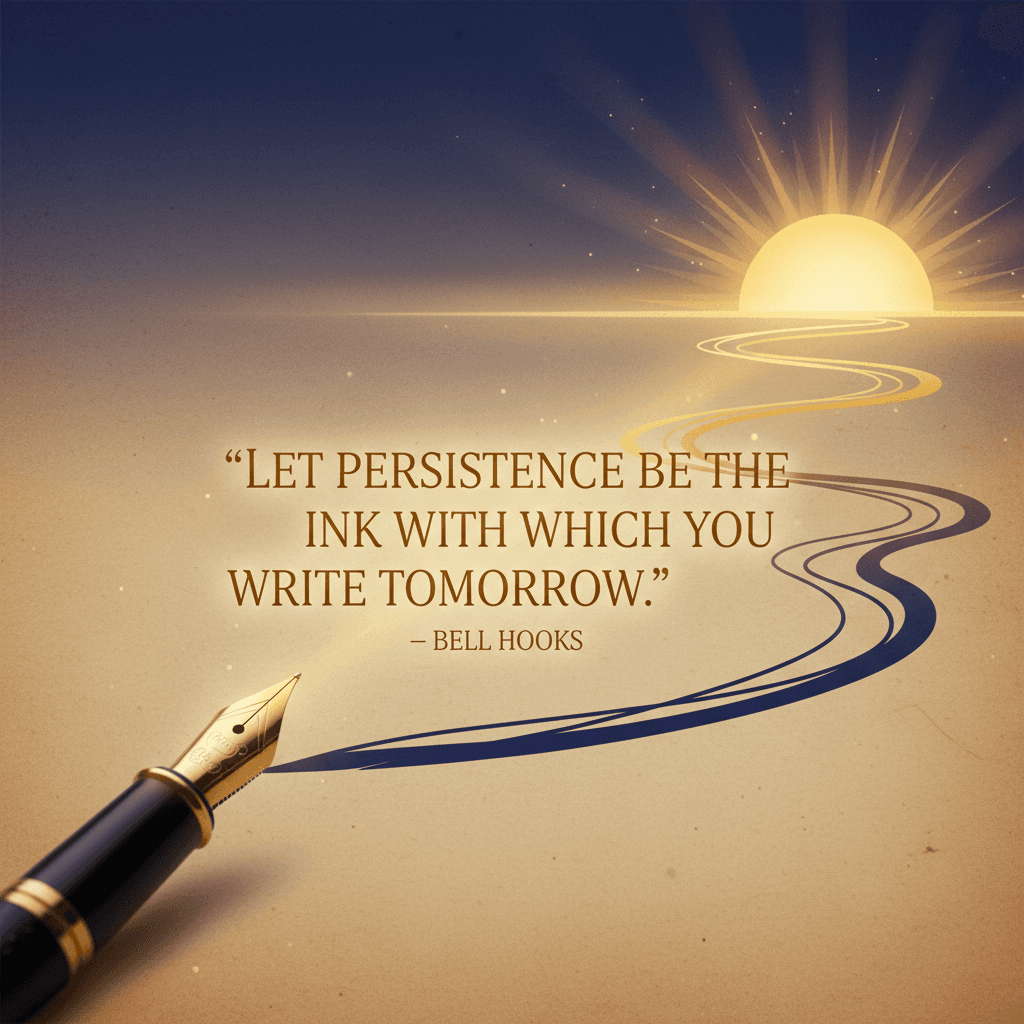
Let persistence be the ink with which you write tomorrow. — bell hooks
—What lingers after this line?
A Metaphor of Agency and Time
To begin, the image of persistence as ink suggests that tomorrow is not a blank page handed to us by fate; it is co-authored by what we keep doing today. Rather than a burst of inspiration, bell hooks evokes steady trace-making—each stroke a repeated act of will. The metaphor reframes endurance as creativity, implying that consistency is not merely survival but authorship. From this vantage, the future ceases to be abstract possibility and becomes a draft we revise through daily commitments, setting the stage for hooks’s broader insistence that change is made, not awaited.
hooks’s Pedagogy: Freedom as Daily Practice
Moving from metaphor to method, hooks’s Teaching to Transgress (1994) argues that education is a practice of freedom—an ongoing labor that turns insight into structure. In All About Love (2000), she further recasts love as action, a steady choosing rather than sentiment. Persistence, then, becomes the ethical through-line: showing up, listening, and revising our habits so care can be sustained. This emphasis resists spectacle; transformation happens in classrooms, homes, and organizing circles where repetition—showing up again—is the form that hope takes. With that frame, persistence becomes not stoicism but a disciplined tenderness that prepares us to act together.
Collective Struggle: Writing Futures in Community
Extending this ethic outward, social movements demonstrate how communal persistence drafts history. Ella Baker’s patient organizing for SNCC (1960) and Fannie Lou Hamer’s tireless testimony in 1964 show how repetition—meetings, canvasses, testimonies—accumulates into legal and cultural change. Likewise, John Lewis’s “good trouble” embodies how principled, sustained action can etch new norms into public life. These stories underscore hooks’s insistence that liberation is collaborative; no single author writes tomorrow. Instead, a chorus of persistent gestures—mutual aid, study circles, policy work—layers ink upon the page until new institutions and imaginations take shape.
What Psychology Adds—and Where It Pauses
From another angle, research on grit (Angela Duckworth, 2016) and growth mindsets (Carol Dweck, 2006) finds that effort over time predicts learning and achievement. Yet, the same literature warns that perseverance without purpose, feedback, or support can calcify into burnout. hooks’s critique complements this: persistence should not reproduce domination or self-erasure. Audre Lorde’s reminder that caring for oneself is political (1988) reframes rest as part of sustained struggle, not its enemy. Thus, evidence and ethics converge: the ink that writes tomorrow flows best when replenished by community, meaning, and restorative rhythms.
Rituals That Keep the Pen Moving
Practically, persistence thrives on design. Small, repeatable actions—micro-goals, cue-based routines, and friction reduction—make perseverance easier (James Clear, Atomic Habits, 2018). Teresa Amabile’s “progress principle” (2011) shows that witnessing small wins fuels motivation, creating a virtuous cycle. In hooks’s spirit, pair such tactics with reflection: ask whom your routine serves, and how it widens care. Accountability circles, regular pauses for learning, and concrete measures of equity ensure that consistency doesn’t drift into complacency. In this way, habits become not just personal productivity but shared praxis oriented toward freedom.
Hopeful Imagination as Editorial Work
Finally, persistence needs a horizon. hooks’s Belonging: A Culture of Place (2009) evokes home as a practice, not merely a locale—an image of belonging that invites ongoing editing of our institutions and selves. Hope here is not prediction but orientation: a reason to keep revising the draft. As adrienne maree brown’s Emergent Strategy (2017) suggests, small patterned actions can scale into transformative change. Returning to the metaphor, we choose the ink by choosing what we repeat. When our repetitions align with care, justice, and learning, tomorrow’s page bears a legible, livable script.
One-minute reflection
What does this quote ask you to notice today?
Related Quotes
6 selectedThe spring that keeps running is more valuable than the jug which bottoms out each day. We unlock that spring by patiently working at our task and giving our best effort every time. — Henri Matisse
Henri Matisse
Matisse’s image contrasts two kinds of value: the jug that must be refilled each day and the spring that continues to flow from within. At first glance, the jug seems useful, but its usefulness is limited by its emptines...
Read full interpretation →Consistency is the jewel worth wearing; it is the anchor worth weighing; it is the thread worth weaving. — Charles Swindoll
Charles Swindoll
At first glance, Charles Swindoll’s line turns consistency into three vivid objects: a jewel, an anchor, and a thread. Each image adds a different dimension to the same virtue.
Read full interpretation →Don't worry about being brilliant; just be consistent. The world is built by people who showed up even when they didn't feel like it. — James Clear
James Clear
At its core, James Clear’s quote pushes back against the modern obsession with exceptional talent. Rather than glorifying brilliance, it elevates consistency—the humble act of returning to the work again and again.
Read full interpretation →The brick walls are there for a reason... to give us a chance to show how badly we want something. — Randy Pausch
Randy Pausch
At first glance, Randy Pausch’s line turns frustration into meaning. Rather than treating barriers as pointless interruptions, he frames them as tests that reveal the seriousness of our intentions.
Read full interpretation →There is no royal road to anything. One thing at a time, all things in succession. That which grows fast, withers as rapidly. That which grows slowly, endures. — J. G. Holland
J. G. Holland
J. G.
Read full interpretation →When you have a difficult task, if you only work a little at a time, every day a little, the work will finish itself. — Isak Dinesen
Isak Dinesen
At its core, Isak Dinesen’s remark transforms a daunting truth into a practical comfort: difficult work becomes less frightening when it is broken into modest, repeatable steps. Rather than demanding heroic bursts of eff...
Read full interpretation →More From Author
More from bell hooks →Your presence is a form of resistance against a culture that profits from your isolation. Show up for those you love, even when it is inconvenient. — bell hooks
At first glance, bell hooks reframes something ordinary—being present for others—as a political and moral act. Her words suggest that care is not merely private sentiment; rather, it pushes back against a social order th...
Read full interpretation →If you don't build your own sanctuary, you will spend your life living in the wreckage of someone else's expectations. — Bell Hooks
Bell hooks frames sanctuary as more than a physical refuge; it is an inner and outer space where a person can live by values they have consciously chosen. At first glance, the quote sounds like a warning about independen...
Read full interpretation →The art of living is a constant process of refining one's own sanctuary against the tide of external expectations. — bell hooks
At its core, bell hooks presents living not as a finished achievement but as a continuous act of shaping and reshaping the self. The phrase “constant process” suggests that identity, peace, and integrity are never perman...
Read full interpretation →Quiet confidence is not about what you say, but about the space you hold for yourself when the world gets loud. — bell hooks
At first glance, bell hooks shifts confidence away from performance and toward presence. She suggests that real assurance is not measured by how forcefully someone speaks, but by how steadily they remain grounded when ex...
Read full interpretation →