
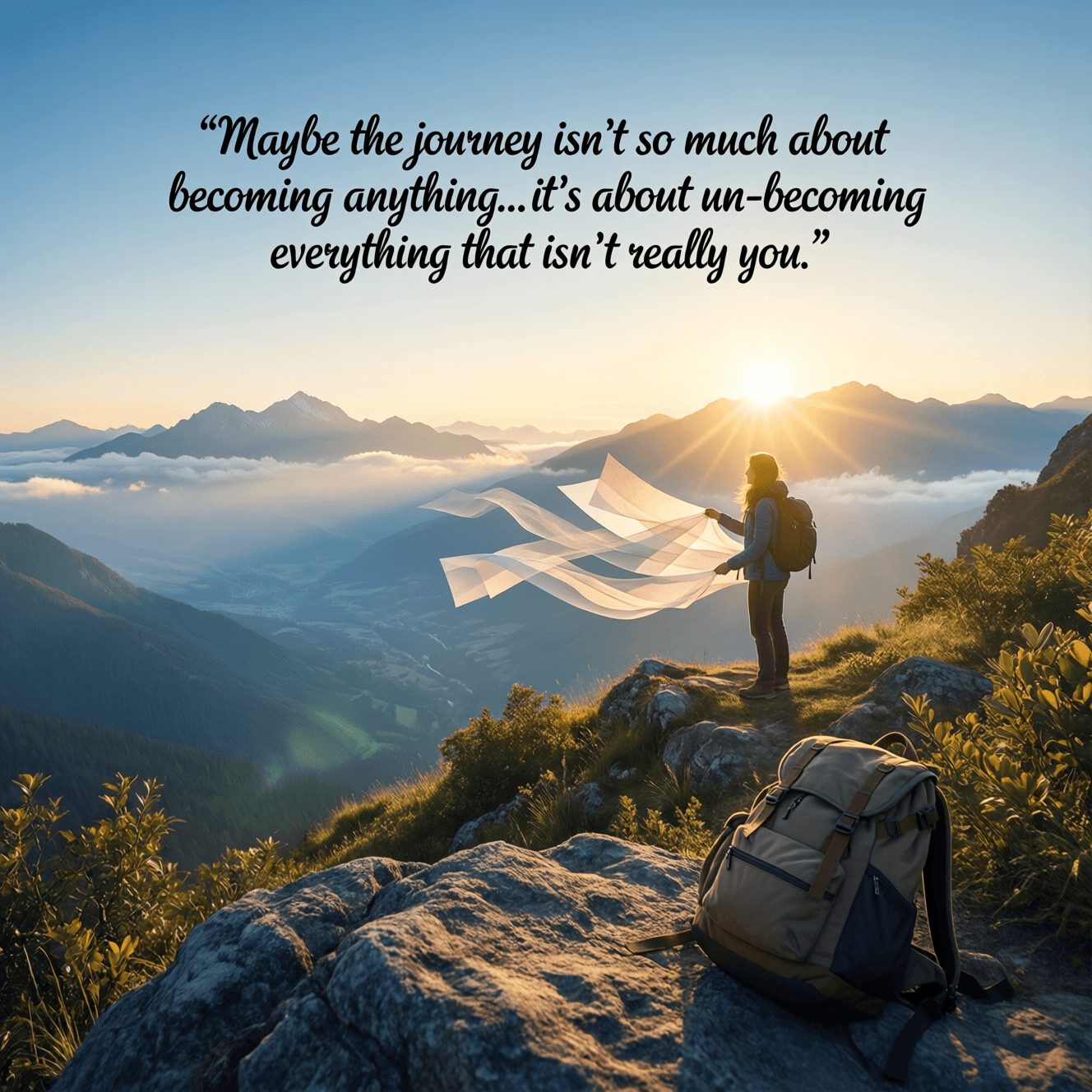
Maybe the journey isn't so much about becoming anything. Maybe it's about un-becoming everything that isn't really you. — Paulo Coelho
—What lingers after this line?
A Journey of Subtraction, Not Addition
Paulo Coelho’s line reframes personal growth as an act of subtraction. Instead of imagining the self as a project that must be upgraded with new traits, titles, or achievements, he suggests the deeper task is removing what is false, borrowed, or performed. In this view, the “journey” is less a ladder to climb than a clearing to make. That shift matters because it changes what counts as progress. Rather than asking, “What should I become?” the quote invites a quieter question: “What have I been carrying that isn’t truly mine?” From there, growth begins to look like honesty—peeling away layers that once felt necessary but no longer fit.
The Masks We Learn to Wear
To understand what must be un-become, it helps to notice how masks form in the first place. Many of us learn early that approval comes with conditions—be easier, be tougher, be impressive, be agreeable—and we adapt accordingly. Over time, these adaptations can harden into an identity that feels real simply because it’s familiar. Yet Coelho’s point is that familiarity is not the same as authenticity. The “not really you” parts may include roles you never chose, beliefs inherited without examination, or a personality built around avoiding rejection. Once seen clearly, these masks start to look less like who you are and more like what you used to need.
Un-Becoming as Inner Honesty
From there, un-becoming becomes a practice of inner honesty: noticing where your choices are driven by fear, comparison, or performance. The quote implies that a truer self is already present, but it can be obscured by layers of expectation. Removing those layers is not dramatic reinvention; it is alignment. This is why the process can feel both relieving and unsettling. When you stop acting out a story that once kept you safe, you may momentarily feel emptier—until you realize that the space you created is exactly where your real preferences, boundaries, and desires can finally be heard.
Echoes in Philosophy and Spiritual Traditions
Coelho’s idea has strong echoes in older traditions that treat the self as something revealed rather than constructed. In Michelangelo’s famous remark about sculpture—often paraphrased as releasing the figure “already in the stone”—the artist’s work is removal, not addition. Similarly, Taoist thought in the Tao Te Ching (c. 4th century BC) often emphasizes returning to simplicity, suggesting that wisdom is found by dropping excess rather than accumulating more. Even modern psychology gestures in this direction: Carl Rogers’ person-centered therapy argues that growth involves moving away from “conditions of worth” toward a more congruent self (Rogers, 1951). Across these lenses, un-becoming is not self-erasure but self-retrieval.
The Discomfort of Letting Go
However, shedding what isn’t you can be painful because identities—authentic or not—offer structure. You might have built a reputation around being the reliable one, the achiever, the caretaker, or the rebel, and letting go can feel like betraying your past. Moreover, others may resist your change because your old role made their world predictable. This is where the quote’s gentleness is important: “maybe” signals patience. Un-becoming isn’t a single decision; it’s repeated moments of choosing truth over habit. As those choices accumulate, the fear of losing yourself flips into a clearer realization: you’re finally meeting yourself.
What Authenticity Looks Like in Practice
In everyday life, un-becoming may look small: saying no without over-explaining, admitting what you actually want, or ending a pattern of people-pleasing that you once called kindness. It can also look like revisiting assumptions—about success, love, masculinity, femininity, spirituality, or status—and asking whether they reflect conviction or conditioning. Over time, what emerges is not a perfected identity but a more truthful one. Coelho’s journey doesn’t promise a shiny new persona; it promises a quieter, sturdier freedom—the kind that comes when your life requires less acting, and your choices start sounding like your own voice.
One-minute reflection
Where does this idea show up in your life right now?
Related Quotes
6 selectedThe seeker's journey is a reflection of the adventure of life itself. — Paulo Coelho
Paulo Coelho
This quote suggests that life itself is an adventure, much like a seeker's quest. It portrays life as a continuous exploration filled with challenges, discoveries, and growth.
Read full interpretation →You will never be able to experience everything. So, please, do poetical justice to your soul and simply experience yourself. — Albert Camus
Albert Camus
Camus begins from a humbling truth: no person can live every possible life, see every landscape, or test every path. Because existence is finite, the dream of total experience becomes a source of restlessness rather than...
Read full interpretation →You cannot express something you have not first discovered. — Carl Jung
Carl Jung
At its core, Jung’s remark suggests that authentic expression begins not with performance but with discovery. A person cannot meaningfully speak, create, or reveal what has never been encountered within the self.
Read full interpretation →Sometimes losing everything is how you find yourself. — J.K. Rowling
J.K. Rowling
At first glance, J.K. Rowling’s line frames devastation not simply as an ending, but as a brutal kind of beginning.
Read full interpretation →Our deepest wishes are whispers of our authentic self. We must learn to respect them. We must learn to listen. — Sarah Ban Breathnach
Sarah Ban Breathnach
Sarah Ban Breathnach’s quote begins with a gentle but radical claim: our deepest wishes are not random fantasies but signals from the truest part of who we are. Rather than treating longing as weakness or distraction, sh...
Read full interpretation →Quietly, I am becoming the woman I was always meant to be. — Mitsuye Yamada
Mitsuye Yamada
Mitsuye Yamada’s line begins not with spectacle, but with stillness. The word “quietly” suggests that the deepest changes in a life often happen away from applause, in private acts of courage, reflection, and endurance.
Read full interpretation →More From Author
More from Paulo Coelho →Have pity on those who are fearful of taking up a pen, or a paintbrush, or an instrument, or a tool because they are afraid that someone has already done so better than they could. — Paulo Coelho
Coelho’s line begins with compassion rather than criticism. He asks us to pity those who hesitate before the pen, brush, instrument, or tool because their fear is not laziness but self-erasure.
Read full interpretation →One doesn't get to be a master of one's own life by rushing. You have to learn the patience of a gardener who knows the harvest cannot be hurried. — Paulo Coelho
At its core, Paulo Coelho’s reflection challenges a modern obsession with speed. He argues that mastery over one’s life does not come from frantic action or constant acceleration, but from learning when to wait, observe,...
Read full interpretation →It is a good idea always to do something relaxing prior to making an important decision in your life. — Paulo Coelho
Paulo Coelho’s remark begins with a simple but powerful premise: important decisions are rarely improved by agitation. When the mind is tense, it tends to confuse urgency with clarity, pushing us toward choices made out...
Read full interpretation →Your 'yes' has no value until you learn to say 'no'. — Paulo Coelho
Paulo Coelho’s line hinges on a simple contrast: a “yes” only carries weight when an alternative is genuinely available. If you can’t—or won’t—say “no,” agreement becomes automatic rather than chosen, and it starts to re...
Read full interpretation →