
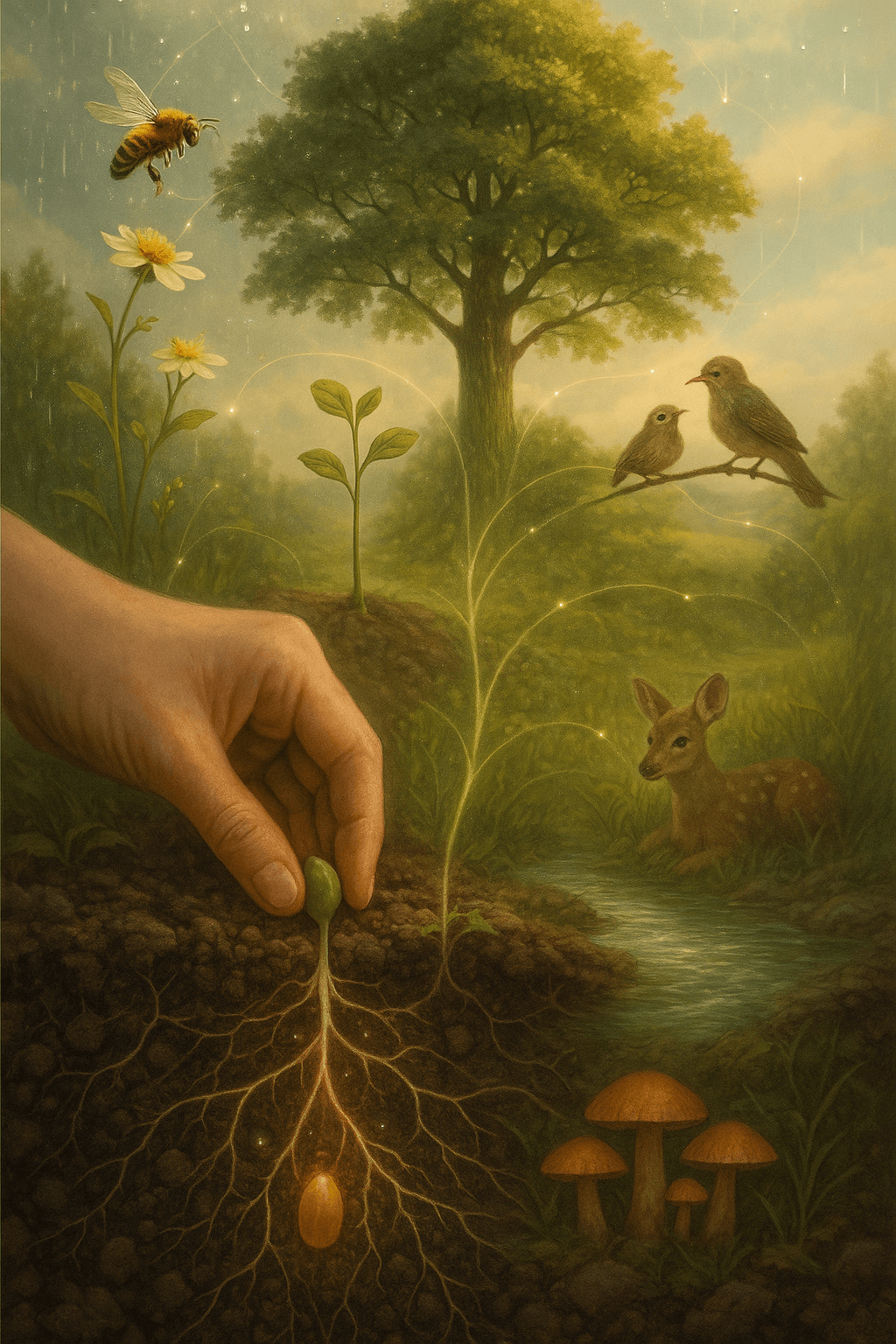
Plant ordinary gestures that yield extraordinary kindness. — Pablo Neruda
—What lingers after this line?
Ordinary Gestures as Living Seeds
At the outset, Neruda’s metaphor reminds us that small, repeatable acts—holding a door, learning a name, sending a brief note of thanks—are like seeds placed in everyday soil. They look insignificant at the moment of planting, yet their hidden roots take hold long before leaves appear. The promise of “extraordinary kindness” doesn’t arrive as spectacle but as growth: incremental, organic, and resilient. Like any garden, the work is humble and rhythmic; water and sunlight matter less as grand gestures and more as constancy. In this way, ordinariness is not the opposite of greatness—it is its nursery.
Neruda’s Odes to the Everyday
From this poetic lens, Neruda’s odes elevate the commonplace into revelation. In Odes to Common Things, he treasures onions, spoons, and socks—humble companions of daily life. “Ode to My Socks” turns a simple gift into a radiant emblem of gratitude, while “Ode to the Onion” honors a kitchen staple as a planet of sweetness. These poems model how attention, bestowed on the overlooked, transforms utility into intimacy. Thus the line about planting ordinary gestures is not an abstraction; it is a practice of seeing. By dignifying the small, we prepare the ground where generosity can thrive without fanfare.
Psychology: How Small Acts Rewire Identity
Turning from image to evidence, psychology shows why modest acts compound. Studies summarized by Sonja Lyubomirsky report that weekly acts of kindness reliably boost well-being, which in turn sustains more prosocial behavior. Likewise, Dunn, Aknin, and Norton (Science, 2008) found that spending on others increases happiness more than self-spending, creating a feedback loop of giving. Even the classic “foot-in-the-door” effect (Freedman & Fraser, 1966) reveals how small commitments reshape self-concept: once we act kindly, we are more likely to see ourselves—and behave—as givers. In other words, ordinary gestures quietly rewrite identity, and identity guides the next gesture.
Networks: Kindness that Cascades
Extending beyond individuals, social network research shows that generosity spreads. Fowler and Christakis’s work on cooperative cascades (PNAS, 2010) suggests the impact of a single kind act can ripple outward across friends of friends, sometimes up to three degrees. Similarly, Tsvetkova and Macy (PNAS, 2014) demonstrated the social contagion of generosity in large networks, where one person’s prosocial choice increases others’ likelihood to pass it on. Thus, a simple, ordinary offering—an introduction, a public thank-you, a first donation—can function like a seed carried by the wind. The harvest appears far from the planter’s sight, yet it is nourished by that first, quiet act.
Designing Daily Micro-Rituals of Care
To translate cascades into habit, we can plant on purpose. If-then plans (Gollwitzer, 1999) anchor kindness to cues: if a meeting starts, then greet each person by name; if you send an ask, then include a note of gratitude. Adam Grant’s Give and Take (2013) profiles Adam Rifkin’s “five-minute favor”—a tiny help (a quick intro, a concise review) delivered without expectation. Because micro-rituals are easy and repeatable, they survive busy seasons and prevent burnout; small does not mean shallow, it means sustainable. As these rituals accumulate, they tilt our default setting toward generosity, lowering the friction to act kindly again tomorrow.
From Seeds to Harvest: Trust as the Yield
Ultimately, what grows from ordinary gestures is social capital—the quiet trust that makes communities resilient. Robert Putnam’s Bowling Alone (2000) chronicles how everyday civic acts, from chatting on porches to helping a neighbor, weave networks that later carry heavier loads. In this light, the “extraordinary” in Neruda’s line is not spectacle but endurance: fewer brittle ties, more shared tools, faster mutual aid when crises come. And because seeds sprout in seasons, we measure progress not by applause but by ease—how naturally a community says yes to help, and how quickly kindness finds its next fertile patch of ground.
One-minute reflection
What feeling does this quote bring up for you?
Related Quotes
6 selectedTend to small acts of care; they become the architecture of a meaningful life. — George Eliot
George Eliot
George Eliot’s line turns attention away from dramatic, once-in-a-lifetime moments and toward the quiet repetitions that fill most of our days. “Tend to” suggests care is something cultivated—like a garden—through steady...
Read full interpretation →Do not wait for extraordinary circumstances to do good; try to use ordinary situations. — Charles Dickens
Charles Dickens
This quote highlights the idea that opportunities to do good often arise in our daily lives rather than in grand or special events. It encourages individuals to act positively in ordinary situations.
Read full interpretation →To make a difference in someone's life, you don’t have to be amazing; you just have to care. — Jessica Sweeney
Jessica Sweeney
The quote highlights that true impact comes not from grand gestures or extraordinary abilities, but from genuine care and empathy toward others.
Read full interpretation →Brighten a single corner of your world and the rest will notice. — Emily Dickinson
Emily Dickinson
At first glance, the line urges a modest beginning: illuminate what you can reach. The metaphor of a single corner suggests focused effort, where clarity replaces overwhelm.
Read full interpretation →Stand for the small mercies; change grows from tiny, persistent kindnesses. — Malala Yousafzai
Malala Yousafzai
At first glance, small mercies may seem inconsequential—one gentle word, one shared meal, one open door. Yet research on the “identifiable victim effect” shows that compassion intensifies when we can picture a single per...
Read full interpretation →Compassion is a practice; begin with the person you meet first today. — Desmond Tutu
Desmond Tutu
Desmond Tutu reframes compassion as a skill rather than a mood, and skills grow through deliberate repetition. By urging us to begin with the first person we meet today, he strips compassion of abstraction and turns it i...
Read full interpretation →More From Author
More from Pablo Neruda →Let the rain kiss you. Let the rain beat upon your head with silver liquid drops. — Pablo Neruda
Neruda’s lines open as a gentle imperative: instead of bracing against bad weather, we are asked to welcome it. “Let the rain kiss you” reframes rain as a gesture offered to the body rather than an inconvenience imposed...
Read full interpretation →Build a bridge of resolve and walk across it one brave step at a time. — Pablo Neruda
Neruda’s image begins with a striking implication: resolve is not merely a feeling you wait for, but a structure you build. A bridge doesn’t appear because the river is intimidating; it exists because someone decided to...
Read full interpretation →Let each sunrise find you leaning toward action. — Pablo Neruda
Neruda’s line frames each sunrise as more than scenery; it’s a daily reset that gently pressures us to move. “Leaning” matters because it suggests a posture, not a perfect performance—an inclination toward doing, even be...
Read full interpretation →Make your hands busy with making—words, gardens, music—and life answers back. — Pablo Neruda
Neruda’s line frames creativity less as self-expression and more as initiation: when you keep your hands busy making, you open a channel through which the world can respond. The emphasis on “hands” matters, because it gr...
Read full interpretation →