
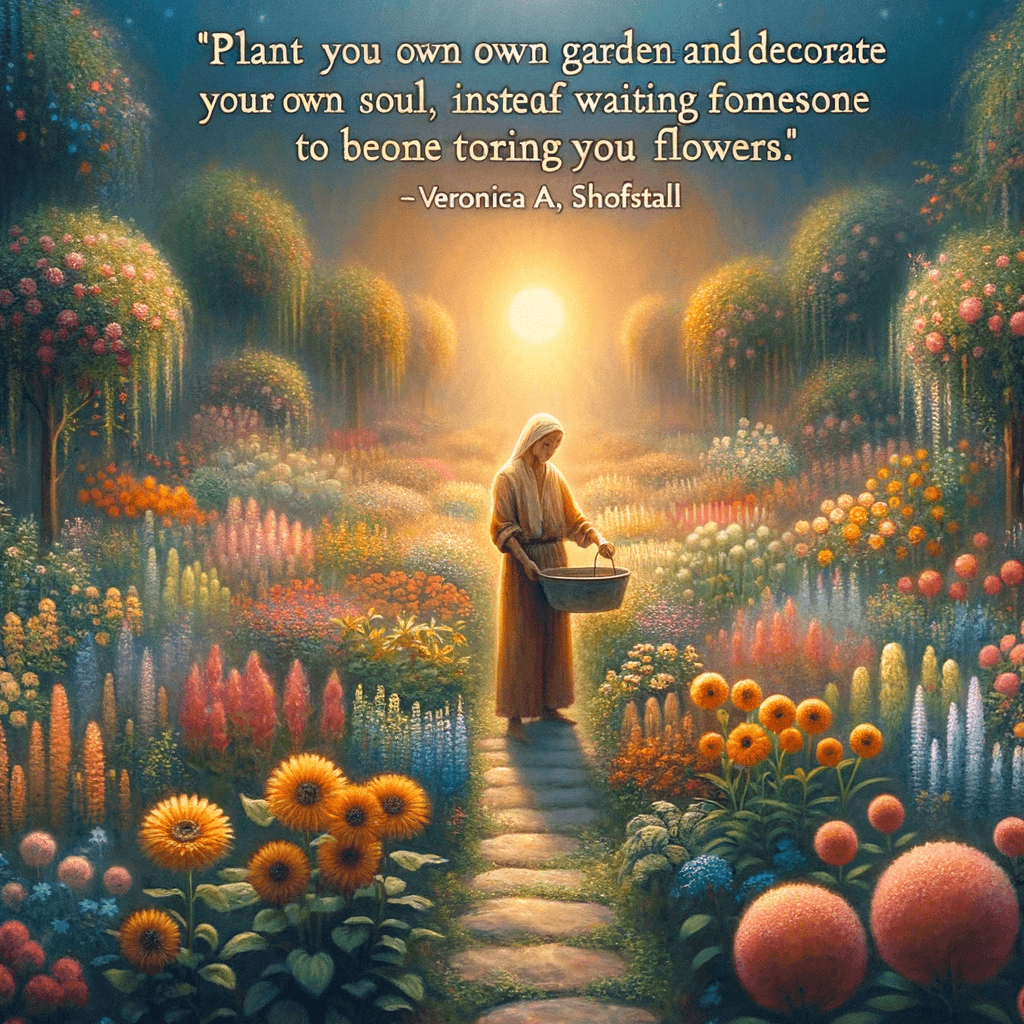
Plant your own garden and decorate your own soul, instead of waiting for someone to bring you flowers. — Veronica A. Shoffstall
—What lingers after this line?
Self-Reliance and Independence
This quote emphasizes the importance of self-reliance and taking responsibility for your own happiness. Instead of waiting for others to fulfill your needs or bring you joy, take proactive steps to cultivate your own well-being.
Personal Growth
'Plant your own garden' symbolizes working on self-improvement and personal development. It suggests nurturing your own talents, interests, and emotional health to grow into a more complete and satisfied individual.
Internal Fulfillment
The idea of decorating your own soul highlights the concept of finding inner peace and contentment. It encourages introspection and enriching your inner life to achieve fulfillment that does not depend on external validation or approval.
Empowerment
By taking control of your own happiness and growth, you empower yourself. This quote inspires a sense of self-empowerment, motivating you to take charge of your destiny and create the life you want.
Resilience
Waiting for someone else to bring you happiness can lead to disappointment and frustration. By planting your own garden, you build resilience, learning to withstand life's challenges and thrive on your own terms.
Self-Sufficiency
The quote promotes self-sufficiency, suggesting that individuals should cultivate their own resources and capabilities rather than relying on others to provide for their emotional or spiritual needs.
Recommended Reading
As an Amazon Associate, we earn from qualifying purchases.
One-minute reflection
Where does this idea show up in your life right now?
Related Quotes
6 selectedYou are not required to set yourself on fire to keep other people warm. — Hiraeth (widely attributed to various modern wellness writers; citing the common modern adaptation: 'You don't have to set yourself on fire to keep others warm.' — Adrienne Maree Brown)
adrienne maree brown
At its heart, the saying warns against a distorted form of care: sacrificing one’s own well-being so completely that nothing healthy remains to give. The image of burning oneself for someone else’s comfort is vivid becau...
Read full interpretation →The body is not the enemy. It is the messenger. Listen to what it needs before it is forced to scream. — Melissa Steginus
Melissa Steginus
Melissa Steginus reframes a common modern habit: treating the body as a problem to conquer rather than a source of information to understand. Her quote suggests that pain, fatigue, tension, and illness are not betrayals...
Read full interpretation →We are human beings, not human doings. You must prioritize your personal well-being as a necessity, not a luxury. A well-rested mind is the most effective tool you possess. — Arianna Huffington
Arianna Huffington
Arianna Huffington’s quote begins by challenging a modern habit: measuring human value by output alone. By saying we are “human beings, not human doings,” she shifts attention from performance to personhood, suggesting t...
Read full interpretation →Give your heart the space it needs to breathe; you do not have to carry everything all at once. — Anne Lamott
Anne Lamott
Anne Lamott’s line begins with a gentle permission: the heart, like the body, needs space, rhythm, and rest. Rather than treating emotional strength as endless endurance, she reframes care as breathing room—something nec...
Read full interpretation →Burnout occurs when your body and mind can no longer keep up with the tasks you demand of them. Don't try to force yourself to do the impossible. — Del Suggs
Del Suggs
At its core, Del Suggs’s statement frames burnout not as a personal failure, but as a signal that human limits have been exceeded. The body and mind are presented as partners in effort, and when both begin to falter, the...
Read full interpretation →You cannot expect to be there for others if you are never there for yourself. — Alice Morse Earle
Alice Morse Earle
Alice Morse Earle’s statement begins with a simple but demanding truth: care for others cannot be sustained if self-care is absent. In other words, being ‘there for yourself’ means more than indulgence; it means showing...
Read full interpretation →More From Author
More from Veronica A. Shoffstall →