
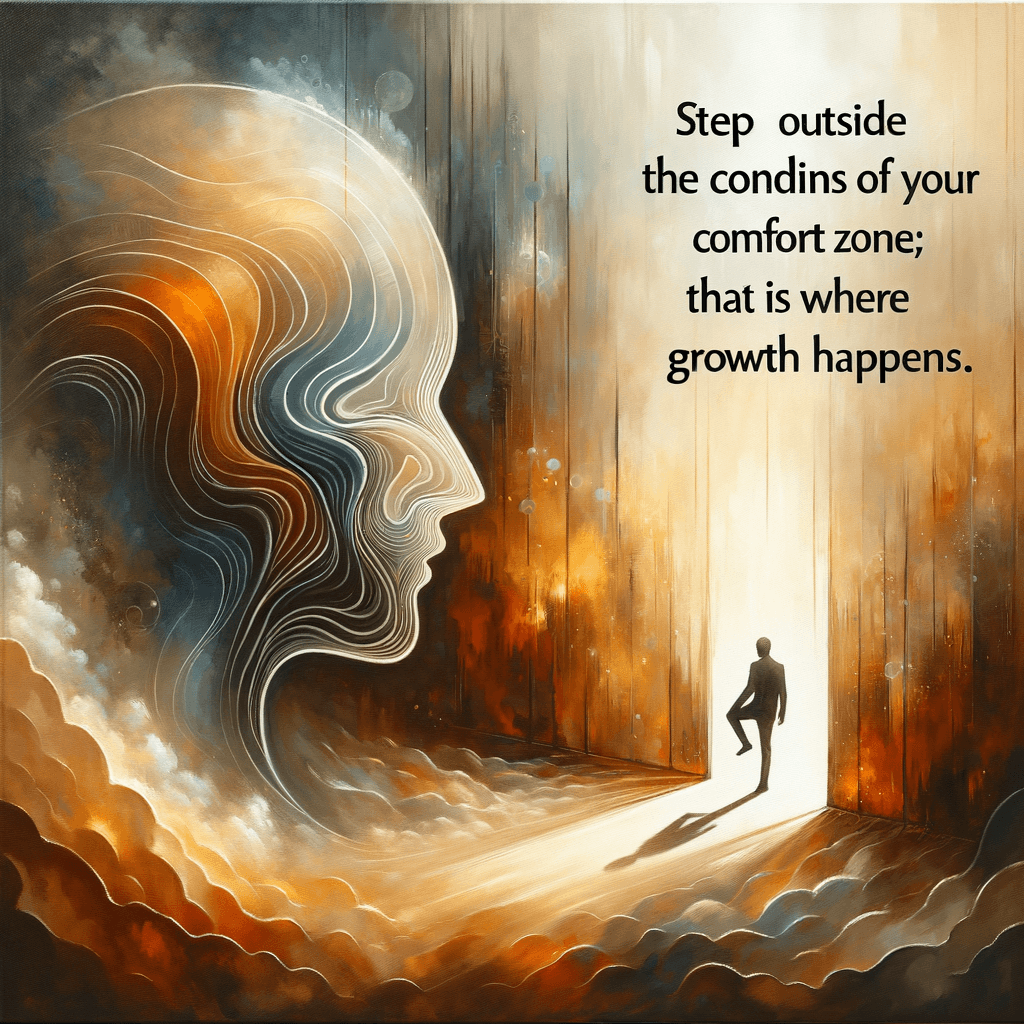
Step outside the confines of your comfort zone; that is where growth happens. — J. J. Abrams
—What lingers after this line?
Embracing Discomfort for Growth
This quote emphasizes that personal growth occurs when individuals challenge themselves beyond their familiar boundaries, suggesting that comfort can hinder progress.
The Necessity of Taking Risks
It highlights the importance of taking risks. Growth often requires stepping into the unknown, which can lead to new opportunities and experiences.
Resilience and Adaptability
By stepping outside one's comfort zone, individuals develop resilience and adaptability. This process enhances one’s ability to cope with change and navigate challenges.
Breaking Barriers
This notion encourages breaking psychological and emotional barriers that hold people back, indicating that overcoming these limits is essential for self-improvement.
J. J. Abrams' Background
J. J. Abrams is a renowned writer and director known for his work in film and television, including 'Lost' and 'Star Wars.' His creative journey reflects the importance of stepping outside creative comfort zones to achieve innovation and success.
One-minute reflection
What does this quote ask you to notice today?
Related Quotes
6 selectedConsistency is a superpower. — Ryan Holiday
Ryan Holiday
Ryan Holiday’s line begins with a deceptively simple idea: greatness is rarely built through dramatic gestures. More often, it emerges from repeated actions that seem ordinary in isolation but become extraordinary over t...
Read full interpretation →Confidence is silent. Insecurities are loud. — Unknown (Wait—skip/replace with: True nobility is being superior to your former self. — Ernest Hemingway)
Ernest Hemingway
At its core, Hemingway’s line redefines nobility as an inward achievement rather than a social rank. Instead of measuring worth by wealth, pedigree, or dominance over others, it points to a quieter standard: becoming bet...
Read full interpretation →You are under no obligation to be consistent with the person you were yesterday. — James McCrae
James McCrae
At its core, James McCrae’s line challenges the quiet pressure to remain legible to others. Many people feel bound to opinions, habits, or identities simply because they once claimed them, as though consistency were a mo...
Read full interpretation →Growth often looks like slowing down, reassessing, and rebuilding with intention. — Erin Gregory
Erin Gregory
At first glance, growth is often imagined as constant acceleration—more output, faster decisions, visible momentum. Erin Gregory’s quote gently overturns that assumption by suggesting that real development may appear qui...
Read full interpretation →The most important, difficult, and rewarding thing to work on is yourself. — Sven Schnieders
Sven Schnieders
At its heart, Sven Schnieders’ statement argues that self-development is the most valuable project a person can undertake. Unlike external goals—career success, status, or possessions—the work done on one’s character, ha...
Read full interpretation →Consistency is the sum that equals what we become. — Henri Matisse
Henri Matisse
At its core, Matisse’s remark suggests that identity is not formed in a single dramatic moment but accumulated through repeated actions. What we do regularly—how we think, practice, respond, and persist—gradually adds up...
Read full interpretation →More From Author
More from J. J. Abrams →