
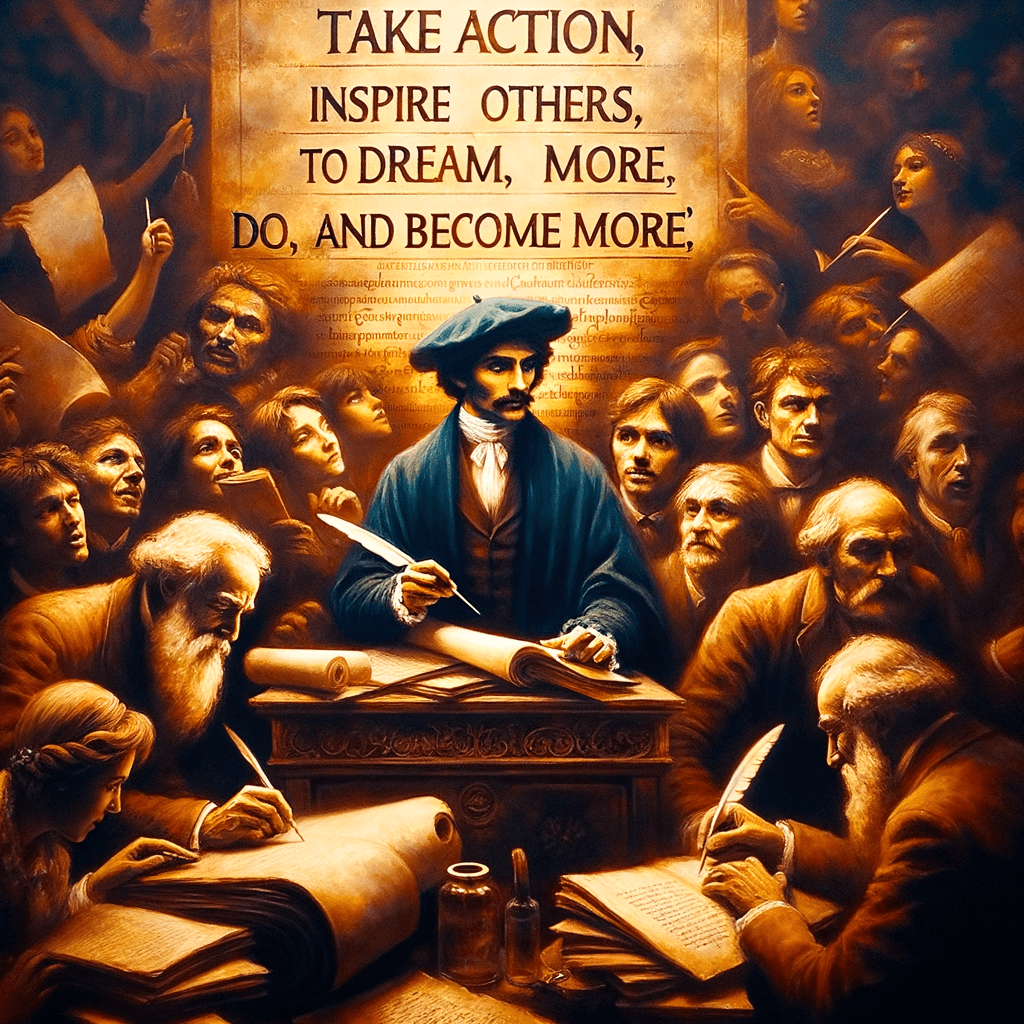
Take action; inspire others to dream more, learn more, do more, and become more. — John Quincy Adams
—What lingers after this line?
The Power of Action
This quote emphasizes the importance of taking initiative. Action is the catalyst for change, and it serves as a model for others to follow.
Inspiration as a Leadership Quality
Adams highlights that true leaders inspire others. By demonstrating passion and commitment to their goals, they encourage those around them to aspire to greater heights.
Dreaming Big
The quote calls for the importance of encouraging others to dream. It suggests that fostering a mindset of dreaming big is essential for personal and communal growth.
Continuous Learning
Learning is a lifelong journey. This quote underscores the idea that by inspiring others to seek knowledge, individuals can foster an environment rich in growth and understanding.
Personal Development
The idea of 'becoming more' speaks to self-improvement and personal growth. Adams advocates for a culture where individuals strive to better themselves and their contributions to society.
Legacy of Leadership
John Quincy Adams, as a former president and statesman, underscores the notion that true leadership transcends position. It involves inspiring and empowering others to reach their full potential.
One-minute reflection
What does this quote ask you to notice today?
Related Quotes
6 selectedThe most gifted members of the human species are at their creative best when they cannot have their way, and must compensate for what they miss by realizing and cultivating their capacities. — Bryant H. McGill
Bryant H. McGill
Bryant H. McGill’s observation begins with a striking reversal: gifted people may not reach their highest potential when everything comes easily, but when something blocks their path.
Read full interpretation →A mind grows by staying with difficulty long enough for the experience to change it. — Mary Catherine Bateson
Mary Catherine Bateson
Mary Catherine Bateson’s observation begins with a quiet but demanding truth: the mind does not grow merely by encountering difficulty, but by remaining with it. Challenge becomes transformative only when we resist the u...
Read full interpretation →Consistency is a superpower. — Ryan Holiday
Ryan Holiday
Ryan Holiday’s line begins with a deceptively simple idea: greatness is rarely built through dramatic gestures. More often, it emerges from repeated actions that seem ordinary in isolation but become extraordinary over t...
Read full interpretation →Confidence is silent. Insecurities are loud. — Unknown (Wait—skip/replace with: True nobility is being superior to your former self. — Ernest Hemingway)
Ernest Hemingway
At its core, Hemingway’s line redefines nobility as an inward achievement rather than a social rank. Instead of measuring worth by wealth, pedigree, or dominance over others, it points to a quieter standard: becoming bet...
Read full interpretation →You are under no obligation to be consistent with the person you were yesterday. — James McCrae
James McCrae
At its core, James McCrae’s line challenges the quiet pressure to remain legible to others. Many people feel bound to opinions, habits, or identities simply because they once claimed them, as though consistency were a mo...
Read full interpretation →Growth often looks like slowing down, reassessing, and rebuilding with intention. — Erin Gregory
Erin Gregory
At first glance, growth is often imagined as constant acceleration—more output, faster decisions, visible momentum. Erin Gregory’s quote gently overturns that assumption by suggesting that real development may appear qui...
Read full interpretation →More From Author
More from John Quincy Adams →Patience and perseverance have a magical effect before which difficulties disappear and obstacles vanish. — John Quincy Adams
This quote underscores the importance of staying calm and patient in the face of challenges. By letting time play its role, seemingly insurmountable problems gradually become more manageable.
Read full interpretation →We must not allow the opinion of man to prevent us from doing what is right. — John Quincy Adams
This quote emphasizes the importance of maintaining moral integrity, even when faced with opposition or criticism from others. It encourages standing firm in one's ethical beliefs, regardless of external pressures.
Read full interpretation →Persist and preserve, and you will find success. — John Quincy Adams
The quote emphasizes that perseverance is key to achieving success. Consistently working towards a goal, despite challenges, leads to eventual accomplishments.
Read full interpretation →The seeds of greatness are planted in the soil of adversity. — John Quincy Adams
This quote suggests that challenges and difficult times are necessary for personal development. Just like seeds need soil to grow, greatness often emerges from enduring and overcoming adversity.
Read full interpretation →