
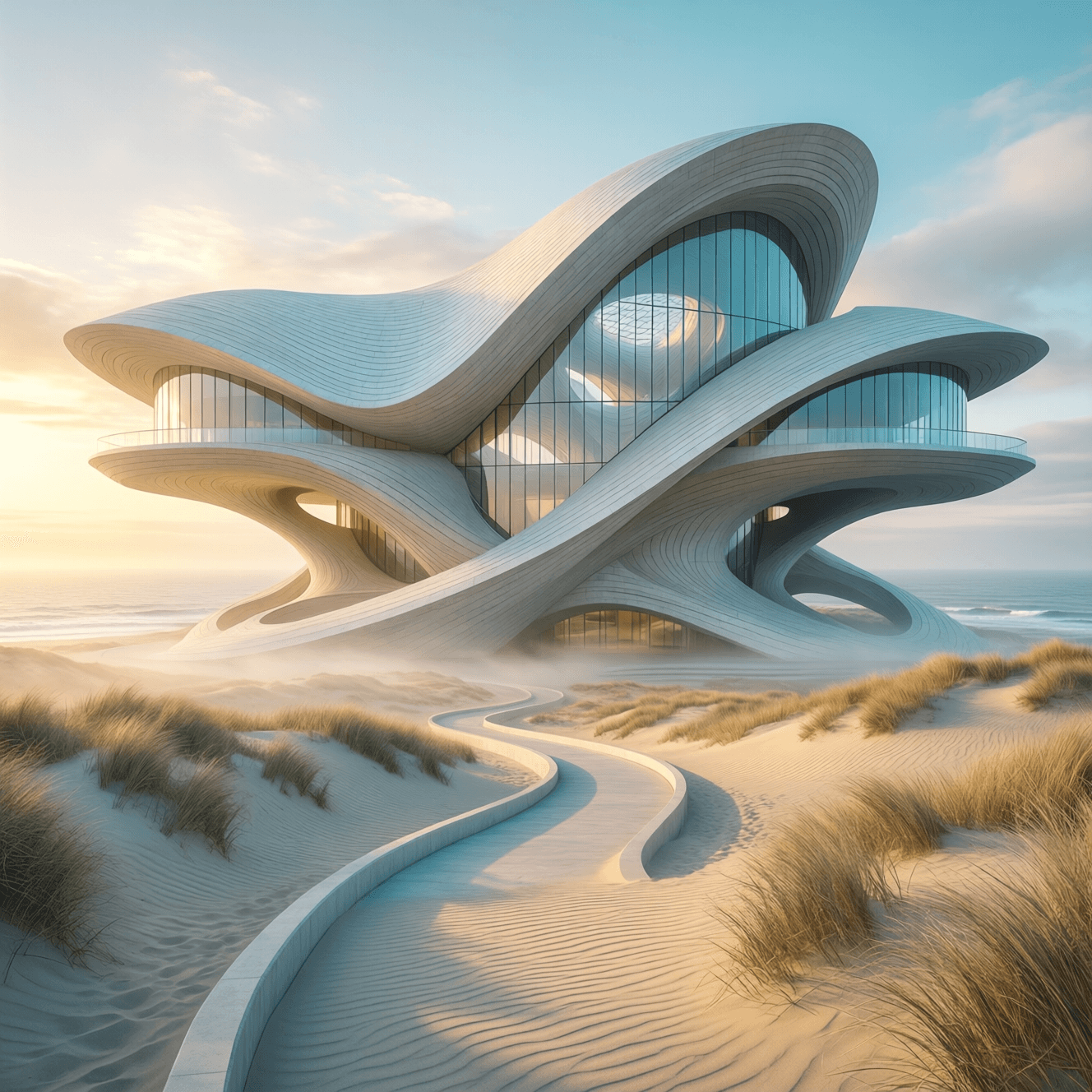
The world is not a rectangle. — Zaha Hadid
—What lingers after this line?
A Simple Sentence, A Spatial Revolt
Zaha Hadid’s line sounds almost childlike at first—of course the world isn’t a rectangle—but its force comes from what it rejects: the quiet assumption that life should be organized into right angles and tidy grids. In one stroke, she reframes “normal” geometry as a limitation rather than a neutral default. That shift matters because buildings don’t merely occupy space; they teach us how to imagine space. From that starting point, the quote becomes less a factual claim and more a call to see differently. If the world is irregular, fluid, and continuously changing, then design that insists on rigid rectangular order may be less truthful to experience—and less responsive to the ways people actually move, gather, and live.
Modernism’s Grid and Its Hidden Costs
To understand why Hadid pushes back, it helps to recall how strongly the twentieth century embraced the rectangle. Modernist architecture often favored orthogonal plans, standardized modules, and repeatable forms, ideas associated with efficiency and clarity; Le Corbusier’s *Toward an Architecture* (1923) argues for rational order and the “machine” logic of building. The grid became a visual promise that society itself could be made coherent. Yet as the grid spread, so did its compromises. Rectangular planning can simplify construction and navigation, but it can also flatten local identity, ignore topography, and privilege what’s easy to measure over what’s meaningful to inhabit. Hadid’s sentence arrives as a corrective: what looks orderly on paper may feel blunt against the complexity of real places.
Nature’s Lesson: Flow, Not Corners
Moving from architectural history to the world outside buildings, Hadid’s claim aligns with a basic observation: nature rarely produces perfect right angles. Coastlines, river deltas, dunes, bones, and clouds are shaped by forces—erosion, growth, gravity, pressure—that generate curvature and gradients. Even when crystals form angular structures, they do so through processes that still reflect dynamic, conditional environments rather than human drafting conventions. Because cities sit inside these natural systems, designing as if the landscape were a neutral rectangular platform can be an act of denial. Hadid’s provocation suggests that architecture should negotiate with flows—wind, water, circulation, views—rather than impose corners by default. In that sense, “not a rectangle” becomes an ecological and experiential reminder as much as a geometric one.
Geometry as a Language of Movement
Hadid’s architecture is often described as dynamic, and her quote hints at why: curves, diagonals, and continuous surfaces can imply motion even when a building stands still. Where rectangles tend to separate—room from corridor, inside from outside—more fluid geometries can connect, guiding the body through spaces that unfold rather than merely repeat. The result is not chaos, but a different kind of legibility: one based on trajectories and transitions. This is also a cultural statement. If daily life is full of detours, overlaps, and accelerating change, then a geometry that acknowledges movement may feel more honest. Hadid’s projects frequently stage this idea by making circulation prominent, turning pathways into spatial events instead of hidden necessities.
Technology and the Return of the Curve
Historically, the rectangle dominated partly because it was easier to build: straight lines, flat slabs, and standardized components reduce cost and risk. But as design and fabrication tools evolved—CAD, parametric modeling, CNC cutting—complex forms became less exotic and more producible. In that context, Hadid’s statement reads not only as philosophy but as confidence that the means now exist to match built form to more intricate ideas. Importantly, this doesn’t mean complexity for its own sake. It means the designer can choose geometry that serves structure, acoustics, airflow, or circulation rather than geometry that merely conforms to construction convenience. The quote, then, sits at the intersection of imagination and capability: once the rectangle is no longer mandatory, the question becomes what form best fits the world’s particularities.
A Broader Ethics: Designing for Real Life
Finally, “The world is not a rectangle” can be read as an ethical stance about inclusivity and lived experience. Real communities are diverse; real bodies vary; real routines are messy. When environments are planned as rigid grids, they can favor a narrow range of behaviors—move here, wait there, live in this box, work in that one. Hadid’s phrase pushes toward spaces that accommodate ambiguity: gathering that isn’t scripted, movement that isn’t linear, identities that don’t fit a single template. Seen this way, the quote is less about hating rectangles than about refusing to let one geometry dictate how everyone should live. By acknowledging that the world resists simplification, design becomes an ongoing negotiation with complexity—an attempt to build forms that meet reality where it actually is.
One-minute reflection
Why might this line matter today, not tomorrow?
Related Quotes
6 selectedOriginality is the best form of rebellion. — Mike Sasso
Mike Sasso
Mike Sasso’s line reframes rebellion in a striking way: instead of imagining protest only as noise, confrontation, or spectacle, it presents originality as a subtler but often more enduring act of defiance. To create som...
Read full interpretation →If you have not been called a defiant, incorrigible, unmannerly woman, there is still time. — Clarissa Pinkola Estés
Clarissa Pinkola Estés
Clarissa Pinkola Estés turns a familiar set of accusations—“defiant,” “incorrigible,” “unmannerly”—into a kind of initiation rather than a shame sentence. The line suggests that these labels often appear not when someone...
Read full interpretation →I have no desire to fit in. I've always been a bit of a weirdo. — Erykah Badu
Erykah Badu
Erykah Badu’s line begins with a clean refusal: she doesn’t merely fail to fit in—she has no desire to. That distinction matters because it frames difference as a choice, not a shortcoming.
Read full interpretation →When you don't dress like everyone else, you don't have to think like everyone else. — Iris Apfel
Iris Apfel
Iris Apfel’s line treats clothing as more than decoration; it becomes a public claim to personal agency. When you choose what genuinely delights you rather than what blends in, you rehearse the act of deciding for yourse...
Read full interpretation →If you obey all the rules, you miss all the fun. — Katharine Hepburn
Katharine Hepburn
Katharine Hepburn’s line is intentionally mischievous: it pokes at the suspicion that strict rule-following can drain life of spontaneity. Her phrasing doesn’t merely celebrate disobedience; it frames “fun” as something...
Read full interpretation →Normal is not something to aspire to, it's something to get away from. — Jodie Foster
Jodie Foster
Jodie Foster’s line flips a familiar goal on its head: instead of treating “normal” as a destination, she treats it as a boundary. The word often functions less as a neutral description and more as a quiet set of rules—h...
Read full interpretation →More From Author
More from Zaha Hadid →